Question
  1. State the condition under which a large magnification can be achieved in an astronomical telescope.
  2. Give two reasons to explain why a reflecting telescope is preferred over a refracting telescope.

Answer

  1. $m=-\frac{f_0}{f_e}$
By increasing $?_0$ / decreasing $?_?$
  1.  
  1. No chromatic aberration.
  2. No spherical aberration.
  3. Mechanical advantage – low weight, easier to support.
  4. Mirrors are easy to prepare.
  5. More economical.

Need a full question paper?

Generate a complete, print-ready paper with questions like this in minutes — across 16+ boards, with answer keys.
Start Generating Free

Similar questions

An electron beam projected along the positive X-axis deflects along the positive Y-axis. If this deflection is caused by a magnetic field, what is the direction of the field? Can we conclude that the field is parallel to the Z-axis?
Find the amount of silver liberated at cathode if 0.500A of current is passed through $AgNO_3$ electrolyte for 1 hour. Atomic weight of silver a 107.9 g/mole.
A spherical surface of radius 30cm separates two transparent media A and B with refractive indices 1.33 and 1.48 respectively. The medium A is on the convex side of the surface. Where should a point object be placed in medium A so that the paraxial rays become parallel after refraction at the surface?
Find the maximum angle of refraction when a light ray is refracted from glass $(\mu=1.50)$ to air.
Write down the difference between vacuum tube (valve) and semiconductors.
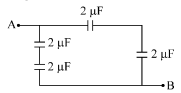
Find the equivalence between A and B in the given circuit diagram.
Image
Draw the series L-C-R AC circuit and obtain the relationship between voltage and current for this circuit. (Derive the necessary equations.)
An electron beam projected along the positive X-axis deflects along the positive Y-axis. If this deflection is caused by a magnetic field, what is the direction of the field? Can we conclude that the field is parallel to the Z-axis?
The mass of a H-atom is less than the sum of the masses of a proton and electron. Why is this?
Explain how the width of depletion layer in a p-n junction diode changes when the junction is (i) forward biased (ii) reverse biased.