Question
State the conservation of linear momentum. Explain linear momentum conservation in a two particle system with an example. Or Under what circumstances does linear momentum conservation occur? For two interacting particles prove that linear momentum will be conserved in the absence of external forces.
Answer

self

Need a full question paper?

Generate a complete, print-ready paper with questions like this in minutes — across 16+ boards, with answer keys.

Start Generating Free

Similar questions

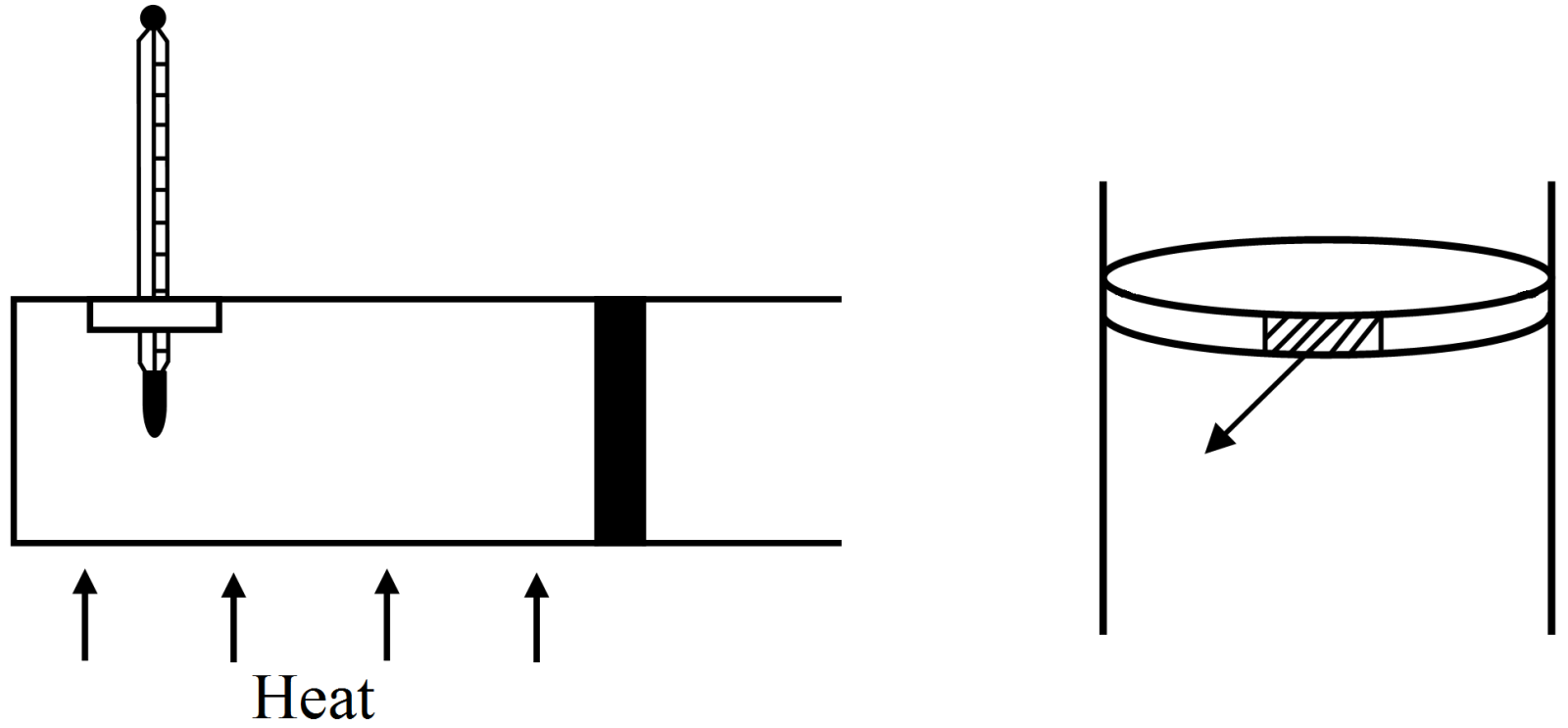
Figure. shows a cylindrical tube of radius 5cm and length 20cm. It is closed by a tight-fitting cork. The friction coefficient between the cork and the tube is 0.20. The tube contains an ideal gas at a pressure of 1 atm and a temperature of 300K. The tube is slowly heated and it is found that the cork pops out when the temperature reaches 600K Let dN denote the magnitude of the normal contact force exerted by a small length dl of the cork along the periphery (see the figure). Assuming that the temperature of the gas is uniform at any instant, calculate $\frac{\text{dN}}{\text{dl}}.$
Six point masses of mass m each are at the vertices of a regular hexagon of side l. Calculate the force on any of the masses.
From a uniform disk of radius R, a circular hole of radius $\frac{\text{R}}{2}$ is cut out. The centre of the hole is at $\frac{\text{R}}{2}$ from the centre of the original disc. Locate the centre of gravity of the resulting flat body.
A stone of mass m tied to the end of a string revolves in a vertical circle of radius R. The net forces at the lowest and highest points of the circle directed vertically downwards are: [Choose the correct alternative]
 
Lowest Point
Highest Point
(a)
$mg - T_1$
$mg + T_2$
(b)
$mg + T_1$
$mg - T_2$
(c)
$mg + T_1 - (mv_1^2)/R$
$mg - T_2 + (mv_1^2)/R$
(d)
$mg - T_1 - (mv_1^2)/R$
$mg + T_2 + (mv_1^2)/R$
$T_1$ and $v_1$ denote the tension and speed at the lowest point. $T_2$ and $v_2$​​​​​​​ denote corresponding values at the highest point.
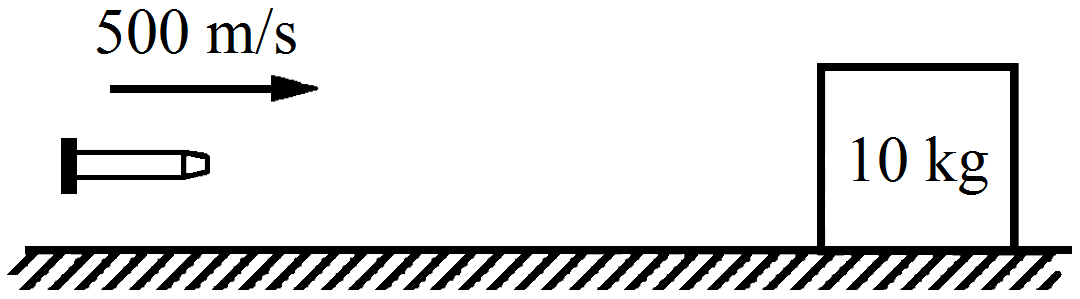
A bullet of mass $20g$ travelling horizontally with a speed of $500m/s$ passes through a wooden block of mass $10.0kg$ initially at rest on a level surface. The bullet emerges with a speed of $100m/s$ and the block slides $20cm$ on the surface before coming to rest. Find the friction coefficient between the block and the surface.
Write the dimensions and derived units in M.K.S. unit system of the following quantities :
(i) Force, (ii) Power, (iii) Pressure, (iv) Stress, (v) Strain, (vi) Coefficient of elasticity, (vii) Relative density (viii) Gravitational constant.
  1. It is known that density r of air decreases with height y as $\rho_0\text{e}^{-\frac{\text{y}}{\text{y}_0}}$ where $\rho=1.25\text{kg m}^{-3}$ is the density at sea level, and $y_0$ is a constant. This density variation is called the law of atmospheres. Obtain this law assuming that the temperature of atmosphere remains a constant (isothermal conditions). Also assume that the value of g remains constant.
  2. A large He balloon of volume $1425m^3$ is used to lift a payload of $400kg$. Assume that the balloon maintains constant radius as it rises. How high does it rise? [Take $y^0 = 8000m$ and $rHe = 0.18 kgm^{–3}$​​​​​​​​​​​​​​].
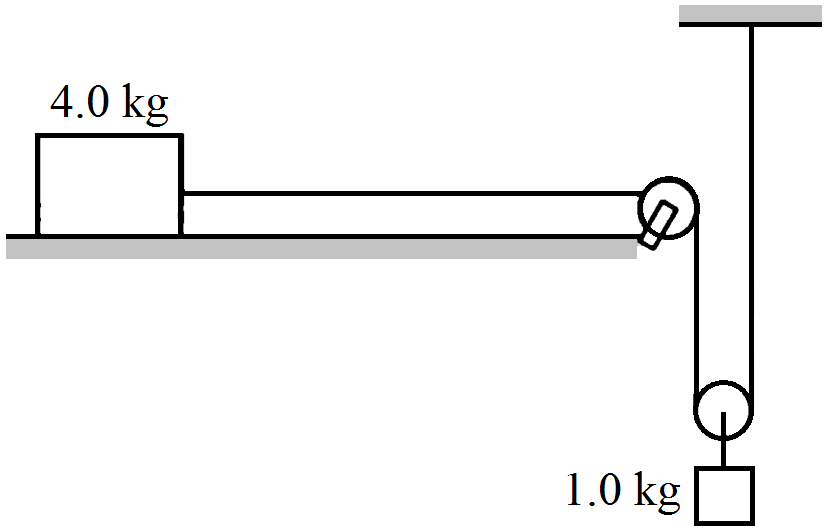
Consider the situation shown in figure. The system is released from rest and the block of mass $1.0kg$ is found to have a speed $0.3m/s$ after it has descended through a distance of $1m$. Find the coefficient of kinetic friction between the block and the table.
Define linear momentum. Prove that for fixed mass, $P \propto v$ and for constant momentum $v \propto \frac{1}{m}$.
A heavy particle is suspended by a $1.5m$ long string. It is given a horizontal velocity of $\sqrt{57}\text{m/s}.$
  1. Find the angle made by the string with the upward vertical, when it becomes slack.
  2. Find the speed of the particle at this instant.
  3. Find the maximum height reached by the particle over the point of suspension. Take $g = 10m/s^2$.