From a uniform disk of radius R, a circular hole of radius $\frac{\text{R}}{2}$ is cut out. The centre of the hole is at $\frac{\text{R}}{2}$ from the centre of the original disc. Locate the centre of gravity of the resulting flat body.
Download our app for free and get started
$\frac{\text{R}}{6},$ from the original centre of the body and opposite to the centre of the cut portion. Mass per unit area of the original disc $=\sigma$ Radius of the original disc = R Mass of the original disc, $\text{M}=\pi\text{R}^2\sigma$ The disc with the cut portion is shown in the following figure: 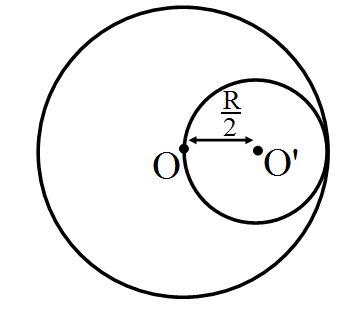 Radius of the smaller disc $=\frac{\text{R}}{2}$ Mass of the smaller disc, $\text{M}'=\pi\Big(\frac{\text{R}}{2}\Big)^2\sigma=\frac{\pi\text{R}^2\sigma}{4}=\frac{\text{M}}{4}$ Let O and O′ be the respective centres of the original disc and the disc cut off from the original. As per the definition of the centre of mass, the centre of mass of the original disc is supposed to be concentrated at O, while that of the smaller disc is supposed to be concentrated at O′. It is given that, $\text{OO}'=\frac{\text{R}}{2}$ After the smaller disc has been cut from the original, the remaining portion is considered to be a system of two masses. The two masses are, M (concentrated at O), and $-\text{M}'=\Big(\frac{\text{M}}{4}\Big)$ concentrated at O′ (The negative sign indicates that this portion has been removed from the original disc). Let x be the distance through which the centre of mass of the remaining portion shifts from point O. The relation between the centres of masses of two masses is given as, $\text{x}=\frac{(\text{m}_1\text{r}_1+\text{m}_2\text{r}_2)}{(\text{m}_1+\text{m}_2)}$ For the given system, we can write, $\text{x}=\frac{\big[\text{M}\times0-\text{M}'\times\big(\frac{\text{R}}{2}\big)\big]}{(\text{M}+\text{M}'))}=\frac{-\text{R}}{6}$ (The negative sign indicates that the centre of mass gets shifted toward the left of point O).
Radius of the smaller disc $=\frac{\text{R}}{2}$ Mass of the smaller disc, $\text{M}'=\pi\Big(\frac{\text{R}}{2}\Big)^2\sigma=\frac{\pi\text{R}^2\sigma}{4}=\frac{\text{M}}{4}$ Let O and O′ be the respective centres of the original disc and the disc cut off from the original. As per the definition of the centre of mass, the centre of mass of the original disc is supposed to be concentrated at O, while that of the smaller disc is supposed to be concentrated at O′. It is given that, $\text{OO}'=\frac{\text{R}}{2}$ After the smaller disc has been cut from the original, the remaining portion is considered to be a system of two masses. The two masses are, M (concentrated at O), and $-\text{M}'=\Big(\frac{\text{M}}{4}\Big)$ concentrated at O′ (The negative sign indicates that this portion has been removed from the original disc). Let x be the distance through which the centre of mass of the remaining portion shifts from point O. The relation between the centres of masses of two masses is given as, $\text{x}=\frac{(\text{m}_1\text{r}_1+\text{m}_2\text{r}_2)}{(\text{m}_1+\text{m}_2)}$ For the given system, we can write, $\text{x}=\frac{\big[\text{M}\times0-\text{M}'\times\big(\frac{\text{R}}{2}\big)\big]}{(\text{M}+\text{M}'))}=\frac{-\text{R}}{6}$ (The negative sign indicates that the centre of mass gets shifted toward the left of point O).
Download our appand get started for free
Experience the future of education. Simply download our apps or reach out to us for more information. Let's shape the future of learning together!No signup needed.*
Similar Questions
- 1View SolutionExplain why friction is necessary to make the disc in roll in the direction indicated.
- Give the direction of frictional force at B, and the sense of frictional torque, before perfect rolling begins.
- What is the force of friction after perfect rolling begins?
- 2View SolutionDefine radius of gyration and give the physical significance of moment of inertia.
- 3View SolutionFind the components along the x, y, z axes of the angular momentum l of a particle, whose position vector is r with components x, y, z and momentum is p with components px, py and pz. Show that if the particle moves only in the x-y plane the angular momentum has only a z-component.
- 4View SolutionFig. shows two blocks of masses 5kg and 2kg placed on a frictionless surface and connected by a spring. An external kick gives a velocity 14 m/ s to the heavier block in the direction of lighter one. Deduce (i) the velocity gained by the centre of mass and (ii) the separate velocities of the two blocks in the centre of mass coordinates just after the kick.
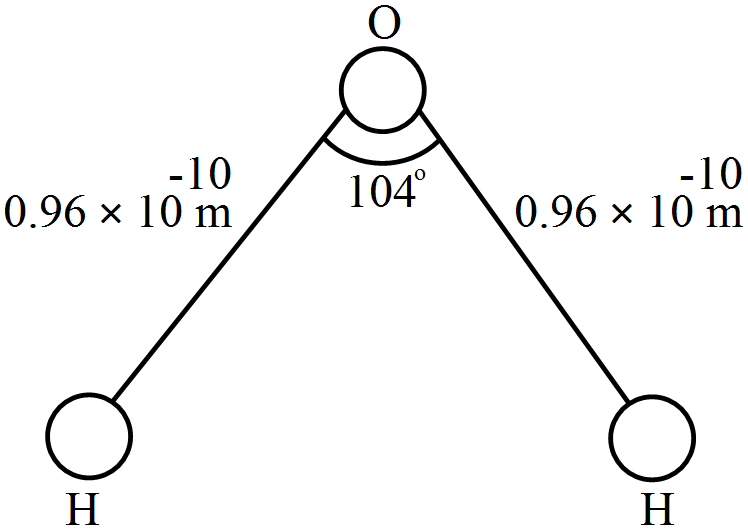
- 5View SolutionThe structure of a water molecule is shown in figure. Find the distance of the centre of mass of the molecule from the centre of the oxygen atom.
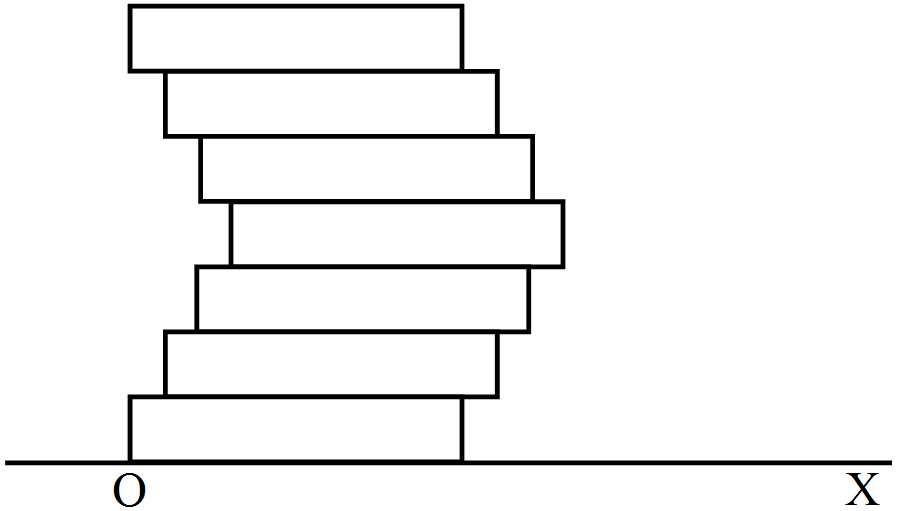
- 6Seven homogeneous bricks, each of length L, are arranged as shown in figure. Each brick is displaced with respect to the one in contact by $\frac{\text{L}}{10}.$ Find the x-coordinate of the centre of mass relative to the origin shown.View Solution
- 7What is Mechanical Advantage (M.A.) in the principle of moments for a lever? Find the reactions forces at knife edge as shown in the figure:View Solution
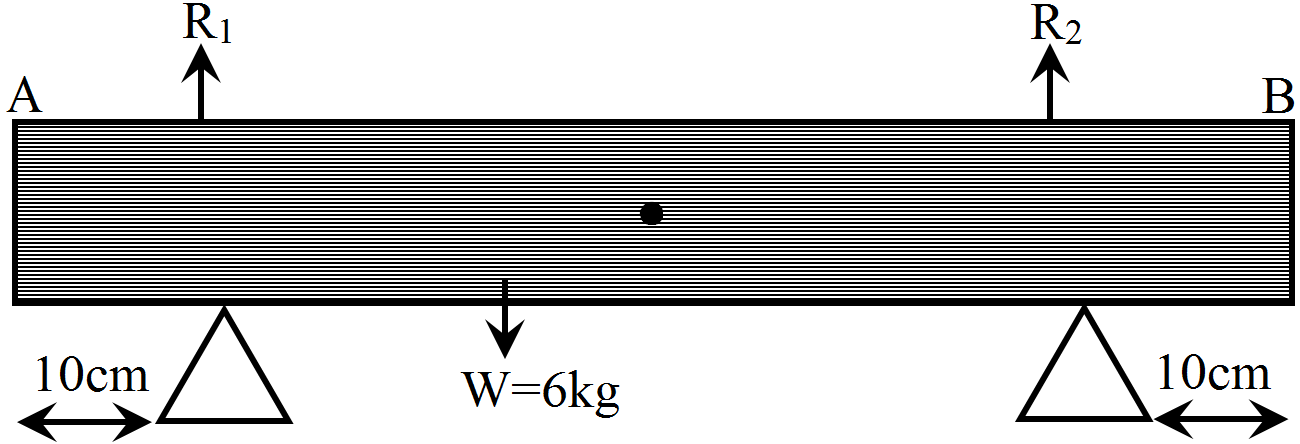
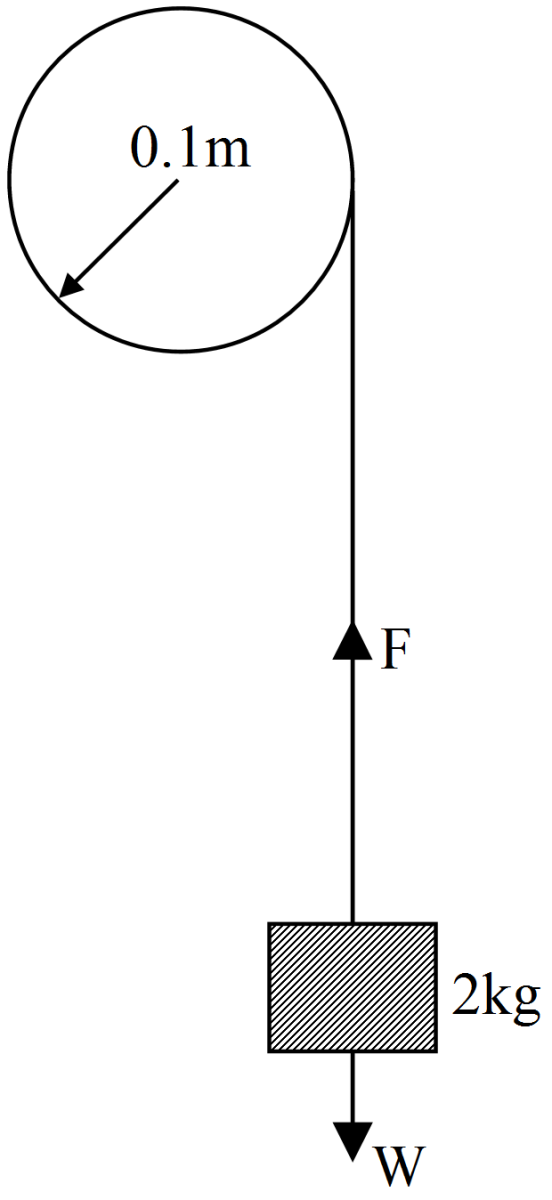
Where AB is a metal bar of $70cm$ length having mass $4kg$ and a $6kg$ load is suspended from $30cm$ from the end A. - 8The moment of inertia of a solid flywheel about its axis is $0.1kg-m^2$. A tangential force of $2kg/ wt$ is applied round the circumference of the flywheel with the help of a string and mass arrangement as shown in Fig. If the radius of the wheel is $0.1m$, find the acceleration of the mass.View Solution
- 9View SolutionA hoop of radius 2m weighs 100kg. It rolls along a horizontal floor so that its centre of mass has a speed of 20cm/s. How much work has to be done to stop it?
- 10View SolutionA solid cylinder of mass M and radius R has a light flexible rope wound around it. The rope carries a mass m at its free end. The mass is rest at a height h above the floor. Find the angular velocity of the cylinder at the instant the mass m, after release, strikes the floor. Assume friction to be absent and the cylinder to rotate about its own axis.