Question
State the general properties of ionic compounds.

Answer

  1. Ionic compounds are solids and hard due to strong electrostatic force of attraction between oppositely charged ions.
  2. They are generally brittle. When pressure is applied they break into pieces.
  3. They have high melting and boiling points, due to intermolecular force of attraction is high in ionic compounds.
  4. They are soluble in water and insoluble in solvents such as kerosene and petrol.
  5. Ionic compounds cannot conduct electricity when in solid state, they are electrically neutral. They conduct electricity in the molten state and also in an aqueous solution.

Need a full question paper?

Generate a complete, print-ready paper with questions like this in minutes — across 16+ boards, with answer keys.
Start Generating Free

Similar questions


Image
A resistor of 8 ohms is connected in parallel with another resistor X. The resultant resistance of the combination is 4.8 ohms. What is the value of the resistor X?
With the help of an example, explain how variation leads to evolution.
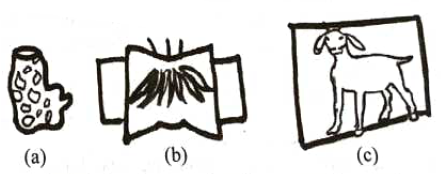
Observe the given figures and answer the following:
Image
Identify the types of body symmetry and give one example of each apart from the given figure.
Complete the given chart:
Sr. No.Body ConstituentsProteins/Amino Acids
1.Blood__________________
2.__________________Ossein
3.Skin__________________
4.__________________Insulin
5.Muscle__________________
6.__________________Various proteins of cell membrane
Two coils A and B of insulated wire are kept close to each other. Coil A is connected to a galvanometer while coil B is connected to a battery through a key. What would happen if:
  1. A current is passed through coil B by plugging the key?
  2. He current is stopped by removing the plug from the key?
Explain your answer mentioning the name of the phenomenon involved.
What is meant by a primary consumer, secondary consumer and a tertiary consumer? Give one example of each.
Calculate the power used in the $2Ω$ resistor in each of the following circuits:
  1. A $6V$ battery in series with $1Ω$ and $2Ω$ resistors.
  2. A $4V$ battery in parallel with $12Ω$ and $2Ω$ resistors.
Name two metals which react violently with cold water. Write any three observations you would make when such a metal is dropped into water. How would you identify the gas evolved, if any, during the reaction?
How is copper extracted from its sulphide ore?