Question
State the laws of reflection and describe an experiment to verify them .
Answer

Laws of reflection :
  1. The angle of incidence is equal to the angle of reflection.
  2. The incident ray, the reflected ray and the normal at the point of incidence, lie in the same plane.
Experiment to verify the laws of reflection:

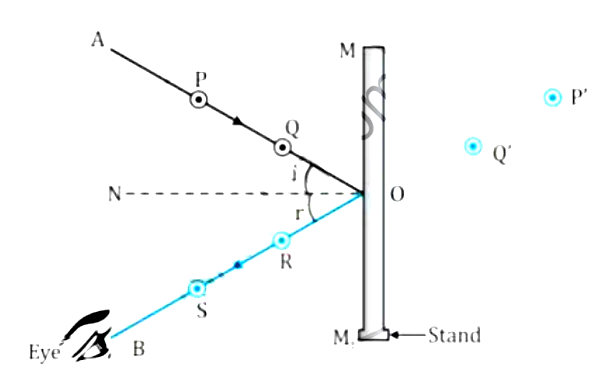
Fix a white sheet of paper on a drawing board and draw a line $MM _1$ as shown in figure. On this line, take a point O nearly at the middle of it and draw a line OA such that $\angle MOA$ is less than $90^{\circ}$. Then draw a normal ON on line $MM _1$ at the point O , and place a small plane mirror vertical by means of a stand with its silvered surface along $MM _1$.

Next fix two pins $P$ and $Q$ at some distance $(\approx 5 cm)$ apart vertically on line $O A$, on the board. Keeping eye on the other side of normal (but on the same side of mirror), see clearly images $P ^{\prime}$ and $Q ^{\prime}$ of the pins P and Q . Next fix a pin $R$ such that it is in line with the images of pins $P$ and $Q$ as observed in the mirror. Next, fix one more pin $S$ such that the pin $S$ is in line with the pin $R$ as well as images $P^{\prime}$ and $Q^{\prime}$ of pins $P$ and $Q$.

Draw small circles on paper around the positions of pins as shown in figure. Remove the pins and draw a line $O B$ joining the pin points $S$ and $R$, which meets the surface of mirror at $O$. The angles $A O N$ and BON are measured and recorded.

The experiment is then repeated for the angle of incidence $\angle A O N$ equal to $40^{\circ}, 50^{\circ}, 60^{\circ}$.
From results, it is observed that angle of incidence is equal to the angle of reflection. This verifies the first law of reflection.

The experiment has been performed on a flat drawing board, with mirror normal to the plane of board on which white sheet of paper is being fixed. Since the lower tips of all the pins also lie on the same plane (i.e., the plane of paper), it proves the second law of reflection.

Need a full question paper?

Generate a complete, print-ready paper with questions like this in minutes — across 16+ boards, with answer keys.

Start Generating Free

Similar questions

What fraction of an iceberg of density 910 $kgm^{-3}$ will be above the surface of sea water of density $1170 kgm ^{-3}$ ?
Explain the meaning of the terms focus and focal length in case of a convex mirror, with the help of suitable ray diagram.
Describe in brief, with the aid of a sketch diagram, an experiment to demonstrate that a material medium is necessary to transmit sound.
What is biogas? Which component of biogas is used as fuel? Describe a fixed dome type biogas plant with the help of a labelled diagram.
A boy covers half of his journey with a uniform speed of u and the other half with a uniform speed of v. What is the average speed for the whole journey?
A body is moving in a straight line and its displacement at various instants of time is given in the following table
Time (s) 0 1 2 3 4 5 6 7
Displacement (m) 2 6 12 12 12 18 22 24
Plot the displacement-time graph and calculate (i) Total distance travelled in the interval 1 s to 5 s. (ii) Average velocity in time interval 1 s to 5 s.
On a 120 km track, a train travels the first 40 km at a uniform speed of 30 km/h. How fast must the train travel the next 80 km, so as to average 60 km/h for the entire trip.
A body of volume $100 cm^3$ weighs $1$ kgf in air. Find:
(i) Its weight in water and
(ii) Its relative density.
State and explain the law of inertia (or Newton's first law of motion).
Two spheres $A$ and $B$, each of volume $100 cm^3$ is placed on water (density $=1.0 g cm ^{-3}$ ). The sphere A is made of wood of density $0.3 g cm ^{-3}$ and sphere B is made of iron of density $8.9 g cm ^{-3}$.
  1. Find:
    1. The weight of each sphere, and
    2. The upthrust on each sphere.
  2. Which sphere will float? Give reason.