Questions

[5 Mark Question Answer]

🎯

Test yourself on this topic

18 questions · timed · auto-graded

Question 15 Marks
An object of length 4 cm is placed in front of a concave mirror at distance 30 cm. The focal length of mirror is 15 cm.
  1. Where will the image form?
  2. What will be the length of image?
Answer
$ O=4 cm$
$u=-30 cm$
$f=-15 cm $
From mirror formula,
$ \frac{1}{ f }=\frac{1}{ v }+\frac{1}{ u }$
$\therefore \frac{1}{ v }=\frac{1}{ f }-\frac{1}{ u }$
$\therefore \frac{1}{ v }=\frac{1}{-15}-\frac{1}{-30}=\frac{1}{30}-\frac{1}{15}$
$\therefore \frac{1}{ v }=\frac{-1}{30}$
$\therefore v =-30 cm $
Hence, the image is formed at a distance of $30 cm$ in front of the mirror .
$ m =-\frac{ v }{ u }=\frac{ I }{ O }$
$\therefore I =\frac{- OV }{ u }=\frac{-4 \times-30}{-30}=-4 cm $
Negative sign indicates inverted image.
So, $I=4 cm$
Hence, the length of the image is $4 cm$.
View full question & answer
Question 25 Marks
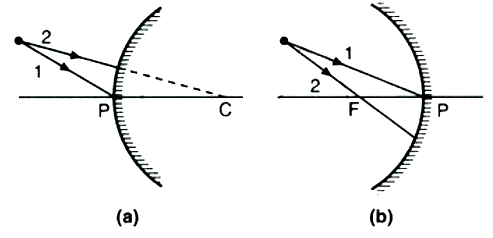
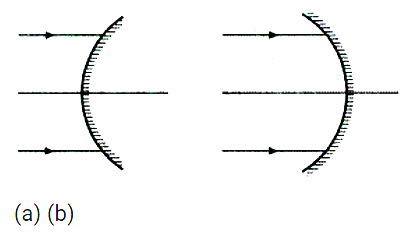
In each case (a) and (b), draw reflected rays for the given incident rays and mark focus by the symbol F.
Answer
(a)

(b)
View full question & answer
Question 35 Marks
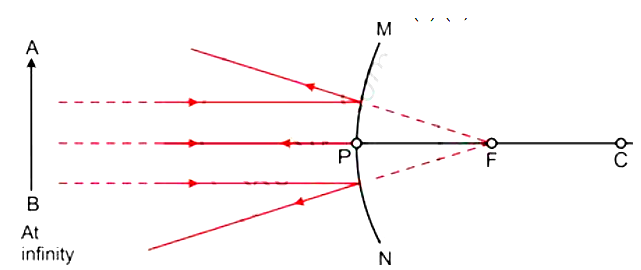
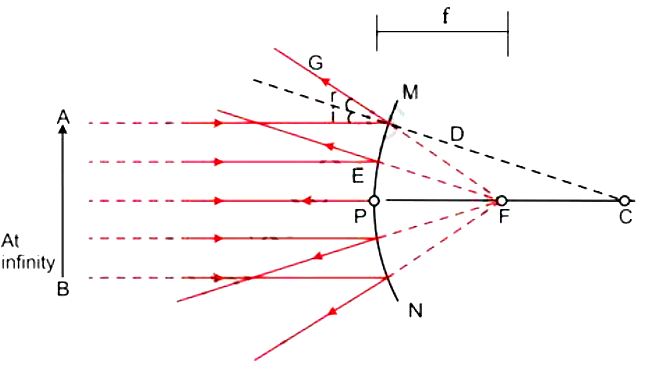
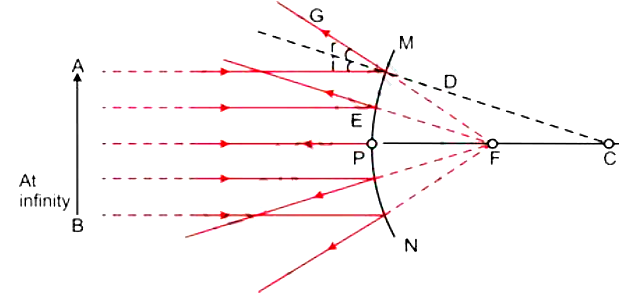
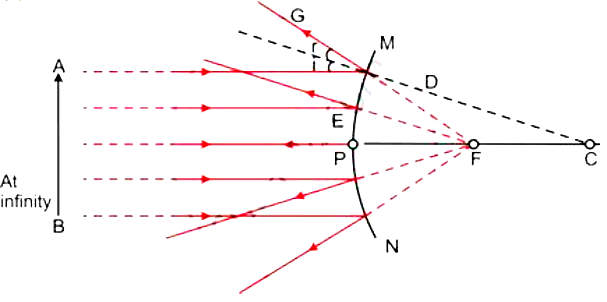
Explain the meaning of the terms focus and focal length in case of a convex mirror, with the help of suitable ray diagram.
Answer
Focus of a convex mirror: The focus of a convex mirror is a point on the principal axis from which, the light rays incident parallel to principal axis, appear to come, after reflection from the mirror. Focal length of a convex mirror: The distance of the focus from the pole of the convex mirror is called its focal length.
View full question & answer
Question 45 Marks
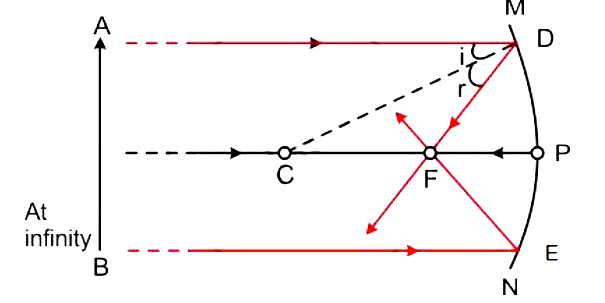
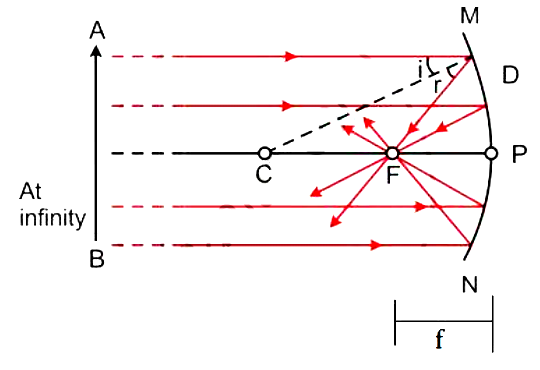
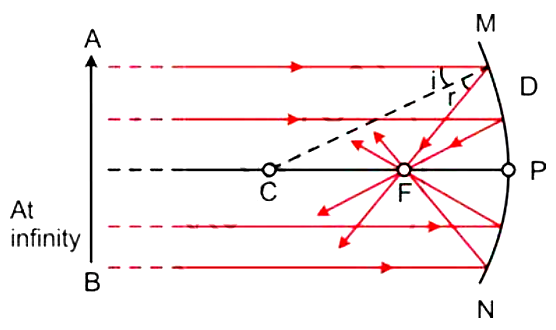
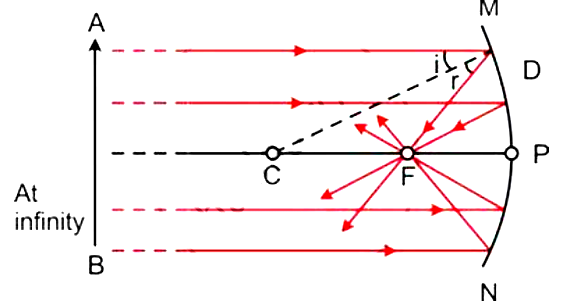
Define the terms focus and focal length of a concave mirror. Draw diagram to illustrate your answer.
Answer
Focus of a concave mirror: The focus of a concave mirror is a point on the principal axis through which the light rays incident parallel to principal axis, pass after reflection from the mirror.
Focal length of a concave mirror: The distance of the focus from the pole of the concave mirror is called its focal length.
View full question & answer
Question 55 Marks
Name the spherical mirror which (i) diverges (ii) converges the beam of light incident on it. Justify your answer by drawing a ray diagram in each case.
Answer
(i) Convex mirror diverges a beam of light falling on it.

(ii) Concave mirror converges a beam of light falling on it.
View full question & answer
Question 65 Marks
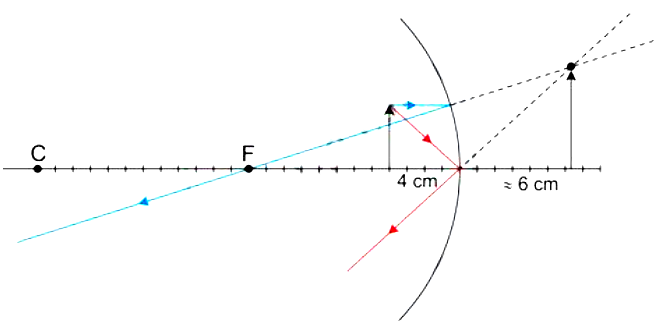
An object is placed at $4\ cm$ distance in front of a concave mirror of radius of curvature $24\ cm.$ Find the position of image. Is the image magnified?
Answer
Given: $u =-4\ cm , R =24\ cm , f =\frac{ R }{2}=\frac{24}{2}=12\ cm (- ve )$
$ \frac{1}{ v }=\frac{1}{ f }-\frac{1}{ u }$
$\Rightarrow \frac{-1}{12}-\left(\frac{-1}{4}\right)$
$\Rightarrow \frac{-1}{12}+\frac{1}{4}$
$\Rightarrow \frac{-1+3}{12}$
$\Rightarrow \frac{2}{12}$
$\therefore \frac{1}{ v }=\frac{1}{6}$
$\therefore v =6 cm $
Yes, the image is magnified.
$m =-\frac{ v }{ u }=\frac{-6}{-4}=1.5$


The image is $6\ cm$ behind the mirror.
View full question & answer
Question 75 Marks
Draw suitable diagrams to illustrate the action of (i) concave mirror and (ii) convex mirror on a beam of light incident parallel to the principal axis.
Answer
(i)

(ii)
View full question & answer
Question 85 Marks
How will you distinguish between a plane mirror, a concave mirror and a convex mirror, without touching them?
Answer
To distinguish between a plane mirror, concave mirror and convex mirror, the given mirror is held near the face and image is seen. There can be following three cases:

Case (i): If the image is upright, of same size and it does not change in size by moving the mirror towards or away from the face, the mirror is plane.

(ii) If the image is upright and magnified, and increases in size on moving the mirror away, the mirror is concave.

(iii) If the image is upright and diminished and decreases in size on moving the mirror away, the mirror is convex.
View full question & answer
Question 95 Marks
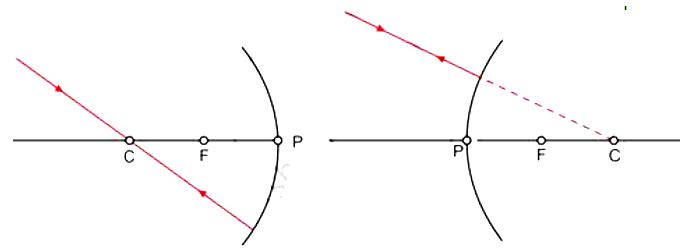
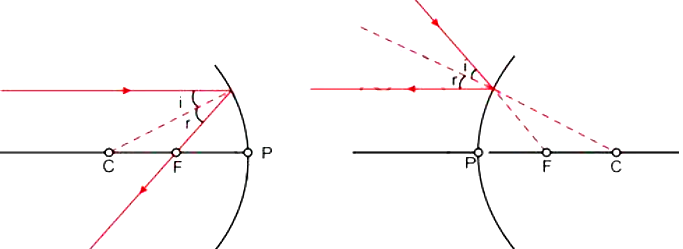
State the two convenient rays that are chosen to construct the image by a spherical mirror for a given object? Explain your answer with the help of suitable ray diagrams.
Answer
Two convenient rays that are chosen to construct the image by a spherical mirror for a given object:
  1. A ray passing through the centre of curvature:A ray of light passing through the centre of curvature of a concave mirror or a ray directed in the direction of centre of curvature of a convex mirror is reflected back along the same path after reflection.

2. A ray parallel to the principal axis: A ray of light parallel to the principal axis, after reflection pass through the principal focus in case of a concave mirror or appears to diverge from it in case of convex mirror.
View full question & answer
Question 105 Marks
A concave mirror forms a virtual image of size twice that of the object placed at a distance 5 cm from it.

Find : (a) the focal length of the mirror (b) position of image
Answer
$ m =\frac{ I }{ O }=\frac{20}{ O }=2$
$\because m =-\frac{ v }{ u }$
$\therefore-\frac{ v }{ u }=2$
$\therefore- v =2 u$
$\because u =-5 cm$
$\therefore v =10 cm $
Hence, the position of the image is $10 cm$ behind the mirror.
From mirror formula,
$ \frac{1}{ f }=\frac{1}{ v }+\frac{1}{ u }$
$\therefore \frac{1}{ f }=\frac{1}{10}+\frac{1}{-5}=\frac{1}{10}-\frac{1}{5} $
$\therefore f =-10 cm$
View full question & answer
Question 115 Marks
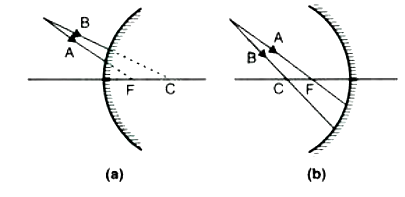
Complete the following diagrams shown in Fig. by drawing the reflected ray for each of the incident ray A and B.
View full question & answer
Question 125 Marks
A concave mirror forms a real image of an object placed in front of it at a distance 30 cm, of size three times the size of object. Find (a) the focal length of mirror (b) position of image.
Answer
$ u =-30 cm$
$m =\frac{ I }{ O }=\frac{30}{ O }=3 $
But, for real object $m$ is negative
$\therefore m =-3$
$\because m=-\frac{v}{u}$
$\therefore-\frac{ v }{ u }=-3$
$\therefore v =3 u$
$\therefore v =3 \times-30=-90 cm$
Hence, the position of the image is $90 cm$ in front of the mirror.
From mirror formula,
$ \frac{1}{ f }=\frac{1}{ v }+\frac{1}{ u }$
$\therefore \frac{1}{ f }=\frac{1}{-90}+\frac{1}{-30}=-\frac{1}{90}-\frac{1}{30}$
$\therefore \frac{1}{ f }=\frac{-1-3}{90}=\frac{-4}{90}$
$\therefore f =-22.5 cm $
View full question & answer
Question 135 Marks
Complete the following diagrams in Figure by drawing the reflected rays for the incident rays 1 and 2.
View full question & answer
Question 145 Marks
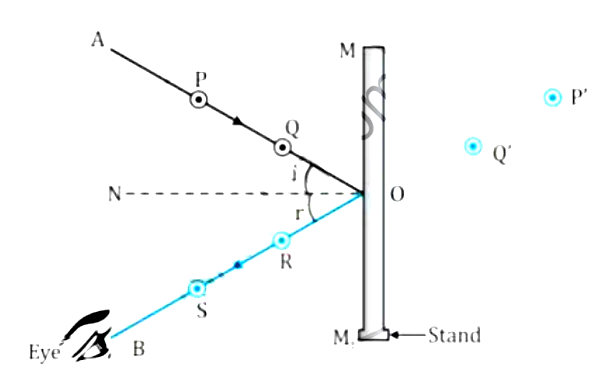
State the laws of reflection and describe an experiment to verify them .
Answer
Laws of reflection :
  1. The angle of incidence is equal to the angle of reflection.
  2. The incident ray, the reflected ray and the normal at the point of incidence, lie in the same plane.
Experiment to verify the laws of reflection:

Fix a white sheet of paper on a drawing board and draw a line $MM _1$ as shown in figure. On this line, take a point O nearly at the middle of it and draw a line OA such that $\angle MOA$ is less than $90^{\circ}$. Then draw a normal ON on line $MM _1$ at the point O , and place a small plane mirror vertical by means of a stand with its silvered surface along $MM _1$.

Next fix two pins $P$ and $Q$ at some distance $(\approx 5 cm)$ apart vertically on line $O A$, on the board. Keeping eye on the other side of normal (but on the same side of mirror), see clearly images $P ^{\prime}$ and $Q ^{\prime}$ of the pins P and Q . Next fix a pin $R$ such that it is in line with the images of pins $P$ and $Q$ as observed in the mirror. Next, fix one more pin $S$ such that the pin $S$ is in line with the pin $R$ as well as images $P^{\prime}$ and $Q^{\prime}$ of pins $P$ and $Q$.

Draw small circles on paper around the positions of pins as shown in figure. Remove the pins and draw a line $O B$ joining the pin points $S$ and $R$, which meets the surface of mirror at $O$. The angles $A O N$ and BON are measured and recorded.

The experiment is then repeated for the angle of incidence $\angle A O N$ equal to $40^{\circ}, 50^{\circ}, 60^{\circ}$.
From results, it is observed that angle of incidence is equal to the angle of reflection. This verifies the first law of reflection.

The experiment has been performed on a flat drawing board, with mirror normal to the plane of board on which white sheet of paper is being fixed. Since the lower tips of all the pins also lie on the same plane (i.e., the plane of paper), it proves the second law of reflection.
View full question & answer
Question 155 Marks
An object is kept at 60 cm in front of a plane mirror. If the mirror is now moved 25 cm away from the object, how does the image shift from its previous position?
Answer
Initially, distance of the object from the mirror = 60 cm.
Therefore, image is formed at a distance 60 cm from the mirror, behind it.
Thus, initial distance between the object and image = 60 + 60 = 120 cm
If the mirror is moved 25 cm away from the object,
The new distance of the object from the mirror = 60 + 25 = 85 cm
The new image is now at a distance 85 cm from the mirror behind it.
Thus, new distance of the image from the object = 85 + 85 = 170 cm
Taking the position of the object as reference point, the distance between the two positions of the image = new distance of image from the object - initial distance of the image from the object
= (170 - 120) cm = 50 cm
Thus, the image shifts 50 cm away.
View full question & answer
Question 165 Marks
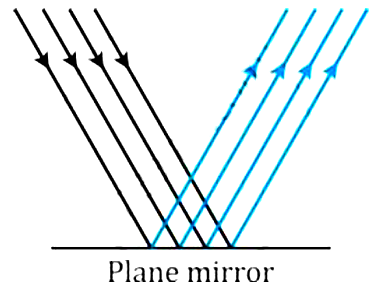
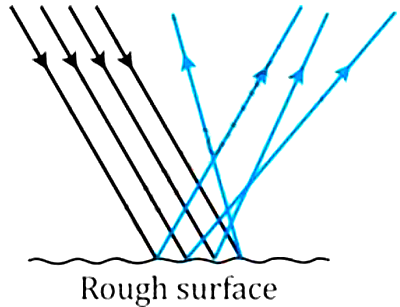
With the help of diagrams, explain the difference between the regular and irregular reflection.
Answer


Regular reflection occurs when a beam of light falls on a smooth and polished surface and irregular reflection occurs when a beam of light falls on a rough surface. Since the surface is uneven, from different points light rays get reflected in different directions and give rise to irregular reflection.
View full question & answer
Question 175 Marks
Explain the following term :
Plane mirror
Draw diagram/diagrams to show them.
Answer
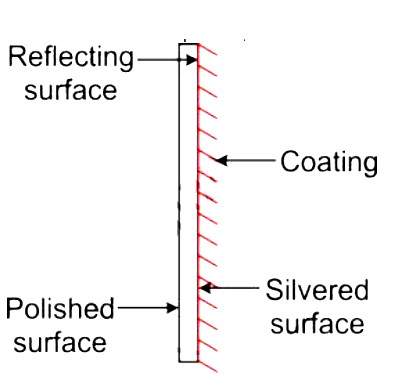
Plane mirror: Plane mirror is a highly polished and smooth reflecting surface made from a clear plane glass sheet, usually thin and silvered with suitable reflecting abrasive (for example, mercury) on one side. Once this pasting is done, then the glass becomes opaque but due to the reflecting property of the abrasive, the plane glass sheet becomes a plane glass reflector or a plane glass mirror.
View full question & answer
Question 185 Marks

Differentiate between a real and a virtual image.

Answer
Real ImageVirtual image
1. A real image is formed due to actual intersection of the reflected rays.1. A virtual image is formed when the reflected rays meet if they are produced backwards.
2. A real image can be obtained on a screen.2. A virtual image cannot be obtained on a screen.
3. A real image is inverted with respect to the object.3. A virtual image is erect with respect to the object.
View full question & answer
[5 Mark Question Answer] - PHYSICS STD 9 Questions - Vidyadip