Question
State the preparation, properties and uses of ethanol.

Answer

$\rightarrow$ Ethanol, $\ce{C_2H_5OH,}$ is obtained commercially by fermentation, the oldest method is from sugars. The sugar in molasses, sugarcane or fruits such as grapes is converted to glucose and fructose, (both of which have the formula $\ce{C_6H_{12}O_6),}$ in the $612$ presence of an enzyme, invertase. Glucose and fructose undergo fermentation in the presence of another enzyme, zymase, which is found in yeast.
$\ce{C _{12} H _{22} O _{11}+ H _2 O \xrightarrow{ Invertase } \underset{Glucose}{ C _6 H _{12} O _6}+\underset{\substack{\\ F{\text {ructose }}}}{ C _6 H _{12}O_6}}$
$\ce{C _6 H _{12} O _6 \xrightarrow{Zymase } 2 C _2 H _5 OH +2 CO _2}$
$\rightarrow$ In wine making, grapes are the source of sugars and yeast. As grapes ripen, the quantity of sugar increases and yeast grows on the outer skin. When grapes are crushed, sugar and the enzyme come in contact and fermentation starts. Fermentation takes place in anaerobic conditions i.e. in absence of air. Carbon dioxide is released during fermentation.
$\rightarrow$ The action of zymase is inhibited once the percentage of alcohol formed exceeds $14$ percent. If air gets into fermentation mixture, the oxygen of air oxidises ethanol to ethanoic acid which in turn destroys the taste of alcoholic drinks.
$\rightarrow$ Ethanol is a colourless liquid with boiling point $351 K.$ It is used as a solvent in paint industry and in the preparation of a number of carbon compounds. The commercial alcohol is made unfit for drinking by mixing in it some copper sulphate $($to give it a colour$)$ and pyridine $($a foul smelling liquid$).$ It is known as denaturation of alcohol.

Need a full question paper?

Generate a complete, print-ready paper with questions like this in minutes — across 16+ boards, with answer keys.
Start Generating Free

Similar questions

A solution of glucose in water is labelled as 10% w/w, what would be the molality and mole fraction of each component in the solution? If the density of solution is 1.2 g mL-1, then what shall be the molarity of the solution?
The rate constant for the decomposition of hydrocarbons is 2.418 × 10⁻⁵ s-1 at 546 K. If the energy of activation is 179.9 kJ/mol. What will be the value of pre-exponential factor?
What is rate of a chemical reaction? Explain average and instantaneous rate of reaction with help of graph and also give unit of rate of reaction.
Describe the froth floatation process of concentration of ores.
Read the following text carefully and answer the questions that follow:
The f-block consists of elements in which 4f and 5f orbitals are progressively filled. They are placed in a separate panel at the bottom of the periodic table. The names transition metals and inner transition metals are often used to refer to the elements of $d-$and $f-$blocks respectively. The d-block occupies the large middle section of the periodic table flanked between $s$ and $p$ blocks in the periodic table. In general, the electronic configuration of the outer orbitals of these elements is $(n-1)d^{1-10}ns^{1-2}$. The electronic configurations of outer orbitals of $Zn, Cd, Hg$ and $Cn$ are represented by the general formula $(n - 1)d^{10}ns^2$. The transition metals and their compounds also exhibit catalytic property and paramagnetic behaviour. Transition metal also forms an alloy. An alloy is a blend of metals prepared by mixing the components. Alloys may be homogeneous solid solutions in which the atoms of one metal are distributed randomly among the atoms of the other.
i. Transition metals form alloys. Justify? 
ii. Why do transition elements exhibit higher enthalpies of atomization? 
iii. Transition metals and many of their compounds show paramagnetic behaviour. Give reason.
A 5% solution (by mass) of cane sugar in water has freezing point of 271 K. Calculate the freezing point of 5% glucose in water if freezing point of pure water is 273.15 K. 
What is the effect of pressure and temperature on crystal structure?
Illustrate with examples the limitations of Williamson synthesis for the preparation of certain types of ethers.
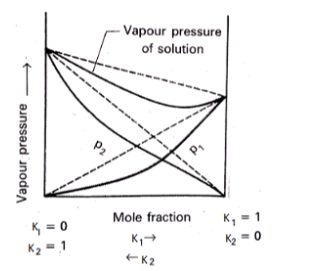
Read the following text carefully and answer the questions that follow: Raoult's law states that for a solution of volatile liquids, the partial vapour pressure of each component of the solution is directly proportional to its mole fraction present in solution.
Dalton's law of partial pressure states that the total pressure $(P_{total})$ over the solution phase in the container will be the sum of the partial pressures of the components of the solution and is given as: $P_{total} = P1 + P2$
Image
i. Is the above $-$ mentioned Raoult's law applicable for non $-$ volatile liquids?
ii. What type of deviation from Raoult's law does the above graph represent?
iii. Give an example of such system.
$OR$
iii. A solution of two liquids boils at a temperature more than the boiling point of either of them. What type of deviation will be shown by the solution formed in terms of Raoult's law?
Write detailed note on the addition reaction of aldehydes and ketones with ammonia derivatives.