Trace the rays of light showing the formation of an image due to a point object placed on the axis of a spherical surface separating the two media of refractive indices $n_1$ and $n_2$. Establish the relation between the distances of the object, the image and the radius of curvature from the central point of the spherical surface. Hence derive the expression of the lens maker’s formula.
CBSE DELHI - SET 1 2009
Download our app for free and get started
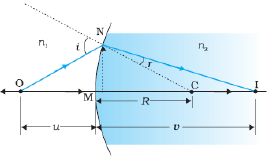
$\tan<\text{NOM} = \frac{\text{MN}}{\text{OM}}$
$<\text{NCM} \cong \tan<\text{NCM} =\frac{\text{MN}}{\text{MC}}$
$<\text{NCM}\cong \tan<\text{NCM} =\frac{\text{MN}}{\text{MI}}$
Now, for $\bigtriangleup\text{NOC}$, i is the exterior angle, Therefore, $\text{I} = <\text{NOM} + <\text{NCM}$
$\ell = \frac{\text{MN}}{\text{OM}} + \frac{\text{MN}}{\text{MC}}$
Similary
$\text{r} = < \text{NCM} -<\text{NIM}'$$\text{i}.\text{e}..\text{r} =\frac{\text{MN}}{\text{MC}} - \frac{\text{MN}}{\text{MI}}$
Now , by Snell's law
$\text{n}_{1}\sin\text{i} = \text{n}_{2}\sin \text{r} , $
or for small angles
$\text{n}_{1}\text{i} = \text{n}_{2}\text{r}$
Substituting for i and r , we then get
$\frac{\text{n}_{1}}{\text{OM}} + \frac{\text{n}_{2}}{\text{MI}} = \frac{\text{n}_{2} - \text{n}_{1}}{\text{MC}}$
Applying the Cartesian sign convention,
$\text{MO} = - u, \text{MI} = + \text{v} , \text{MC} = + \text{R} , $ we get
$\frac{\text{n}_{2}}{v} - \frac{\text{n}_{1}}{u} = \frac{\text{n}_{2} - \text{n}_{1}}{\text{R}}$
Lens Maker’s Formula:
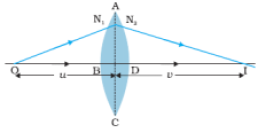
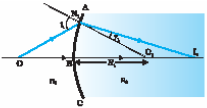
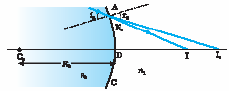
Applying the above result to the first interface ABC, we get,
$\frac{\text{n}_{1}}{\text{OB}} + \frac{\text{n}_{2}}{\text{BI}_{1}} = \frac{\text{n}_{2} - \text{n}_{2}}{\text{BC}_{1}}$
A similar procedure applied to the second interfaceADC gives,
$ - \frac{\text{n}_{2}}{\text{DI}_{1}} + \frac{\text{n}_{1}}{\text{DI}} = \frac{\text{n}_{2} - \text{n}_{2}}{\text{DC}_{2}}$
For a thin lens, $BI_1 = DI_1$. Adding the above two equations,we then get,
$\frac{\text{n}{1}}{\text{OB}} + \frac{\text{n}_{1}}{\text{DI}} = \big(\text{n}_{2} - \text{n}_{1}\big)\bigg(\frac{1}{\text{BC}_{1}} + \frac{1}{\text{DC}_{2}}\bigg)$
Suppose the object is at infinity. Then
$\text{OB} = \infty$ and $\text{DI} = f$ and the above equation becomes
$\frac{\text{n}_{1}}{f} = \big(\text{n}_{2} - \text{n}_{1}\big)\bigg(\frac{1}{\text{BC}_{1}} + \frac{1}{\text{DC}_{2}}\bigg)$
By the sign convention,
$\text{BC}_{1} = + \text{R}_{1}.$
$\text{DC}_{1} = - \text{R}_{2}$ $\frac{1}{f} = \big(\text{n}_{21} - 1\big)\bigg(\frac{1}{\text{R}_{1}} - \frac{1}{\text{R}_{2}}\bigg)$ $\big(\because\text{n}_{21} = \frac{\text{n}_{2}}{\text{n}_{1}}\big)$

Download our appand get started for free
Experience the future of education. Simply download our apps or reach out to us for more information. Let's shape the future of learning together!No signup needed.*
Similar Questions
- 1View SolutionAn optical instrument used for angular magnification has a 25D objective and a 20D eyepiece. The tube length is 25cm when the eye is least strained.
- Whether it is a microscope or a telescope?
- What is the angular magnification produced?
- 2View SolutionA compound microscope consists of an objective lens of focal length 2.0 cm and an eyepiece of focal length 6.25 cm separated by a distance of 15 cm. How far from the objective should an object be placed in order to obtain the final image at (a) the least distance of distinct vision (25 cm), and (b) at infinity? What is the magnifying power of the microscope in each case?
- 3View Solution
- For a ray of light travelling from a denser medium of refractive index $n_1$ to a rarer medium of refractive index $n_2$ prove that $\frac{\text{n}_{2}}{\text{n}_{1}} = \sin \text{i}_{c} ,$ where $i_c$ is the critical angle of incidence for the media.
- Explain with the help of a diagram, how the above principle is used for transmission of video signals using optical fibres.
- 4A point object 'O' is kept in a medium of refractive index $n_1$ in front of a convex spherical surface of radius of curvature R which separates the second medium of refractive index $n_2$ from the first one, as shown in the figure. Draw the ray diagram showing the image formation and deduce the relationship between the object distance and the image distance in terms of $n_1, n_2$ and R.View Solution
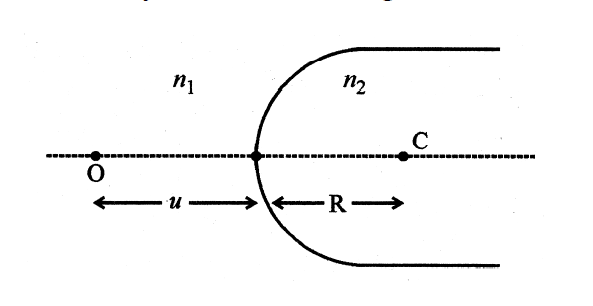
- hen the image formed above acts as a virtual object for concave spherical, surface separating the medium $n_2$ from $n_1 (n_2> n_1),$ draw this ray diagram and write the similar (similar to (a) relation. Hence obtain the expression for the lens maker's formula.
- 5View Solution
- Draw a ray diagram to show refraction of a ray of monochromatic light passing through a glass prism.
- Explain briefly how the phenomenon of total internal reflection is used in fibre optics.
- 6View Solution
- Draw a ray diagram showing the image formation by a compound microscope. Hence obtain expression for total magnification when the image is formed at infinity.
- Distinguish between myopia and hypermetropia. Show diagrammatically how these defects can be corrected.
- 7A card sheet divided into squares each of size $1\ mm^2$ is being viewed at a distance of 9 cm through a magnifying glass (a converging lens of focal length 9 cm) held close to the eye.View Solution
- What is the magnification produced by the lens? How much is the area of each square in the virtual image?
- What is the angular magnification (magnifying power) of the lens?
- Is the magnification in (a) equal to the magnifying power in (b)? Explain.
- 8View Solution
- Derive the mathematical relation between refractive indices $n_1$ and $n_2 $ of two radii and radius of curvature R for refraction at a convex spherical surface. Consider the object to be a point since lying on the principle axis in rarer medium of refractive index $n_1$ and a real image formed in the denser medium of refractive index $n_{2}$.Hence, derive lens maker's formula.
- Light from a point source in air falls on a convex spherical glass surface of refractive index 1.5 and radius of curvature 20 cm. The distance of light source from the glass surface is 100 cm. At what position is the image formed?
- 9View SolutionA man with normal near point (25 cm) reads a book with small print using a magnifying glass: a thin convex lens of focal length 5 cm.
- What is the closest and the farthest distance at which he should keep the lens from the page so that he can read the book when viewing through the magnifying glass?
- What is the maximum and the minimum angular magnification (magnifying power) possible using the above simple microscope?
- 10View Solution
- Draw the ray diagram showing refraction of light through a glass prism and hence obtain the relation between the refractive index $\mu$ of the prism, angle of prism and angle of minimum deviation.
- Determine the value of the angle of incidence for a ray of light travelling from a medium of refractive index $\mu_1=\sqrt{2}$ into the medium of refractive index $\mu_2=1$, so that it just grazes along the surface of separation.