Question
Explain why elemental semiconductor cannot be used to make visible LEDs.

Answer

Specially designed diodes, which give out light rediations when forward biases. LED's are made of GaAsp, Gap etc.
There are forwad biased P-N junctions which emits spontaneous fadiation. In elemental semiconductor, the band gap is such that the emission are in infrared region and not in visible region. $\lambda=\frac{\text{hc}}{\text{E}_\text{g}}$ For Si; $\text{E}_\text{g}= 1.1\text{eV},\lambda=\frac{1242}{1.1}=1129\text{nm}$ For Ge; $\text{E}_\text{g}=0.7\text{eV},\lambda=\frac{1242}{0.7}=1725\text{nm}$

Need a full question paper?

Generate a complete, print-ready paper with questions like this in minutes — across 16+ boards, with answer keys.
Start Generating Free

Similar questions

Define the terms (i) capacitance of a capacitor (ii) dielectric strength of a dielectric. When a dielectric is inserted between the plates of a charged parallel plate capacitor, fully occupying the intervening region, how does the polarization of the dielectric medium affect the net electric field? For linear dielectrics, show that the introduction of a dielectric increases its capacitance by a factor $\kappa$, characteristic of the dielectric.
A concave mirror forms an image of 20cm high object on a screen placed 5.0m away from the mirror. The height of the image is 50cm. Find the focal length of the mirror and the distance between the mirror and the object.
The plates of a capacitor of capacitance $10\mu\text{F},$ charged to $60\mu\text{C},$ are joined together by a wire of resistance $10\Omega$ at t = 0. Find the charge on the capacitor in the circuit at (a) t = 0 (b) $\text{t}=30\mu\text{s}$ (c) $\text{t}=120\mu\text{s}$ and (d) t = 1.0ms.
Are the nucleons fundamental particles, or do they consist of still smaller parts? One way to find out is to probe a nucleon just as Rutherford probed an atom. What should be the kinetic energy of an electron for it to be able to probe a nucleon? Assume the diameter of a nucleon to be approximately $10^{-15}m.$
Describe the procedure for obtaining V-I characteristic curve in forward bias of P-N junction diode. Make a circuit diagram of the experimental arrangement.
  1.  
  1. State the principle on which a potentiometer works. How can a given potentiometer be made more sensitive?
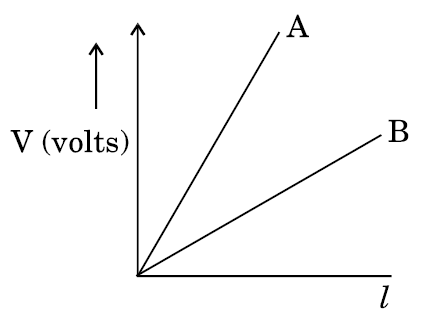
  2. In the graph shown below for two potentiometers, state with reason which of the two potentiometers, A or B, is more sensitive.
  1. Two metallic wires, $P_1$ and $P_2$ of the same material and same length but different cross-sectional areas, $A_1$ and $A_2$​​​​​​​ are joined together and connected to a source of emf. Find the ratio of the drift velocities of free electrons in the two wires when they are connected (i) in series, and (ii) in parallel.
A pin of length 2.00cm is placed perpendicular to the principal axis of a converging lens. An inverted image of size 1.00cm is formed at a distance of 40.0cm from the pin. Find the focal length of the lens and its distance from the pin.
  1. Define the term drift velocity.
  2. On the basis of electron drift, derive an expression for resistivity of a conductor in terms of number density of free electrons and relaxation time. On what factors does resistivity of a conductor depend?
  3. Why alloys like constantan and manganin are used for making standard resistors?
Lenses are constructed by a material of refractive index 1.50. The magnitude of the radii of curvature are 20cm and 30cm. Find the focal lengths of the possible lenses with the above specifications.
A mercury lamp is a convenient source for studying frequency dependence of photoelectric emission, since it gives a number of spectral lines ranging from the UV to the red end of the visible spectrum. In our experiment with rubidium photo-cell, the following lines from a mercury source were used: $\lambda_1=3650\ \mathring{\text{A}},\ \lambda_2=4047\ \mathring{\text{A}},\ \lambda_3=4358\ \mathring{\text{A}},\ \lambda_4=5461\ \mathring{\text{A}},\ \lambda_5=6907\ \mathring{\text{A}},$ The stopping voltages, respectively, were measured to be: $V_{01} = 1.28 V, V_{02} = 0.95 V, V_{03} = 0.74 V, V_{04} = 0.16 V, V_{05} = 0 V$ Determine the value of Planck’s constant h, the threshold frequency and work function for the material. [Note: You will notice that to get h from the data, you will need to know e (which you can take to be $1.6 \times 10^{–19}$ C). Experiments of this kind on Na, Li, K, etc. were performed by Millikan, who, using his own value of e (from the oil-drop experiment) confirmed Einstein’s photoelectric equation and at the same time gave an independent estimate of the value of h.]