Question
State the principle on which transformer works. Explain its working with construction. Derive an expression for ratio of e.m.f.s and currents in terms of number of turns in primary and secondary coil.
Answer

A transformer is a device with the help of which, a given alternating voltage can be increased or decreased to any desired value. The first type of transformer which delivers an output voltage smaller than the input voltage
is called a step down transformer. The second type of transformer which delivers an output voltage larger than the input voltage is called a step up transformer.
Principle of working of a transformer:
A transformer works on the principle that whenever the magnetic flux linked with a coil changes, an emf is induced in the neighbouring coil.Construction:
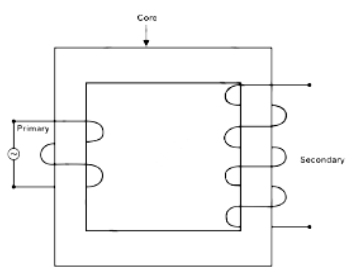
It consists of two coils, primary (P) and secondary (S), insulated from each other and wound on a soft iron core as shown in the figure below.
Image
The primary coil is called the input coil and the secondary coil is called the output coil.
Working:
When an alternating voltage is applied to the primary coil, the current through the coil goes on changing. Hence, the magnetic flux through the core also changes. As this changing magnetic flux is linked with both coils, an emf is induced in each of them. The amount of magnetic flux linked with the coil depends on the number of turns of the coil.Derivation:
Let ‘$Φ$’ be the magnetic flux linked per turn with both coils at a certain instant of time $‘t’.$
Let the number of turns of the primary and secondary coils be $‘N_p’$ and $‘N_s’$, respectively.
Therefore, the total magnetic flux linked with the primary coil at certain instant of time $‘t’$ is $N_pΦ$. Similarly, the total magnetic flux linked with the secondary coil at certain instant of time $‘t’$ is $N_sΦ$.
Now, the induced emf in a coil is
\(e=\frac{d \phi}{d t}\)
Therefore, the induced emf in the primary coil is
\(e_p=\frac{d \phi_p}{d t}=\frac{d N_p \phi}{d t}=-N_p \frac{d \phi}{d t}\).......(1)
Similarly, the induced emf in the secondary coil is
\(e_s=\frac{d \phi_s}{d t}=\frac{d N_s \phi}{d t}=-N \frac{d \phi}{d t}\).......(2)
Dividing equations (1) and (2), we get
\(\frac{e_s}{e_p}=\frac{-N_s \frac{d \phi}{d t}}{-N_p \frac{d \phi}{d t}}=\frac{N_s}{N_p}\)........(3)
The above equation is called the equation of the transformer and the ratio \(\frac{N_s}{N_p}\) is known as the turns ratio of the transformer.
Now, for an ideal transformer, we know that the input power is equal to the output power.
\(\therefore P_p=P_s\)
\(\therefore e_p i_p=e_s i_s\)
\(\therefore \frac{e_s}{e_p}=\frac{i_p}{i_s}\)
From equation (3), we have
\(\frac{e_s}{e_p}=\frac{N_s}{N_P}\)
\(\therefore \frac{e_s}{e_p}=\frac{N_s}{N_p}=\frac{i_p}{i_s}\)

Need a full question paper?

Generate a complete, print-ready paper with questions like this in minutes — across 16+ boards, with answer keys.
Start Generating Free

Similar questions

Two charges of magnitudes -4Q and +2Q are located at points (2a, 0) and (5a, 0) respectively. What is the electric flux due to these charges through a sphere of radius 4a with its centre at the origin?
Describe biprism experiment to find the wavelength of monochromatic light. Draw the necessary ray diagram for ( magnified and diminished images of virtual sources.
Monochromatic electromagnetic radiation from a distant source passes through a slit. The diffraction pattern is observed on a screen 2.50 m from the slit. If the width of the central maximum is 6.00 mm, what is the slit width if the wavelength is
(a) 500 nm (visible light);
(b) 50 µm (infrared radiation);
(c) 0.500 nm (X-rays)?

What is a rectifier? With the help of the neat circuit diagram explain the working of all full wave rectifier.
Discuss the composition of two S.H.M.s along the same path having same period. Find the resultant amplitude and initial phase.
A flywheel rotating about an axis through its centre and perpendicular to its plane loses $100 \mathrm{~J}$ of energy on slowing down from $60 \mathrm{rpm}$ to $30 \mathrm{rpm}$. Find its moment of inertia about the given axis and the change in its angular momentum.
Explain the degrees of freedom a polyatomic molecule can have. Hence write the expressions for
(i) the energy per molecule
(ii) the energy per mole
(iii) $\mathrm{C}_{\mathrm{V}}$
(iv) $\mathrm{C}_{\mathrm{p}}$
(v) the adiabatic constant, for a polyatomic gas.
What is logic gate? Write down the truth table and Boolean expression for ‘AND’ gate.
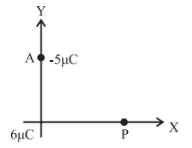
A charge $6 \mu C$ is placed at the origin and another charge $-5 \mu C$ is placed on the y axis at a position $A (0, 6.0)$ m.
Image
(a) Calculate the total electric potential at the point P whose coordinates are $(8.0, 0)$ m
(b) Calculate the work done to bring a proton from infinity to the point P. What is the significance of the sign of the work done ?
Why is a potentiometer preferred over a voltmeter for measuring emf?