Question
State three points of difference between Single Entry and Double Entry System. Difference between Double Entry System and Single Entry System?

Answer

Difference between Double Entry System and Single Entry System:
S.No.
Basis
Double Entry System
Single Entry System
1.
Aspect of a Transaction
Under this system, both aspect of a transaction are recorded.
Under this system, both aspect of transaction may not be recorded. In fact, for some transaction both the aspect, for some others one aspect and yet for others no aspect at all are recorded.
2.
Accounts Maintained
Under this system, personal, real and nominal etc.., all the accounts are maintained. Thus, it is a complete and scientificsystem of accounting.
Under this system, only personal accounts and Cash Book and maintained. Hence, it reamin an incomplete record of accounts.
3.
Trial Balance
Under this system, Trial Balance is prepared and thus, the arithmetical accuracy of all books of account is verified.
Under this system, Trial Balance cannot be prepared due to incomplete system of accounting. Therefore, arithmetical accuracy of the accounting cannot be verified.
4.
Profit or Loss
Under this system, after a certain period, net profit or net loss can be ascertained by preparing the Profit and Loss Account.
Under this system, Profit and Loss Account is not prepared to ascertain the net profit or loss. Method for ascertaining the profit or loss is not adequate.

Need a full question paper?

Generate a complete, print-ready paper with questions like this in minutes — across 16+ boards, with answer keys.
Start Generating Free

Similar questions

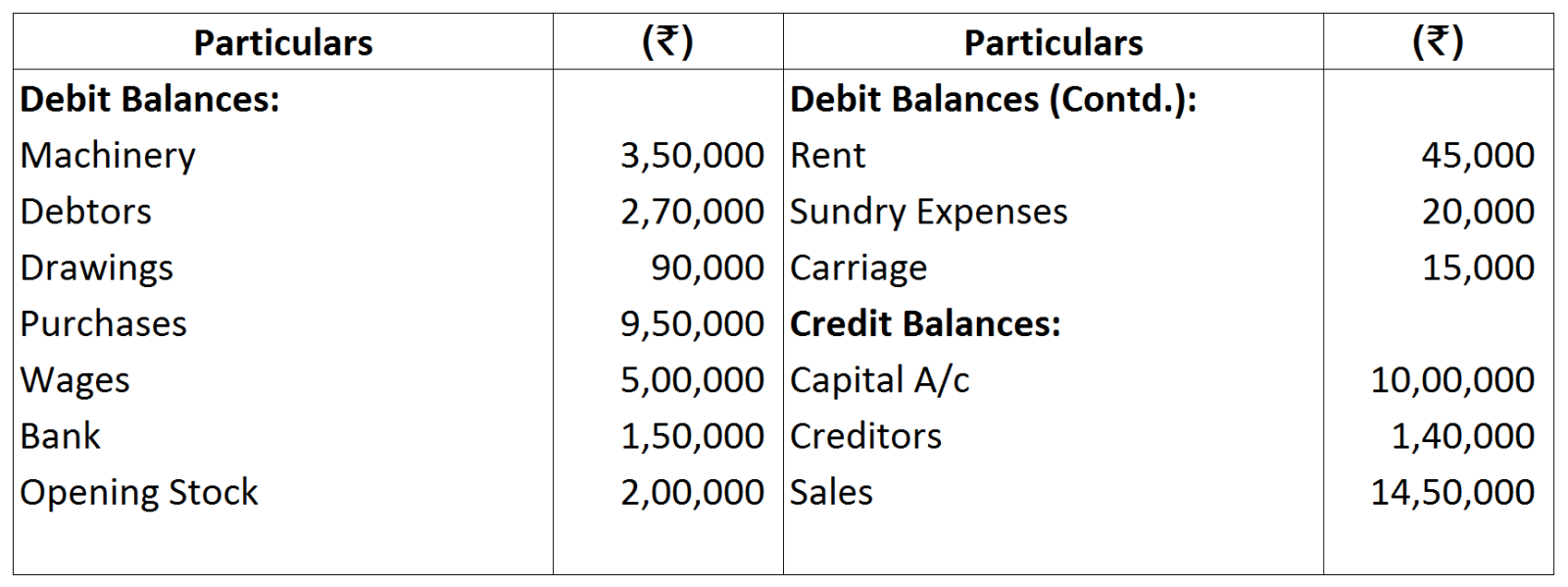
Following balances were extracted from the books of Vijay on 31st March, 2019:
Stock as on 31st March, 2019 was valued at ₹ 2,30,000.Prepare Trading and Profit and Loss Account for the year ended 31st March, 2019 and Balance Sheet as at that date after giving effect to the following adjustments:
  1. Write off further ₹ 1,800 as Bad Debts and maintain the Provision for Doubtful Debts at 5%.
  2. Depreciate Machinery at 10%.
  3. Provide ₹ 7,000 as outstanding interest on loan.
Give rectifying Journal entries for the following errors:
  1. Sales of goods to Madan ₹ 6,000 were entered in the Sales Book as ₹ 600.
  2. Credit purchase of ₹ 1,500 from Ajay has been wrongly passed through the Sales Book.
  3. Repairs to building ₹ 300 were debited to Building Account.
  4. ₹ 2,050 paid to Rohit is posted to the debit of Mohit’s Account as ₹ 5,020.
  5. Purchases Return Book is overcasted by ₹ 400.
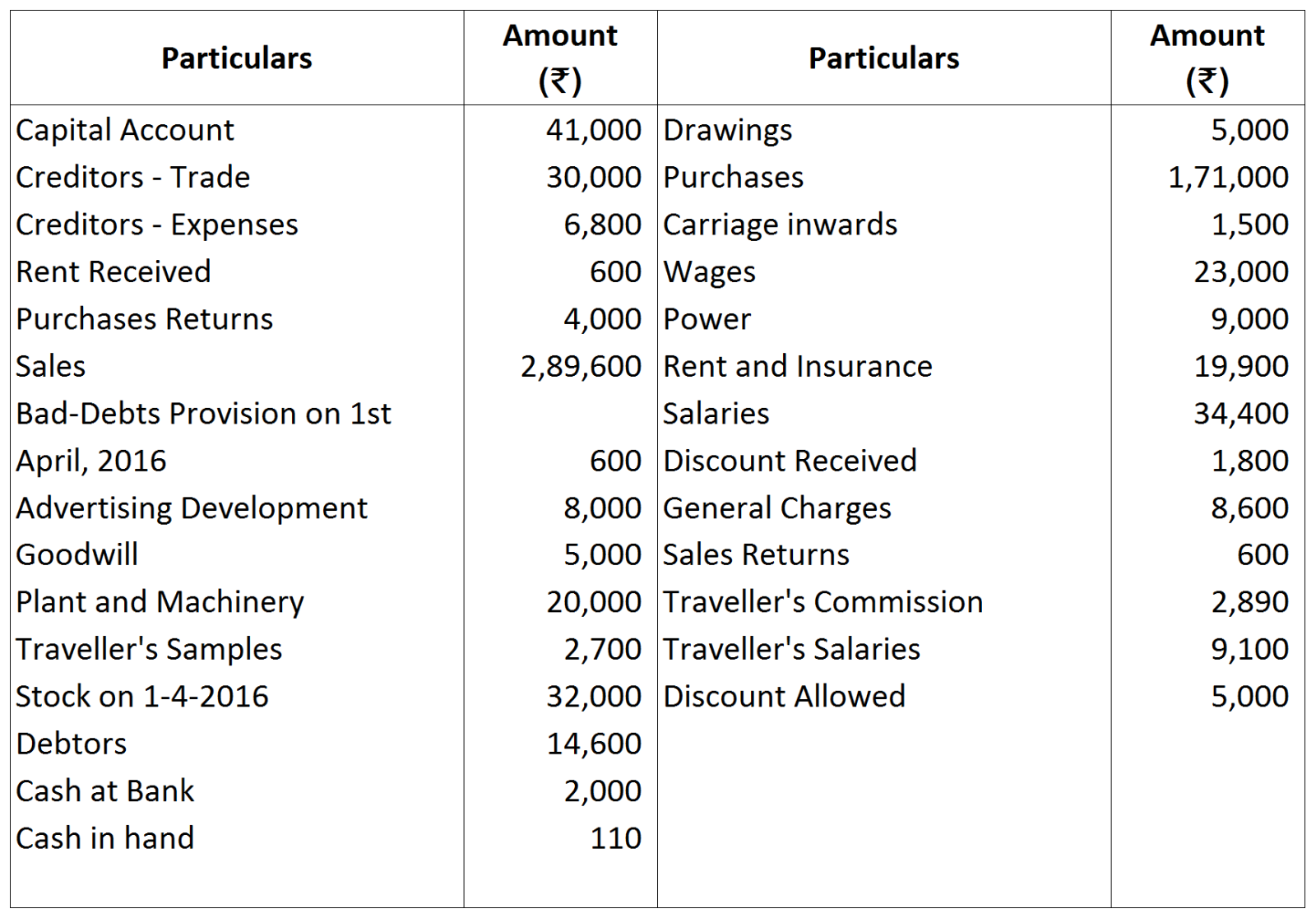
Prepare Trading and Profit and Loss Account and Balance Sheet as at 31st March, 2017 from the following Balances of Mr. Sardari Lal :

Adjustments: The Closing stock was ₹ 23,000 but there has been a loss by fire on 20th March, 2017, to the extent of ₹ 20,000, not covered by insurance. Depreciate Plant and Machinery by 10% and Traveller's Samples by $33\frac{1}{3}\%$ Increase the Bad-debts Provision to ₹ 2,000. Write 20% off Advertising Development Account. Annual premium on insurance expiring 1st June, 2017 was ₹ 1,200. Provide for Manager's commission @ 5% on Net Profits after charging such Commission.
Describe the various types of accounting software along with their advantages and limitations.
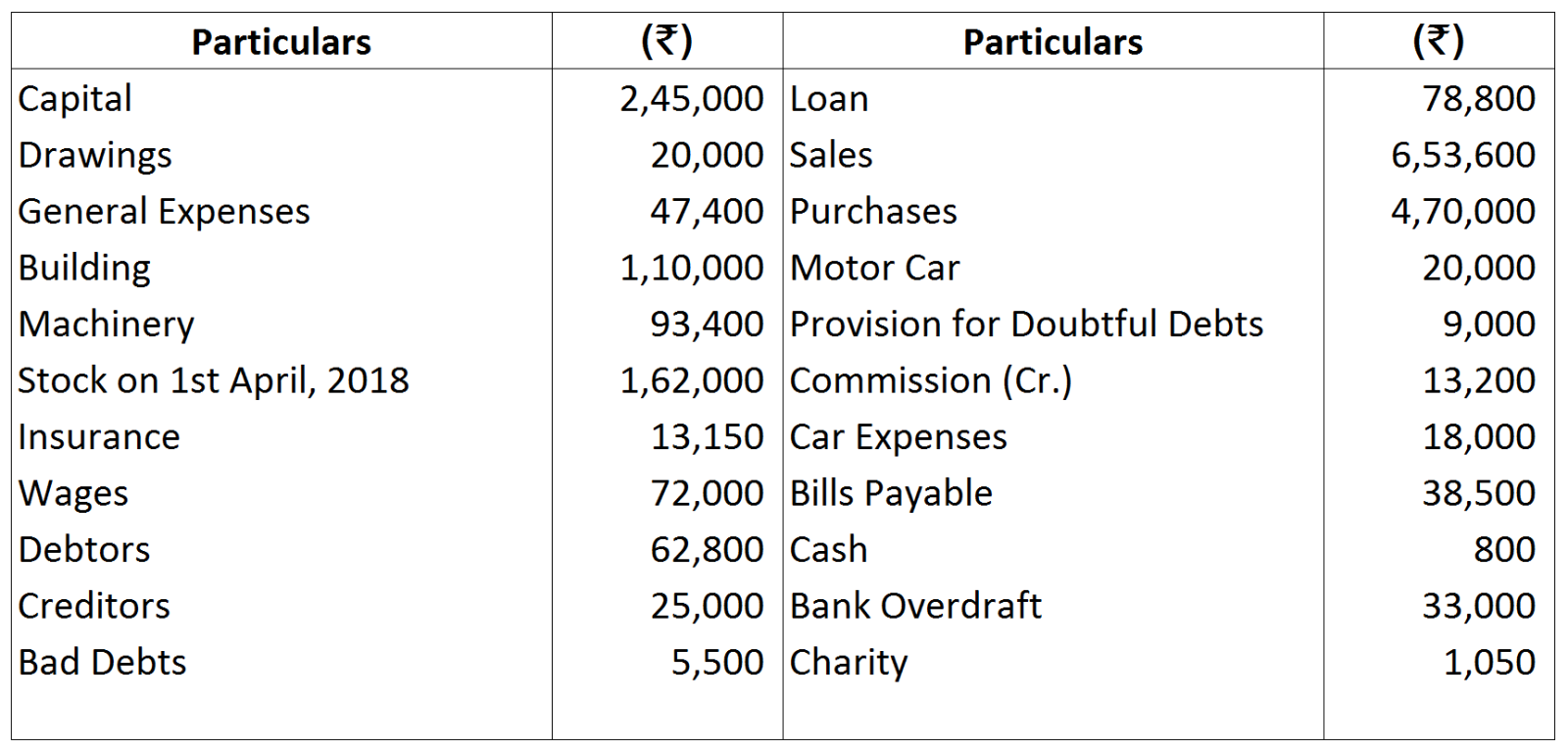
From the following balances, prepare Trading and Profit and Loss Account and Balance Sheet:
Closing Stock was valued at ₹ 30,000.
What are the salient features in Tally?
Show the treatment of the following in Final Accounts when given inside the Trial Balance.
  1. Prepaid Expenses.
  2. Depreciation.
  3. Closing Stock.
  4. Interest on Capital.
  5. Commission received in advance.
Mr. A does not keep proper records of his business. Following information is available from records kept by him:
Mr. A withdrew from the business ₹ 3,000 per month upto 30th September 2016 and thereafter ₹ 4,000 per month as drawings. ₹ 50,000 realised by the proprietor as maturity value of National Saving Certificates was invested in the business. Prepare a statement showing net profit (or net loss) for the year.
Give Journal entries for the following adjustments in final accounts:
  1. Salaries ₹ 5,000 are outstanding.
  2. Insurance amounting to ₹ 2,000 is paid in advance.
  3. ₹ 4,000 for rent have been received in advance.
  4. Cornmission earned but not received ₹ 1,000.
  5. Interest on Capital ₹ 1,500.
  6. Interest on Drawings ₹ 300.
  7. Write off ₹ 2,000 as further debts.
  8. Closing Stock ₹ 3,000.