Question
  1. State two main differences between globular proteins and fibrous proteins.
  2. Based on their chemical composition, state how are lipids classified Give one example of each class.

Answer

  1. Sr. No.
    Globular Proteins
    Fiberous Proteins
    I.
    II.
    They are cross linked condensation products .
    Three dimensional spherical shape.
    They are linear condensation products.
    Rod like rigid shape.
  2. Lipids are naturally occuring compounds related to fatty acids which include fats, oils, waxes, etc.

  1. Simple lipids (Homolipids): e.g, neutral fats/waxes.
  2. Compound Lipids (Hetrolipids): e.g, Phospholopids/Glycolipids.
  3. Derived Lipids: fatty acids/fatty alcohols/steroids/terpenes, etc.

Need a full question paper?

Generate a complete, print-ready paper with questions like this in minutes — across 16+ boards, with answer keys.

Start Generating Free

Similar questions

(a) (i) Write the disproportionation reaction of $H _3 PO _3$.
(ii) Draw the structure of $XeF _4$.
(b) Account for the following:
(i) Although fluorine has less negative electron gain enthalpy yet $F_2$ is a strong oxidizing agent.
(ii) Acidic character decreases from $N _2 O _3$ to $Bi _2 O _3$ in group 15.
(c) Write a chemical reaction to test Sulphur dioxide gas. Write the chemical equation involved.
Describe the reactions of -COOH group present in carboxylic acids.
Using crystal field theory, draw energy level diagram, write the electronic configuration of the central metal atom/ion and determine the magnetic moment value in the following:
i. $\left[ CoF _6\right]^{3-},\left[ Co \left( H _2 O \right)_6\right]^{2+},\left[ Co ( CN )_6\right]^{3-}$
ii. $\left[ FeF _6\right]^{3-},\left[ Fe \left( H _2 O \right)_6\right]^{2+},\left[ Fe ( CN )_6\right]^{4-}$
Explain in detail the changing oxidation states of the elements of d group (transition elements) in the context of 3d series.
What happens to most probable kinetic energy and the energy of activation with increase in temperature?
Two elements A and B form compounds having formula AB2 and AB4. When dissolved in 20 g of benzene $\left( C _6 H _6\right), 1 g$ of $AB _2$ lowers the freezing point by 2.3 K whereas 1.0 g of AB4 lowers it by 1.3 K. The molar depression constant for benzene is 5.1 K kg mol-1. Calculate atomic masses of A and B.
I. Show how p-aminoazobenzene can be obtained from aniline.
II. Write structures for the following compounds:
   a. Benzene diazonium chloride
   b. p-Nitrotoluene
   c. Sulphanilic acid
  1. Define the following terms:
  1. Ideal solution.
  2. Azeotrope.
  3. Osmotic pressure.
  1. A solution of glucose (C6H12O6) in water is labelled as 10% by weight. What would be the molality of solution?

(Molar mass of glucose = 180 g mol-1).
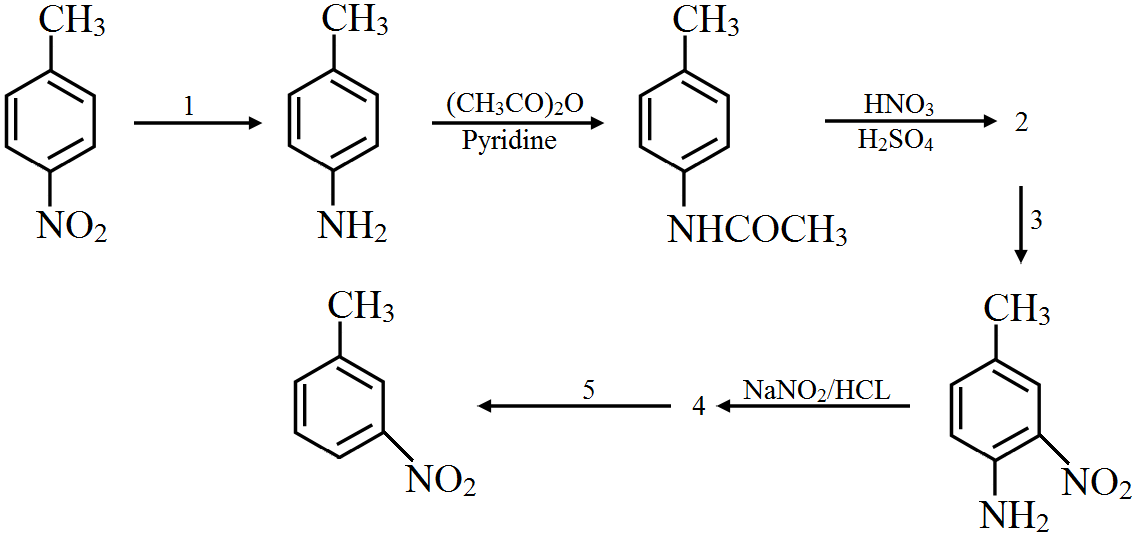
(i). Illustrate the following reactions giving suitable example in each case:
a. Ammonolysis
b. Coupling reaction
c. Acetylation of amines
(ii). Describe Hinsberg method for the identification of primary, secondary and tertiary amines. Also, write the chemical equations of the reactions involved.
