Question
State Werner's co-ordination theory.

Answer

Get the step-by-step solution for this question inside the Vidyadip app.

Get the answer in the app

Need a full question paper?

Generate a complete, print-ready paper with questions like this in minutes — across 16+ boards, with answer keys.
Start Generating Free

Similar questions

  1. Define the following terms:
  1. Molarity.
  2. Molal elevation constant$(Kb).$
  1. A solution containing $15\ g$ urea $($molar mass $= 60\ g\ mol^{–1})$ per litre of solution in water has the same osmotic pressure $($isotonic$)$ as a solution of glucose $($molar mass $= 180\ g\ mol^{–1})$ in water. Calculate the mass of glucose present in one litre of its solution.
State Henry's law and mention some important applications.
  1. Complete the following chemical equations for reactions:
i. $\text{MnO}_{4(aq)}^{-}+\text{S}_{2}\text{O}_{3(aq)}^{2-}+\text{H}_{2}\text{O}_{(l)}\rightarrow$
ii. $\text{Cr}_{2}\text{O}^{-}_{7(aq)}+\text{H}_{2}\text{S}_{(g)}+\text{H}^{+}_{(aq)}\rightarrow$
  1. Give an explanation for each of the following, observations:
  1. The gradual decrease in size $($actinoid contraction$)$ from element to element is greater among the .actinoids than that among the lanthanoids $($lanthanoid contraction$).$
  2. The greatest number of oxidation states are exhibited by the members in the middle of a transition series.
  3. With the same d-orbital configuration $(d^4) Cr^{2+}$ ion is a reducing agent but $Mn^{3+}$ ion is an oxidising agent.
Why is it not possible to obtain pure ethanol by fractional distillation? What general name is given to binary mixtures which show deviation from Raoult’s law and whose components cannot be separated by fractional distillation. How many types of such mixtures are there?
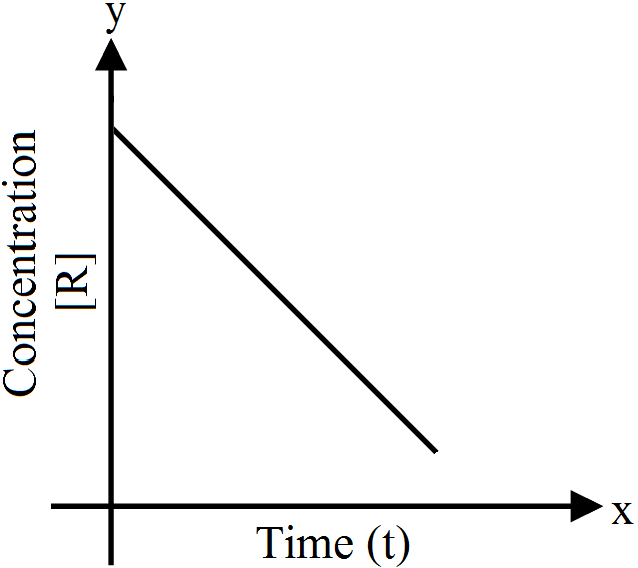
Consider the reaction $\text{R}\xrightarrow{\ \ \text{k}\ \ } \text{P}.$ The change in concentration of $R$ with time is shown in the following plot:
  1. Predict the order of the reaction.
  2. Derive the expression for the time required for the completion of the reaction.
  3. What does the slope of the above line indicate?
For an elementary reaction$:$
$2A + B \rightarrow 3C$
the rate of appearance of $C$ at time $'t\ ’$ is $1.3 \times 10-^4 \ce{mol L-^1 s-^1.}$ Calculate at this time$:$
  1. Rate of the reaction.
  2. Rate of disappearance of $A.$
Giving an example for each describe the following reactions:
i. Hofmann bromamide reaction.
ii. Gattermann reaction.
iii. Coupling reaction.
$(a).$ Out of formic acid and acetic acid, which one will give the $\text{HVZ}$ reaction? Give a suitable reason in support of your answer and write the chemical reaction involved.
$(b)$. Alcohols are acidic but they are weaker acids than water. Arrange various isomers of butanol in the increasing order of their acidic nature. Give a reason for the same.
$(c).$  An organic compound $A$ which is a Grignard reagent is used to obtain $2-$methylbutan$-2-ol$ on reaction with a carbonyl compound $'B\ '.$ Identify $A\ '$ and $'B\ '.$ Write the equation for the reaction between $A$ and $B.$
Explain the mechanism of rusting of iron.
  1. When $2.56\ g$ of sulphur was dissolved in $100\ g$ of $CS_2,$ the freezing point lowered by $0.383\ K.$ Calculate the formula of sulphur $(S_x).$
$(K_f$ for $CS_2 = 3.83 K \ kg\ mol^{–1},$ Atomic mass of Sulphur $= 32\ g\ mol^{–1}]$
  1. Blood cells are isotonic with $0.9\%$ sodium chloride solution. What happens if we place blood cells in a solution containing.
  1. $1.2\%$ sodium chloride solution?
  2. $0.4\%$ sodium chloride solution?