Question
State your observation for the following electrolytic reaction
Aqueous copper sulphate is electrolysed between platinum electrodes.

Answer

When the electrolysis of copper sulphate(aqueous) is electrolysed between platinum electrodes the following reaction follows :
$\begin{aligned} & CuSO _4 \rightleftharpoons Cu ^{+2}+ SO _4^{2-} \\ & H _2 O \rightleftharpoons H ^{+}+ OH ^{-}\end{aligned}$
Reaction at cathode : Copper ions and hydrogen ions migrate towards the cathode, $Cu ^{+2}$ ions being lower in the electrochemical series are preferentially discharged to hydrogen ions to form neutral copper atoms at platinum cathode.
$
Cu ^{+2}+2^{e-} \longrightarrow Cu
$
Reaction at anode: Sulphate ions and hydroxyl ions migrate towards the anode, Hydroxyl ions are preferentially discharged to sulphate ions at anode, to form neutral particles of $OH ^{-}$, The electrically neutral hydroxyl reacts
among themselves to give water and oxygen.
$
\begin{aligned}
& OH ^{-}- e ^{-} \longrightarrow OH \\
& 4( OH ) \xrightarrow{-4 e ^{-}} 2 H _2 O + O _2
\end{aligned}
$

Need a full question paper?

Generate a complete, print-ready paper with questions like this in minutes — across 16+ boards, with answer keys.

Start Generating Free

Similar questions

How is ethylene prepared in laboratory? Give balanced equation and
procedure. How is the gas prepared and dried?
(a) Copy and complete the following table which refers to two practical applications of electrolysis
  Anode Electrolyte Cathode
Silver plating of a spoon   A solution of potassium argentocyanide  
Purification of copper      
(iii) Extraction of sodium      
(b) Write the equation taking place at the anode for Q. 2(a).
You are given three white powders-calcium carbonate, lead carbonate and zinc carbonate. Describe the tests you would carry out in solution, to identify the metal ion in each of the above compounds. Indicate clearly how you would prepare the solutions for the tests.
Choose A, B, C or D to match the descriptions (i) to (v) below . Some alphabets may be repeated.
(A) Non-electrolyte, (B) Strong electrolyte, (C) Weak electrolyte, (D) Metallic conductor
(i) Molten ionic compound
(ii) Carbon tetrachloride
(iii) An aluminium wire
(iv) A solution containing solvent molecules, solute molecules and ions formed by the dissociation of solute molecules
(v) A sugar solution with sugar molecules and water molecules.
If the empirical formula of two compounds is CH and their Vapour densities are 13 to 39 respectively, find their molecular formula.
Making use only of substances chosen from those given below:
Dilute sulphuric acid
Sodium carbonate
Zinc
Sodium sulphite
Lead
Salcium carbonate
Give the equation for the reaction by which you could obtain:
(i) Hydrogen
(ii) Sulphur dioxide
(iii) Carbon dioxide
(iv) Zinc Carbonate (two steps required).
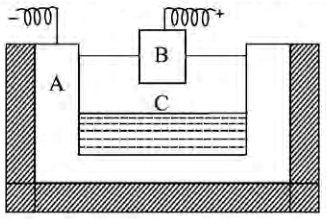
The following is a sketch of an electrolytic cell used in the extraction of aluminium:
Image
(i) What is the substance of which the electrodes A and B are made?
(ii) At which electrode (A or B) is aluminium formed?
(iii) What are the two aluminium compounds in the electrolyte C?
(iv) Why is it necessary for electrode B to be continuously replaced?
$112 cm^3$ of $H_2S(g)$ is mixed with $120 cm^3$ of $Cl_2(g)$ at STP to produce $HCl(g)$ and sulphur(s). Write a balanced equation for this reaction and calculate (i) the volume of gaseous product formed (ii) composition of the resulting mixture.
Write the names and formula of the products formed when Methane reacts with : (i) Chlorine (ii) bromine. Write the chemical equations.
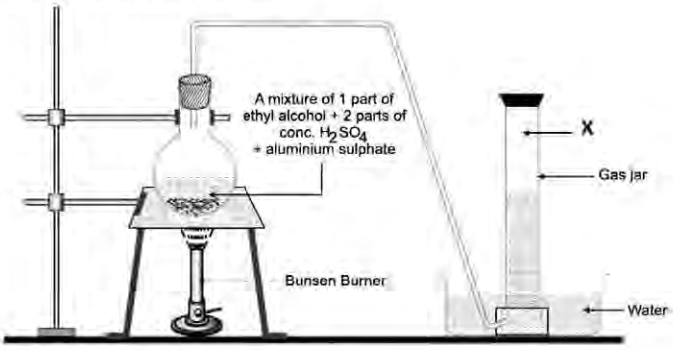
Look at the set-up of given apparatus carefully.
Image
(i) Identify 'X'.
(ii) Name the process of collection of 'X'. Justify.
(iii) Write the chemical equations involved.
(iv) What is the role of sulphuric acid in the above process?