Questions

[5 Mark Question Answer]

🎯

Test yourself on this topic

14 questions · timed · auto-graded

Question 15 Marks
Differentiate between the terms strong electrolyte and weak electrolyte (stating any two differences)
Answer
Strong ElectrolytesWeak Electrolytes
Electrolytes which allow a large amount of electricity to flow through them.Electrolytes which allow small amounts of electricity to flow through them.
These are good conductors of electricity.These are poor conductors of electricity.
These almost completely dissociate in the fused or aqueous solution state.These are partially dissociated in the fused or aqueous solution state.
These solutions contain only free mobile ions. These solutions contain ions as well as molecules.
View full question & answer
Question 25 Marks
M is a metal above hydrogen in the activity series and its oxide has the formula $M_2O$. The oxide when dissolved in water forms the corresponding hydroxide which is a good conductor of electricity. In the above context answer the following:
(i) What kind of combination exists between $M$ and $O$?
(ii) How many electrons and there in the outermost shell of $M$?
(iii) Name the group to which M belongs
(iv) State the reaction taking place in the cathode
(v) Name the product at the anode
Answer
(i) Electrovalent or ionic compounds
(ii) One electron
(iii) Since it has valency $1, M$ belongs to Group $1.$
(iv) At the cathode: $M^++ 1e^-→ M$
(v) At the anode: Oxygen gas
View full question & answer
Question 35 Marks
Mr Ramu wants electrolyte his key chain with nickel to prevent rusting. For this electroplating
(i) Name the electrolyte
(ii) Name the cathode
(iii) Name the anode
(iv) Give the reaction at the cathode
(v) Give the reaction at the anode
Answer
(i) Aqueous solution of nickel sulphate with few drops of dil. sulphuric acid
(ii) Article (e.g. key chain)
(iii) Pure nickel
(iv) $Ni^{2+} + 2e^-→ Ni$
(v) $Ni → Ni^{2+}+ 2e^-$​​​​​​​
View full question & answer
Question 45 Marks
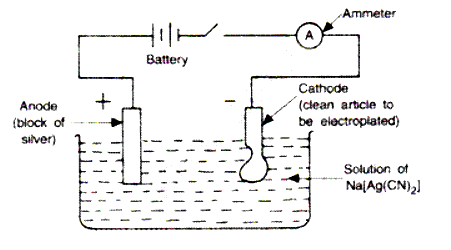
A metal article is to be electroplated with silver. The electrolyte selected is sodium argentocyanide.
(a) What kind of salt is sodium argento cyanide?
(b) Why is it preferred to silver nitrate as an electrolyte?
(c) State one condition to ensure that the deposit is smooth, firm and long lasting.
(d) Write the reaction taking place at the cathode.
(e) Write the reaction taking place at the anode.
Answer
(a) It is a complex salt.
(b) Sodium argento cyanide is preferred over silver nitrate because it gives a smooth and firm silver plating over article.
(c) If silver nitrate is used then deposition of silver will be fast and not smooth.
(d) Reaction At Cathode :
$Ag^+ + e^- → Ag$​​​​​​​
(e) Reaction at Anode :
$Ag^+ + e^- → Ag^+​​​​​​​$​​​​​​​
View full question & answer
Question 55 Marks
The following is an extract from metals in the service of man, Alexander and street /Pelican $1976$: Alumina (aluminium oxide) has a very high melting point over $2000^oC$ so that I cannot readily be liquefied. However, conversion of alumina to aluminium and oxygen, by electrolysis, an occur when it is dissolved in some other substance.
(a) Which solution is used to react with bauxite as first step in obtaining pure aluminium oxide?
(b) The aluminium oxide for the electrolytic extraction of aluminium is obtained by heating aluminium hydroxide. Write the equation for this reaction.
(c) Name the element which serves both as the anode and the cathode in the extraction of aluminium.
(d) Write the equation for the reaction that occurs at the cathode during the extraction of aluminium.
(e) Write the equation for the reaction that occurs at the cathode during extraction of aluminium by electrolysis.
(f) Give the equation for the reaction that occurs at the anode when aluminium is purified by electrolysis.
Answer
(a) Bauxite is reacted with sodium hydroxide to obtain pure aluminium oxide.
(b) $2Al(OH)_3 → Al_2O_3 + 3H_2O$
(c) Carbon serves both as anode and cathode.
(d) Reaction at cathode :
$Al^{+3} + 3e^- → Al$
(e) Reaction at cathode :
$Al^{+3} + 3e^- → Al$
(f) Reaction at anode :
$O^{-2} - 2e^- → O$
$O + O → O_2$
View full question & answer
Question 65 Marks
Choose A, B, C or D to match the descriptions (i) to (v) below . Some alphabets may be repeated.
(A) Non-electrolyte, (B) Strong electrolyte, (C) Weak electrolyte, (D) Metallic conductor
(i) Molten ionic compound
(ii) Carbon tetrachloride
(iii) An aluminium wire
(iv) A solution containing solvent molecules, solute molecules and ions formed by the dissociation of solute molecules
(v) A sugar solution with sugar molecules and water molecules.
Answer
(i) Molten ionic compound - Strong electrolyte
(ii) Carbon tetrachloride- Non-electrolyte
(iii) An aluminium wire- Metallic conductor
(iv) A solution containing solvent molecules, solute molecules and ions formed by the dissociation of solute molecules- weak electrolyte
(v) A sugar solution with sugar molecules and water molecules- Non-electrolyte
View full question & answer
Question 75 Marks
How electrolysis can be used in extraction of aluminium? Why aluminium cannot be reduced by conventional reducing agents?
Answer
Aluminium is extracted by the electrolysis of fused pure alumina dissolved in fused mixture of cryolite and fluorspar. This mixtures lowers the melting point of alumina and increases the electrical conductivity and the electrolysis
is carried out in an iron tank lined with gas carbon. This lining of a gas carbon serves as cathode. The anode consists of a number of carbon rods which dip in fused electrolyte. On passing electric current following reaction takes place.
At Cathode : $Al^{+3} + 3e^-→ Al$
At anode : $O^{-2} - 2e^- → O$
$O + O → O_2$​​​​​​​
Certain metal oxides are highly stable and so cannot be reduced by conventional reducing agents like coke, carbon monoxide or hydrogen. They are extracted from their oxides or salts by the electrolysis in fused state. For e.g.; metals like aluminium, sodium, potassium, magnesium, titanium, calcium etc. are extracted by this method.
View full question & answer
Question 85 Marks
Make a neatly labeled sketch to show how a brass spoon can be plated with silver. Explain your choice of electrolyte used.
Answer
In order to get a spoon plated with silver a solution of sodium silver silver cyanide can be taken as electrolyte. If silver nitrate was chosen as electrolyte then the deposition of silver will be very fast and hence not very uniform and smooth.
View full question & answer
Question 95 Marks
With reference to the electrolysis of acidulated water, answer the following :
a) why distilled water is a non- electrolyte?
b) What is the electrolytic cell called?
c) State what you would observe at the (i) Cathode (ii) Anode
d) Summarize the electrode reactions.
e) why is electrolysis of acidulated water considered as an example of catalysis?
Answer
a) Distilled water is a non electrolyte because it does not contain any ions.
b) The electrolytic cell used in electrolysis of acidulated water is called Hoffmanns Apparatus.
c) (i) At Cathode: Hydrogen ions are $H ^{+}$ions. They migrate to the cathode and discharge there. The ions gain electrons from the cathode to form atoms of Hydrogen which combine in pairs to form molecules of Hydrogen.
$
\begin{aligned}
& H ^{+}+ e ^{-} \rightarrow H \\
& H + H \rightarrow H _2 \text { or } \\
& 4 H ^{+}+4 e ^{-} \rightarrow 2 H _2
\end{aligned}
$
(ii) At anode: Sulphate ions and hydroxyl ions are the anions present in the solution. Both migrate to the anode. $OH ^{-}$ions are discharged in preference to sulphate ions. The $OH ^{-}$ions loose their elctrons and become elcctrically neutral particles of $OH _{ r }$ which react among themselves to give water and oxygen.
$2 OH ^{-}-2 e ^{-} \rightarrow H _2 O + O$
Or $4 OH ^{-}-4 e ^{-} \rightarrow 4 OH$
$4 OH \rightarrow 2 H _2 O + O _2$
d) Electrolytic Cell : Hoffmann Voltameter
Electrolyte : Acidified water
Electrode : Cathode - Platinum Foil, Anode - Platinum Foil
Dissociaton of acidified water :
$
H _2 SO _4 \rightleftharpoons 2 H ^{+}+ SO _4^{-2}
$
$
H _2 O \rightleftharpoons H ^{+}+ OH ^{-}
$
Reaction at cathode :
$
\begin{aligned}
& H ^{+}+ e ^{-} \rightarrow H \\
& H + H \rightarrow H _2
\end{aligned}
$Or $4 H ^{+}+4 e ^{-} \rightarrow 2 H _2$
Reaction at anode :
$
\begin{aligned}
& 20 H ^{-}-2 e ^{-} \rightarrow H _2 O + O \\
& Or 4 OH ^{-}-4 e ^{-} \rightarrow 4 OH \\
& 4 OH \rightarrow 2 H _2 O + O _2
\end{aligned}
$
e) Electrolysis of acidulated water is considered as an example of catalysis because the reaction is catalyzed by acids.
View full question & answer
Question 105 Marks
State the factors that influence the preferential discharge of ions at the electrodes.
Answer
The following are the factors that influence the preferential discharge of ions at the electrode:
i) Position of the metallic ion in electrochemical series : If all the factors remain the same, an ion placed lower in the electrochemical series gets preferentially discharged at the respective electrode in comparison to all those ios, which are placed above it in the series.
ii) Concentration of ions in the electrolyte : Higher the
concentration of negative ion in the electrolytic solution, greater is its probability of being discharged at the anode.
iii) Nature of the electrode : If the electrode used is inert i,e made of less reactive material such as graphite, platinum etc, the electrode does not play any role in deciding the preferential discharge of an ion at it.
If the electrode used is active i,e made of active material such as Cu, Ag, Ni etc it takes part in the electrode reaction and plays an important role in deciding the ions which will preferentially be discharged. In such a case, anions migrate to the anode but do not get discharged ,Instead the active anode itself loses electrons and form ions.
View full question & answer
Question 115 Marks
State your observation for the following electrolytic reaction
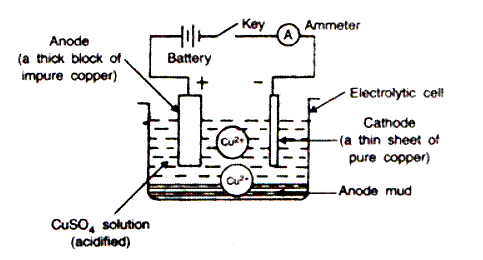
Aqueous copper sulphate is electrolysed between copper electrodes.
Answer
When Aqueous copper sulphate is electrolysed between copper electrodes then the ions formed are
$\ce{CuSO4 ⇌ Cu^{+2} + SO^{-2}_{4}}$
$\ce{H2O ⇌ H+ + OH-}$
Reaction at the Cathode : Copper and hydrogen ions both being positively charged migrate towards the cathode, Copper ions are discharged in preference to hydrogen ions, Copper gains two electrons from the cathode and changes into an atom of copper, The atoms of copper are deposited at the cathode, The atoms of copper are deposited at the cathode ad form a layer of pink copper metal which gradually turns reddish brown.
$\ce{Cu^{+2} + 2e- -> Cu}$
Reaction at the anode : Anode receives electrons from the ions and supplies them to the cathode, The atoms of copper from the anode changes into ions of copper which go into the solution and the electrons liberated in this change are taken up by the anode.
$\ce{Cu - 2e- -> Cu^{+2}}$
Thus for every copper ion discharged at the cathode, an ion of copper is formed at the anode which goes into the solution, Thus the atoms of copper are deposited at the cathode, the cathode becomes thicker and the atoms of
copper from the anode change into ions of copper, the anode becomes thinner.

Therefore there is transference of copper atoms from anode to cathode.
View full question & answer
Question 125 Marks
State your observation for the following electrolytic reaction
Aqueous copper sulphate is electrolysed between platinum electrodes.
Answer
When the electrolysis of copper sulphate(aqueous) is electrolysed between platinum electrodes the following reaction follows :
$\begin{aligned} & CuSO _4 \rightleftharpoons Cu ^{+2}+ SO _4^{2-} \\ & H _2 O \rightleftharpoons H ^{+}+ OH ^{-}\end{aligned}$
Reaction at cathode : Copper ions and hydrogen ions migrate towards the cathode, $Cu ^{+2}$ ions being lower in the electrochemical series are preferentially discharged to hydrogen ions to form neutral copper atoms at platinum cathode.
$
Cu ^{+2}+2^{e-} \longrightarrow Cu
$
Reaction at anode: Sulphate ions and hydroxyl ions migrate towards the anode, Hydroxyl ions are preferentially discharged to sulphate ions at anode, to form neutral particles of $OH ^{-}$, The electrically neutral hydroxyl reacts
among themselves to give water and oxygen.
$
\begin{aligned}
& OH ^{-}- e ^{-} \longrightarrow OH \\
& 4( OH ) \xrightarrow{-4 e ^{-}} 2 H _2 O + O _2
\end{aligned}
$
View full question & answer
Question 135 Marks
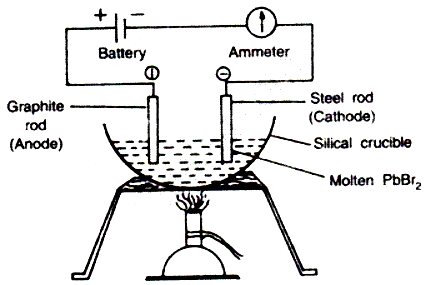
Explain electrolysis of lead bromide.
Answer
A steel rod is connected to the negative terminal and a graphite rod to positive terminal of a battery. A silica crucible is filled to about two thirds with solid lead bromide and the rods are dipped into into it and is then melted by heating it over a Bunsen burner.
Lead bromide contains :
$PbBr _2 \rightleftharpoons Pb ^{+2}+2 Br ^{-}$

Reaction at cathode : Lead ions are positively charged they get discharged at cathode. It receives two electrons from cathode and changes to atom of lead and get deposited at the cathode.
$Pb^{+2} + 2e^-→ Pb$​​​​​​​
Reaction at the anode : Bromide ions, being negatively charged discharge at anode. It loses its only elctron and becomes an atom of bromine. Thus the atoms of bromine combine in pairs to form molecules of bromine which escape as red vapours, at the anode.
$Br^-+ e^-→ Br$
$Br + Br → Br_2​​​​​​​$​​​​​​​
View full question & answer
Question 145 Marks
Write the difference between with examples:
A strong electrolyte and a weak electrolyte
Answer
Sr.No. Characteristics Strong electrolyte Weak electrolyte
1 Dissociation into ions in aqueous solution. Almost complete Partial and not much
2 Species present in solution. Almost only free ions Both ions and undissociated molecules.
3 Number of ions present in solution. Very large Only limited in numbers
4 Quantity of current conducted Large amounts, a bulb glows brightly Only small amounts, a bulb glows dimly
5 Examples HCl, NaOH, NaCl $CH_3COOH, NH_4OH.$
View full question & answer
[5 Mark Question Answer] - Chemistry STD 10 Questions - Vidyadip