MCQ
$STATEMENT-1$

An astronaut in an orbiting space station above the Earth experiences weightlessness. and

$STATEMENT-2$

An object moving around the Earth under the influence of Earth's gravitational force is in a state of 'free-fall'.

  • $STATEMENT-1$ is True, $STATEMENT-2$ is True; $STATEMENT-2$ is a correct explanation for $STATEMENT-1$
  • B
    $STATEMENT-1$ is True, $STATEMENT-2$ is True; $STATEMENT-2$ is $NOT$ a correct explanation for $STATEMENT-1$
  • C
    $STATEMENT -1$ is True, $STATEMENT-2$ is False
  • D
    $STATEMENT - 1$ is False, $STATEMENT-2$ is True
Answer

Correct option: A.
$STATEMENT-1$ is True, $STATEMENT-2$ is True; $STATEMENT-2$ is a correct explanation for $STATEMENT-1$
a

Need a full question paper?

Generate a complete, print-ready paper with questions like this in minutes — across 16+ boards, with answer keys.

Start Generating Free

Similar questions

The displacement of a particle varies with time according to the relation:

$\text{y}=\text{a}\sin\omega\text{t}+\text{b}\cos\omega\text{t}$

  1. The motion is oscillatory but not S.H.M.
  2. The motion is S.H.M. with amplitude a + b.
  3. The motion is S.H.M. with amplitude a2 + b2
  4. The motion is S.H.M. with amplitude $\sqrt{\text{a}^2+\text{b}^2}.$
What should be the velocity of a sound source moving towards a stationary observer so that apparent frequency is double the actual frequency (Velocity of sound is $v$)
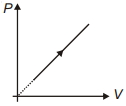
During the thermodynamic process shown in figure for an ideal gas
$A$ smooth sphere is moving on a horizontal surface with a velocity vector $(\,2\,\hat i + 2\,\hat j\,)$ $m/s$ immediately before it hit a vertical wall. The wall is parallel to vector $\hat j$ and coefficient of restitution between the sphere and the wall is $e = 1/2$ . The velocity of the sphere after it hits the wall is
Equation of travelling wave on a stretched string of linear density $5\,g/m$ is $y = 0.03\,sin\,(450\,t -9x)$ where distance and time are measured in $SI$ united. The tension in the string is ... $N$
A body starts to fall freely under gravity. The distances covered by it in first, second and third second are in ratio
Which of the following doesn't represent rotatory motion?
A satellite of mass $200 \,kg$ revolves around a planet of mass $5 \times 10^{30} \,kg$ in a circular orbit of radius $6.6 \times 10^6 \,m$. Binding energy of the satellite is .............. $J$
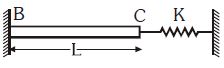
A rod $BC$ of negligible mass fixed at end $B$ and connected to a spring at its natural length having spring constant $K = 10^4\  N/m$ at end $C$, as shown in figure. For the rod $BC$ length $L = 4\ m$, area of cross-section $A = 4 × 10^{-4}\   m^2$, Young's modulus $Y = 10^{11} \ N/m^2$ and coefficient of linear expansion $\alpha = 2.2 × 10^{-4} K^{-1}.$ If the rod $BC$ is cooled from temperature $100^oC$  to $0^oC,$ then find the decrease in length of rod in centimeter.(closest to the integer)
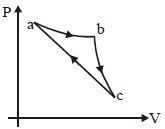
In the $P-V$ diagram shown, the gas does $5\, J$ of work in isothermal process $ab$ and $4\,J$ in adiabatic process $bc$.   .... $J$ will be the change in internal energy of the gas in straight path $c$ to $a$ ?