Statement $-1$ : Due to the motion of listener, the frequency of the sound waves (as received by listener) emitted by stationary source is affected.
Statement $-2$ : Due to the motion of source, wavelength of the sound waves (emitted by source) as received by stationary listener is affected.
Statement $-3$ : If receiver and source both are moving, the observed frequency must be different from the original frequency of source.
Treat motion of source or listener as always along a line joining them for all above cases.
Medium


Download our appand get started for free
Experience the future of education. Simply download our apps or reach out to us for more information. Let's shape the future of learning together!No signup needed.*
Similar Questions
- 1View SolutionAsufficiently long close organ pipe has a small hole at its bottom. Initially the pipe is empty. Water is poured into the pipe at a constant rate. The fundamental frequency of the air column in the pipe
- 2A motor car blowing a horn of frequency $124\,vib/sec$ moves with a velocity $72\, km/hr$ towards a tall wall. The frequency of the reflected sound heard by the driver will be .... $vib/sec$ (velocity of sound in air is $330\, m/s$)View Solution
- 3The equation of stationary wave along a stretched string is given by $y = 5\sin \frac{{\pi x}}{3}\cos 40\pi t$ where $x$ and $y$ are in centimetre and $t$ in second. The separation between two adjacent nodes is .... $cm$View Solution
- 4A source of sound is moving with constant velocity of $20\, m/s$ emitting a note of frequency $1000 \,Hz.$ The ratio of frequencies observed by a stationary observer while the source is approaching him and after it crosses him will beView Solution
(Speed of sound $v = 340\, m/s$)
- 5Two tuning forks $A$ and $B$ give $4$ beats per second. The frequency of $A$ is $256 Hz$. On loading $B$ slightly, we get $5$ beats in $2$ seconds. The frequency of $B$ after loading is .... $Hz$View Solution
- 6Two sound waves with wavelengths $5.0\,\, m$ and $5 .5\,\, m$ respectively, each propagate in a gas with velocity $330\,\, m/s.$ We expect the following number of beats per second.View Solution
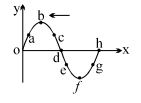
- 7The figure represents the instantaneous picture of a transverse harmonic wave traveling along the negative $x$-axis. Choose the correct alternative $(s)$ related to the movement of the nine points shown in the figure. The points moving downwards is/areView Solution
- 8A taut string at both ends vibrates in its $n^{th}$ overtone. The distance between adjacent Node and Antinode is found to be $'d'$. If the length of the string is $L,$ thenView Solution
- 9The speed of sound in a gas, in which two waves of wavelength $1.0\,\, m$ and $1.02\,\, m$ produce $6$ beats per second, is approximately .... $m/s$View Solution
- 10A horizontal stretched string, fixed at two ends, is vibrating in its fifth harmonic according to the equation, $y(x$, $t )=(0.01 \ m ) \sin \left[\left(62.8 \ m ^{-1}\right) x \right] \cos \left[\left(628 s ^{-1}\right) t \right]$. Assuming $\pi=3.14$, the correct statement$(s)$ is (are) :View Solution
$(A)$ The number of nodes is $5$ .
$(B)$ The length of the string is $0.25 \ m$.
$(C)$ The maximum displacement of the midpoint of the string its equilibrium position is $0.01 \ m$.
$(D)$ The fundamental frequency is $100 \ Hz$.