MCQ
Stationary waves
  • A
    Transport energy
  • B
    Does not transport energy
  • C
    Have nodes and antinodes
  • Both $(b)$ and $(c)$

Answer

Correct option: D.
Both $(b)$ and $(c)$
d
Stationary waves do not transport energy. The energy gets cancelled out due to superposing of the two waves in opposite directions. These stationary waves have points which equals to zero at all time. These points are called nodes. Also there are points at which the amplitude gets to maximum or minimum at all time. These points are called antinodes.

Need a full question paper?

Generate a complete, print-ready paper with questions like this in minutes — across 16+ boards, with answer keys.

Start Generating Free

Similar questions

Two waves are simultaneously passing through a string and their equations are :

${y}_{1}={A}_{1} \sin {k}({x}-v {t}), {y}_{2}={A}_{2} \sin {k}\left({x}-{vt}+{x}_{0}\right) .$ Given amplitudes ${A}_{1}=12\, {mm}$ and ${A}_{2}=5\, {mm}$ ${x}_{0}=3.5\, {cm}$ and wave number ${k}=6.28\, {cm}^{-1}$. The amplitude of resulting wave will be $......\,{mm}$
$Joule-second$ is the unit of
A cubical box of side $a$ sitting on a rough table-top is pushed horizontally with a gradually increasing force until the box moves. If the force is applied at a height from the table top which is greater than a critical height $H$, the box topples first. If it is applied at a height less than $H$, the box starts sliding first. Then, the coefficient of friction between the box and the table top is
Which of the following formulae is wrong
The length of an elastic string is a metre when the longitudinal tension is $4\, N$ and $b$ metre when the longitudinal tension is $5\, N$. The length of the string in metre when the longitudinal tension is $9\, N$ is
The angle of contact at the interface of water-glass is 0°, Ethylalcohol-glass is 0°, Mercury-glass is 140° and Methyliodideglass is 30°. A glass capillary is put in a trough containing one of these four liquids. It is observed that the meniscus is convex. The liquid in the trough is:
A steel ball and a rubber ball of equal weight are dropped from the same height on a firm surface then:
Where will be the centre of mass on combining two masses $m$ and $M$ $(M>m)$
Two ions have equal masses but one is singly-ionised and the other is doubly-ionised. They are projected from the same place in a uniform magnetic field with the same velocity perpendicular to the field.
  1. Both ions will move along circles of equal radii.
  2. The circle described by the singly-ionised charge will have a radius that is. double that of the other circle.
  3. The two circles do not touch each other.
  4. The two circles touch each other.
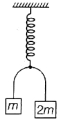
In the figure, blocks $A$ and $B$ of masses $2m$ and $m$ are connected with a string and system is hanged vertically with the help of a spring. Spring has negligible mass. Find out magnitude of acceleration of masses $2m$ and $m$ just after the instant when the string is cut