Question
Study the diagram given alongside and answer the questions that follow:
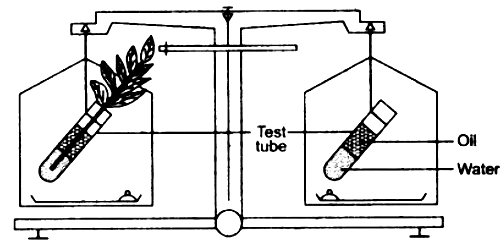
(i) Explain the physiological process of being study.
(ii) What will be the observations in the two test-tubes after about 2-3 days?
(iii) Give a reason for your answer in (ii) above.
(iv) Why is the surface of water covered with oil?
(v) State the purpose of setting up test tube B.
Answer

(i) Transpiration: Loss of water as water vapour from aerial parts of the plant.
(ii) After 2-3 days the level of waterfalls in test-tube A while it remains constant in test tube B.
(iii) The fall in the level of water in test-tube A due to the absorption of water by the roots.
(iv) The oil has been put in each test-tube to prevent the loss of water by evaporation.
(v) The purpose of setting up test-tube B is to show that in the absence of a plant, there is no change in the level of water.

Need a full question paper?

Generate a complete, print-ready paper with questions like this in minutes — across 16+ boards, with answer keys.

Start Generating Free

Similar questions

Given below is the diagram showing external view of human heart. Read the information and fill in the blanks:
The human heart, a vital organ, pumps blood throughout the body. It is conical in shape, encased in the pericardium. Made of cardiac muscle tissue, it contracts rhythmically to circulate blood. Valves inside regulate blood flow, ensuring unidirectional movement.
The heart is a muscular organ located slightly towards the (i) __________ side of the chest cavity. It is divided into four chambers: two upper chambers and two lower chambers called as $\qquad$ (ii) __________ . The right atrium receives deoxygenated blood from the body through the (iii) __________ The left atrium receives axygenated blood from the lungs through the (iv) __________ . Blood is pumped from the right ventricle to the lungs through the (v) __________ -

Image
Give Reasons for the following:
Transplanting of seedlings to a flowerbed in the evening is better than doing so in the morning.
What is the difference between ‘flaccid’ and ‘turgid’? Give one example of flaccid condition in plants.
Differentiate between the followig
Afferent arteriole and Efferent arteriole
Complete the following table:
 
Components Origin Function Approx. No. $(mm^3)$ Life span
RBCs        
WBCs        
Platelets        
Draw the diagram of the Position of valves in the human heart.
Draw a neat and well-labeled diagram of the apparatus you would set up to show that oxygen is given out during photosynthesis.
The thyroid gland is called as nature gland.
A potted plant was taken in order to prove a factor necessary for photosynthesis. The potted plant was kept in the dark for 24 hours. One of the leaves was covered with black paper in the centre. The potted plant was then placed in sunlight for a few hours.

Draw a neat diagram of a chloroplast and label its parts.

List four common diseases prevalent in India. What measures have been taken to eradicate them?