Question
Study the diagram given below and answer the questions that follow:
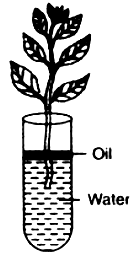
(i) Name the process being studied in the above experiment.
(ii) Explain the process mentioned in (i) above.
(iii) Why is oil placed over water?
Answer

(i) Transpiration
(ii) It is the process by which plants lose water as vapours through the aerial parts.
(iii) To prevent evaporation of water from the test tube.
(iv)

  1. In bright sunlight, the level of water decreases quickly.
  2. In humid conditions level of water does not decrease for a long time.
  3. On a windy day, the level of water decreases very quickly.

(v)

  1. The number of stomata may be reduced.
  2. leaves may become narrow.
  3. A thick layer of cuticle on the leaf surface helps to decrease transpiration

Need a full question paper?

Generate a complete, print-ready paper with questions like this in minutes — across 16+ boards, with answer keys.

Start Generating Free

Similar questions

What is the difference between ‘flaccid’ and ‘turgid’? Give one example of flaccid condition in plants.
Explain the Term: Glomerulus
What is the cause of haemophilia and colour blindness?
Describe the impact of air pollution?
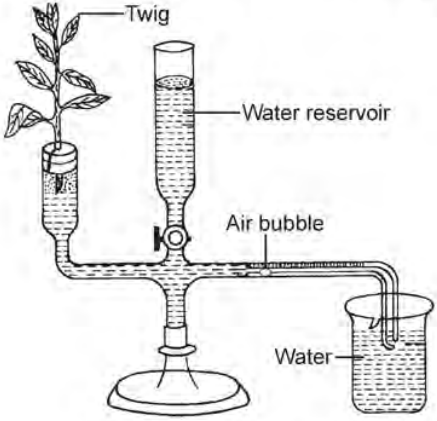
Given below is an apparatus used to study a particular process in plants.
Study the same and answer the questions that follow :
(i) Name the apparatus.
(ii) Mention one limitation of this apparatus.
(iii) Which phenomenon is studied with the help of this apparatus?

Image
What is lenticular transpiration? Mention one major difference between lenticular transpiration and stomatal transpiration.
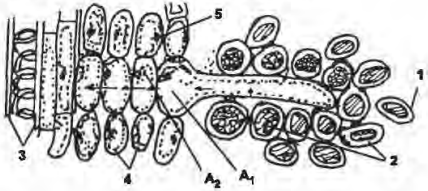
The figure given below is a diagramatic representation of a part of the cross section of the root in the root hair zone. Study the same and answer the questions that follow:
Image
(i) Name the parts indicated by guidelines 1 to 5 .
(ii) Name the process responsible for the passage of water molecules from soil into $A_1$ and then into $A_2$.
(iii) How is this pressure set up?
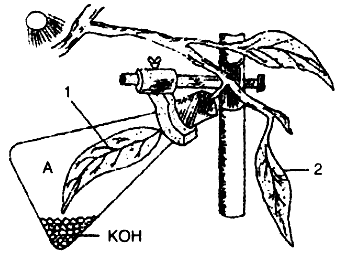
The figure given below represents an experiment to demonstrate a particular aspect of photosynthesis. The alphabet ‘A’ represents a certain condition inside the flask.

(i) What is the aim of the experiment?
(ii) Identify the special condition inside the flask.
(iii) Name an alternative chemical that can be used instead of $KOH.$
(iv) In what manner do the leaves 1 and 2 differ at the end of the starch test?
What are the common sources of oil spills, and how do they affect sea life.
Sketch and label the structure of malphigian body.