Question
Study the double bar graphs given below and answer the following questions:
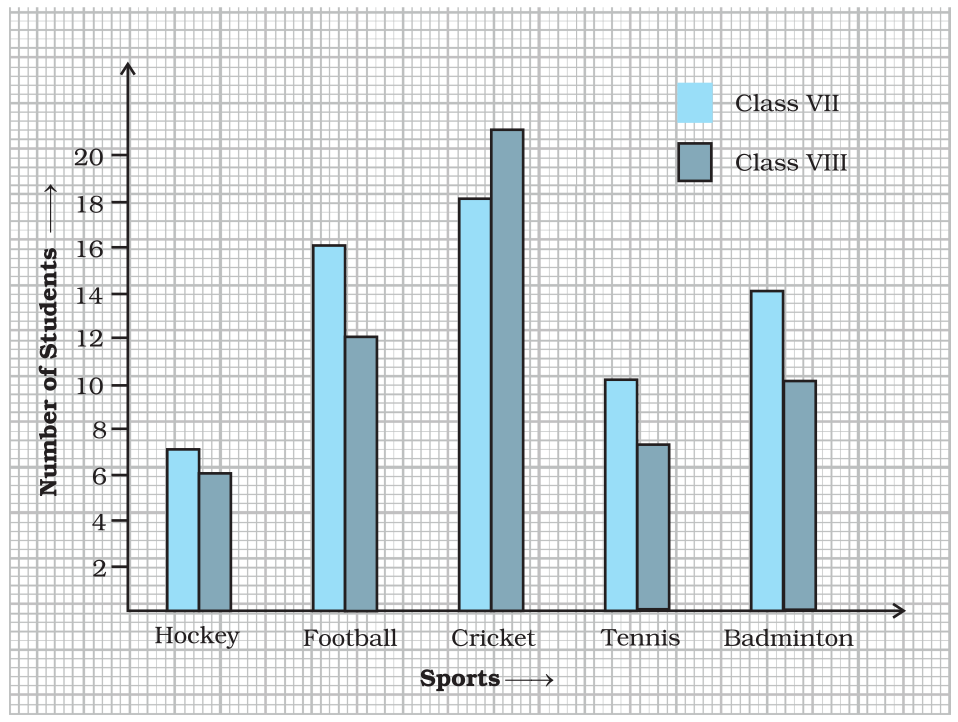
$a.$ Which sport is liked the most by Class $VIII$ students?
$b.$ How many students of Class $VII$ like Hockey and Tennis in all?
$c.$ How many students are there in Class $VII$?
$d.$ For which sport is the number of students of Class $VII$ less than that of Class $VIII?$
$e.$ For how many sports students of Class $VIII$ are less than Class $VII?$
$f.$ Find the ratio of students who like Badminton in Class $VII$ to students who like Tennis in Class $VIII.$
Answer

$a.$ By observing the graph, we can say that the height of the bar corresponding to cricket for class $VIII$ student is largest. Hence, cricket is liked the most by class $VIII$ students.
$b.$ Height of bar corresponding to hockey and tennis for class $VII$ are $ 7$ and $10$ respectively. So, total students of class $VII$ who like hockey and tennis $= 7 + 10 = 17$
$c.$ Total number of students in class $VII =$ Sum of heights of all the bars for class $VII$
$= 7 + 16 + 18 + 10 + 14 = 65$
$d.$ The sport for which number of students of class $VII$ is less than that of class $VIII$ will be that for which height of bar is less.
By observing the graph in case of cricket height of bar is less for class $VII$ as compared to class $VIII.$
$e.$ We can clearly see from the double bar graph for Hockey, Football, Tennis and Badminton, the number of students are less for class $VIII$ as compared to class $VII.$
$f.$ Number of students who like badminton in class $VII = 14$ and number of students who like tennis in class $VIII = 7$
$\therefore$ Required ratio $= 14 : 7 = 2 : 1$

Need a full question paper?

Generate a complete, print-ready paper with questions like this in minutes — across 16+ boards, with answer keys.

Start Generating Free

Similar questions

$8(2x - 5) - 6(3x - 7) = 1$
State whether the answer is greater than $1$ or less than $1$. Put a $\checkmark$ mark in appropriate box.
Questions
Greater than $1$
Less than $1$
$\frac{2}{3}\div\frac{1}{2}$    
$\frac{2}{3}\div\frac{2}{1}$    
$6\div\frac{1}{4}$    
$\frac{1}{5}\div\frac{1}{2}$    
$4\frac{1}{3}\div3\frac{1}{2}$    
$\frac{2}{3}\times8\frac{1}{2}$    
Take the data giving the minimum and the maximum temperature of various cities given in Table. Plot a double bar graph using the data and answer the question: Name the city which has the least difference between its minimum and the maximum temperature.
Temperatures of Cities as on $20.6.2006$
City Max. Min.
Ahmedabad $38^{\circ} \mathrm{C}$ $29^{\circ} \mathrm{C}$
Amritsar $37^{\circ} \mathrm{C}$ $26^{\circ} \mathrm{C}$
Banglore $28^{\circ} \mathrm{C}$ $21^{\circ} \mathrm{C}$
Chennai $36^{\circ} \mathrm{C}$ $27^{\circ} \mathrm{C}$
Delhi $38^{\circ} \mathrm{C}$ $28^{\circ} \mathrm{C}$
Jaipur $39^{\circ} \mathrm{C}$ $28^{\circ} \mathrm{C}$
Jammu $41^{\circ} \mathrm{C}$ $26^{\circ} \mathrm{C}$
Mumbai $32^{\circ} \mathrm{C}$ $27^{\circ} \mathrm{C}$
The side $BC$ of $\triangle \text{ABC}$ is produced to a point $D$. The bisector of $\angle \text{A}$ meets side $BC$ in $L$. If $\angle \text{ABC}= 30^\circ$ and $\angle \text{ACD}=115^\circ,$ find $\angle \text{ALC}$
Take any three non-collinear points $A, B, C$ and draw $\angle\text{ABC}.$ Through each vertex of the triangle, draw a line parallel to the opposite side.
In a charity show ₹ 6496 were collected by selling some tickets. If the price of each ticket wis ₹$ 50 \frac{3}{4}$ how many tickets were sold?
If  ₹250 is to be divided amongst Ravi, Raju and Roy, so that Ravi gets two parts, Raju three parts and Roy five parts. How much money will each get? What will it be in percentages?
Calculate the mean and median for the following data:
Marks:1011121314161920
Number of students:35452321
Using empirical formula, find its mode.
Arrange the following rational numbers in ascending order: $\frac{-3}{10},\frac{7}{-15},\frac{-11}{20},\frac{17}{-30}$
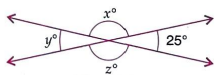
In Fig. find the values of x, y and z.
Image