Question
Study the graph given below and answer the questions that follow:
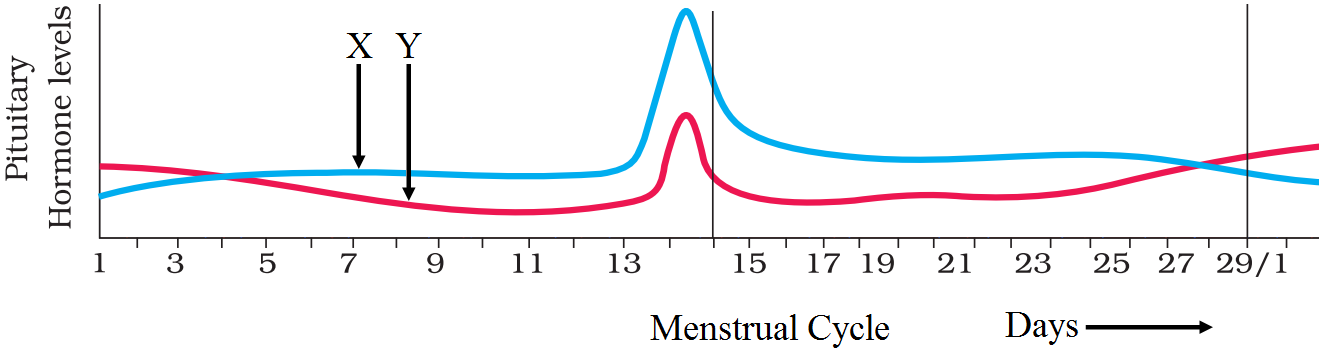
Identify the ovarian phases during a menstrual cycle:

  1. 5th day to 12th day of the cycle.
  2. 14th day of the cycle.
  3. 16th day to 25th day of the cycle.

Answer

  1. 5th day to 12th day of the cycle: Follicular phase (Proliferative phase).
  2. 14th day of the cycle: Ovulatory phase (release of ovum) followed by luteal phase.
  3. 16th day to 25th day of the cycle: Luteal phase.
  4. FSH is secreted by the anterior pituitary which stimulates the ovarian follicle to secrete estrogen, which in turn stimulates the proliferation of the endometrium of the uterine wall.

Need a full question paper?

Generate a complete, print-ready paper with questions like this in minutes — across 16+ boards, with answer keys.

Start Generating Free

Similar questions

Answer the following questions:
State and explain the law of dominance as proposed by Mendel.
Fill in the blanks,
Species A
Species B
Type of Interaction
Example
+
+
+
-
+
_____
_____
_____
Commensalism
_____
_____
_____
What are the various advantages of using genetically modified plants to increase the overall yield of the crop?
What do you understand by micro proagation? Write the methods involved with suitable diagrams.###(a) What are the plants raised through the micropropagation termed as somaclones?
(b) Mention two advantages of this technique.
B.
(i) Name the two types of desirable approaches to conserve biodiversity? Explain with examples bringing out the difference between the two types.
(ii) State the features of a stable biological community?
Write about multiple allelism with suitable example.###Describe multiple albinism showing the inheritance pattern of blood groups in human beings.
What essential features must be present in a cloning vector?
(i) Define net primary productivity.
(ii) Explain with diagram that the pyramid of energy is always upright.
A woman with blood group “A” marries a man with blood group “O”. Discuss the possibilities of the inheritance of the blood groups in the following starting with “yes” or “no” for each:
  1. They produce children with blood group “A” only.
  2. They produce children some with “O” blood group and some with “A” blood group.
Which of the following ecosystems will be more productive in terms of primary productivity? Justify your answer.
A young forest, a natural old forest, a shallow polluted lake, alpine meadow.