Question
Study the table related to colour change with indicators and answer the questions that follow.
SolutionsColour change with phenolphthalein indicatorColour change with methyl orange indicator
PPinkYellow
QColourlessOrange
RColourlessRed

(i) Name the solution which is acidic.
(ii) Arrange the given solutions in increasing order of their $pH$ value.
(iii) What is the name of solution $P$ and $Q$ ?
or
(iv) When solution $P$ added to the china rose indicator, what is the colour of solution $P$ ?
Answer

COMING SOON

Need a full question paper?

Generate a complete, print-ready paper with questions like this in minutes — across 16+ boards, with answer keys.

Start Generating Free

Similar questions

When a more reactive element displaces a less reactive element from its compound, it is called a displacement reaction. The reaction is of two types. Single displacement reaction and double displacement reaction.
Iron being more reactive than copper displaces copper from an aqueous solution of copper sulphate. This is an example of a single displacement reaction.
On adding silver nitrate solution to sodium bromide, a yellow ppt of silver bromide and solution of sodium nitrate is formed. This is an example of a double displacement reaction.
i. When dil. sulphuric acid is added to pieces of iron sulphide, hydrogen sulphide gas is produced and soluble ferrous sulphate is formed. Which chemical reaction is involved in this process?
ii. Mention reaction which is used for the preparation of oxygen gas in the laboratory.
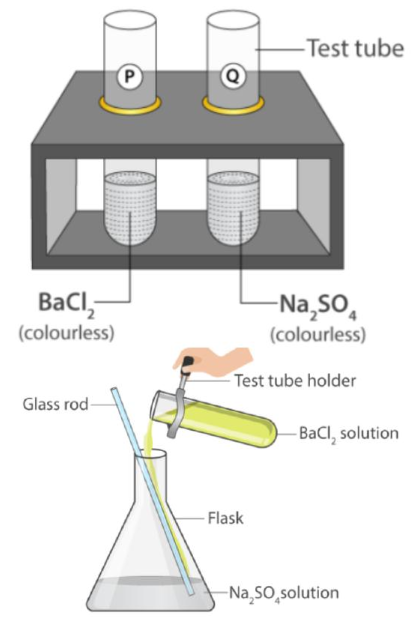
iii. What are the products formed in the double displacement reaction discussed below?
Image
OR
Which elements displace aluminum from its salt?
As neutral atom carbon has electronic configuration $\underset{2,}{K} \underset{4}{L}$. To gain inert gas configuration carbon can either donate 4 valence electrons (helium gas configuration) or gain 4 electrons (neon gas configuration), but it cannot do so. To acquire inert gas configuration carbon can only share its 4 valence electrons with other atoms forming covalent bonds. A covalent bond can be defined as a chemical bond formed between two atoms by mutual sharing of valence electrons so that each atom acquires the stable electronic configuration of the nearest noble gas. The concept of covalent bonds was given by Langmuir and Lewis to explain bonding in non-ionic compounds. The covalent bonds are of three types. If each atom contributes one electron, the covalent bond formed is called a single covalent bond and is represented by a single line (-) and if each atom contributes two electrons, the covalent bond formed is called a double bond and is represented by a double line ( $=$ ) and if each atom contributes three electrons, the covalent bond formed is called a triple bond and is represented by a triple line ( $\equiv$ ).
i. Define Catenation.
ii. What are name given for carbon atoms linked with single, double, triple bond?
iii. Define Valency and write two examples of molecules containing double bond.
OR
Draw the electron dot structure for $\mathrm{Cl}_{2}$ molecule.
The equation below shows a chemical reaction.
X is a non-metal, but Y is a metal. 
$H ^{(+)} X + YOH ^{(-)} \rightarrow YX + HOH YOH \rightarrow YX + HOH$
4. What is the chemical nature of YX?
Write your answer in terms of acid/base/salt.
5.Builders use plaster of Paris to make the surface layer of the inner walls of a building.
Which property of plaster of Paris powder makes it a suitable building material?
  A. It is lightweight.
  B. It is white in colour.
  C. It is found readily in nature.
  D. It gets hard when mixed with water.
Some reaction of metal with some compounds are given in the table:
MetalIron (II) SulphateCopper (II) SulphateZinc SulphateSilver Nitrate
ANo reactionDisplacement………………………………
BDisplacement………………No reaction………………
CNo reactionNo reactionNo reactionDisplacement
DNo reactionNo reactionNo reactionNo reaction
(i) Name the most and least active metal.
(ii) Arrange the metals $A, B, C$ and $D$ in order of increasing reactivity.
or
(ii) Container of which metal can be used to store both zinc sulphate solution and silver nitrate solution?
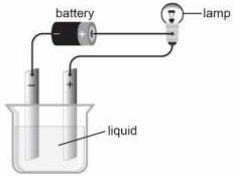
Mike placed an electric circuit separately in a dilute acid and a dilute base.

Image
Mike observed whether the lamp in the circuit glowed or not for each liquid.
8. Which property of acids and bases was Mike trying to test through his experiment?
9. Will the lamp glow if the circuit is placed in distilled water? 
Explain your answer.
10. Acid + Metal →Salt + X
What is X in the equation?

Sample of four metals $P , Q , R$ and $S$ were taken and added to the following solution one by one. The results obtained have been tabulated as follows.
Metal$FeSO_4$$CuSO_4$$ZnSO_4$$AgNO_3$
PNo reactionDisplacement...........................................
QDisplacementNo reactionDisplacement
RNo reactionNo reactionNo reaction
SNo reactionNo reactionNo reactionNo reaction
(i) Which is the most reactive metal ?
(ii) What would you observe if $Q$ is added to a solution of $CuSO _4$. Also, what is the colour change when $Q$ is added to $FeSO _4$.
or
What do you mean by displacement reaction?
Salts play a very important role in our daily life. Sodium chloride which is known as common salt is used almost in every kitchen. Baking soda is also a salt used in faster cooking as well as in baking industry. The family of salts is classified on the basis of cations and anions present in them.
i. Identify the acid and base from which Sodium chloride is formed.
ii. Find the cation and the anion present in Calcium sulphate.
iii. "Sodium chloride and washing soda both belong to the same family of salts." Justify this statement.
OR
Define the term pH scale. Name the salt obtained by the reaction of Potassium hydroxide and Sulphuric acid and give the pH value of its aqueous solution.
A hydrocarbon (P) has the molecular formula $\mathrm{C}_{10} \mathrm{H}_{22}$. A hydrocarbon (Q) has two carbon atoms less than (P) and belong to the same homologous series. A hydrocarbon (R) has two carbon atoms more than (P) and belong to the same homologous series.
i. What is the molecular formula of (Q)? Also write its IUPAC name.
ii. To which homologous series do the compound $(\mathrm{P}),(\mathrm{Q})$ and $(\mathrm{R})$ belong?
iii. State two characteristics of homologous series?
OR
What can you say about properties of compounds (P), (Q) and (R)
Redox reactions are those reactions in which oxidation and reduction occur simultaneously. A redox reaction is made up of two half reactions. In the first half reaction, oxidation takes place and in second half reaction, reduction occurs. Oxidation is a process in which a substance loses electrons and in reduction, a substance gains electrons. The substance which gains electrons is reduced and acts as an oxidising agent. On the other hand, a substance which loses electrons is oxidised and acts as a reducing agent.
i. Illustrate where oxidation and reduction occurs together with an example?
ii. What do you mean by oxidising agent and reducing agent?
iii. For the given reaction, identify the oxidation and reduction parts.
$ZnO + CO \longrightarrow Zn + CO _2$
OR
In the following reaction, which substance is reduced?
$\mathrm{PbS}+4 \mathrm{H}_{2} \mathrm{O}_{2} \longrightarrow \mathrm{PbSO}_{4}+4 \mathrm{H}_{2} \mathrm{O}$