Question
As neutral atom carbon has electronic configuration $\underset{2,}{K} \underset{4}{L}$. To gain inert gas configuration carbon can either donate 4 valence electrons (helium gas configuration) or gain 4 electrons (neon gas configuration), but it cannot do so. To acquire inert gas configuration carbon can only share its 4 valence electrons with other atoms forming covalent bonds. A covalent bond can be defined as a chemical bond formed between two atoms by mutual sharing of valence electrons so that each atom acquires the stable electronic configuration of the nearest noble gas. The concept of covalent bonds was given by Langmuir and Lewis to explain bonding in non-ionic compounds. The covalent bonds are of three types. If each atom contributes one electron, the covalent bond formed is called a single covalent bond and is represented by a single line (-) and if each atom contributes two electrons, the covalent bond formed is called a double bond and is represented by a double line ( $=$ ) and if each atom contributes three electrons, the covalent bond formed is called a triple bond and is represented by a triple line ( $\equiv$ ).
i. Define Catenation.
ii. What are name given for carbon atoms linked with single, double, triple bond?
iii. Define Valency and write two examples of molecules containing double bond.
OR
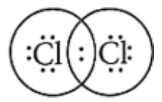
Draw the electron dot structure for $\mathrm{Cl}_{2}$ molecule.

Answer

i. Catenation can be defined as the self-linking property of atoms of an element through a covalent bond so as to form large chain, rings, branched chain of varying length.
ii. Alkanes- carbon atoms connected by single bond.Alkenes- carbon atoms connected by double bond.
Alkyne- Carbon atoms connected by triple bond.
iii. The combining power of an element with other atom to form chemical bond is called valency.Examples of molecules having double bond are
Carbon dioxide( $\mathrm{CO}_{2}$ ),Sulphur dioxide( $\mathrm{SO}_{2}$ )
$\mathrm{O}=\mathrm{C}=\mathrm{O}, \mathrm{O}=\mathrm{S}=\mathrm{O}$
Image
OR
In chlorine molecule, both chlorine atoms contribute one electron and thus share single electron pair to form single covalent bond. As shared pair is shared by both atoms, they acquire inert gas configuration of argon atom in valence shell.
Image

Need a full question paper?

Generate a complete, print-ready paper with questions like this in minutes — across 16+ boards, with answer keys.

Start Generating Free

Similar questions

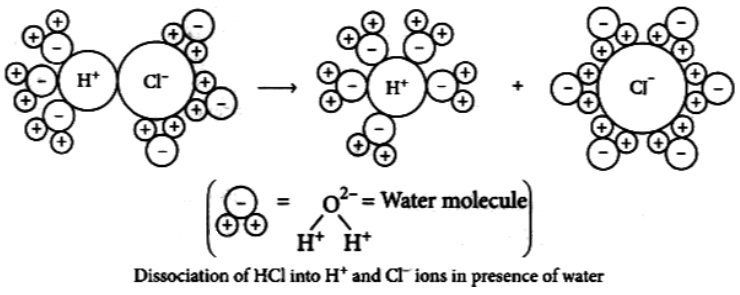
The acidic behaviour of acids is due to the presence of hydrogen ( $H ^{+}$) ions in them. They produce hydrogen ions in the presence of water. Water is a polar solvent and this property of water helps in weakening the bond between the ions and makes them soluble.
Hence, acids and bases produce ions in aqueous solutions. It may be noted that a dry HCl gas or a solution of hydrogen chloride in organic, non-polar solvents like toluene or benzene do not show acidic properties. This is because hydrogen chloride does not undergo ionization in toluene.
The reason why HCl splits into $H ^{+}$and $Cl ^{-}$ions in presence of water lies in the fact that water molecules, being polar, pull the $H ^{+}$and $Cl ^{-}$ions apart and thus, the bond in HCl is broken.
Image
i. Which acids are present in bee stings?
ii. If the pH of a solution is 8 , then find its $\left[ H ^{+}\right]$ion.
iii. If you are given water, Hydrochloric acid, and Acetic acid, then mention increasing the order of acid strength.
OR
If you are provided $H _3 PO _4, C _2 H _5 OH , H _2 CO _3$, and $CH _3 COOH$, then which compound does not give $H ^{+}$ions in an aqueous solution?
Some reaction of metal with some compounds are given in the table:
MetalIron (II) SulphateCopper (II) SulphateZinc SulphateSilver Nitrate
ANo reactionDisplacement………………………………
BDisplacement………………No reaction………………
CNo reactionNo reactionNo reactionDisplacement
DNo reactionNo reactionNo reactionNo reaction
(i) Name the most and least active metal.
(ii) Arrange the metals $A, B, C$ and $D$ in order of increasing reactivity.
or
(ii) Container of which metal can be used to store both zinc sulphate solution and silver nitrate solution?
Read the following and answer any four questions from (i) to (v).ln decomposition reactions, a single reactant breaks down to form two or more products. Decomposition reaction is opposite to combination reaction. Thermal decomposition reactions use the energy in form of heat for decomposition of reactants. Electrolytic decomposition reactions involve the use of electrical energy for the decomposition of reactant molecules. Photolysis or photochemical decomposition involves the use of light energy for the purpose of decomposition.
  1. Which reactions are a decomposition reaction?
  2. Amino acid is fanned by the decomposition of which component of our diet?
  3. Silver chloride on exposure to sunlight for a long duration turns gray due to which formation?
    OR
    A) What type of chemical reaction takes place when electricity is passed through water?
    B) Which involves the use of light energy for the purpose of decomposition?
Read the following and answer any three questions from (i) to (iv).

The compounds which have the same molecular formula but differ from each other in physical or chemical properties are called isomers and the phenomenon is called isomerism. When the isomerism is due to difference in the arrangement of atoms within the molecule, without any reference to space, the phenomenon is called structural isomerism. ln other words, structural isomers are compounds that have the same molecular formula but different structural formulas, i.e., they are different in the order in which different atoms are linked. In these compounds, carbon atoms can be linked together in the form of straight chains, branched chains or even rings.

i. Which sets of compounds have same molecular formula?

ii. How many an organic compound is their, In order to form branching?

iii. what is an isomers?
             
           OR

    A)Name three different types of chain?

    B)The number of isomers of pentane are?


Baking soda is used in small amounts for making bread and cakes. It helps to make these soft and spongy. An aqueous solution of baking soda turns red litmus blue. It is also used in soda acid fire extinguisher. Use this information to answer the following questions.
(i) Write the equation for the reaction between baking soda and acid.
(ii) How does it help in extinguishing fire?
(iii) What is the reaction involved when it is heated?
or
(iv) Is the $pH$ value of baking soda solution lower than or higher than 7 ?
Read the following and answer any four questions from (i) to (v).Reactions, in which one element takes place of another element in a compound, are known as displacement reactions. ln general, more reactive elements displaces a less reactive element from its compound. ln all single displacement reactions, only one element displaces another element from its compound. The single displacement reactions are, however, written as just displacement reactions. The displacement reaction between iron (III) oxide and powdered aluminum produces so much heat that iron metal obtained is in molten form.
  1. which of the metals from its salt solution displaces copper ?
  2. When zinc reacts with dilute sulfuric acid, which gas is evolved ?
  3. When dry hydrogen is passed over a heated oxide of metal X using the apparatus , what substance is obtained and it could be in which form ?
          OR
    a) Which reactions are called displacement reaction?
    b) When dilute hydrochloric acid is added to granulated zinc placed in a test tube, what result will be there after observation ?
Read the following and answer any three questions from (i) to (iv).

Sodium chloride obtained from sea water or from lakes contains many impurities such as sulphates of sodium and magnesium, along with chlorides of calcium and magnesium. The chlorides of calcium and magnesium are particularly undesirable on account of their deliquescent nature.

For its purification, common salt is dissolved in minimum quantity of water to get a saturated solution from which insoluble impurities are filtered off. Then hydrogen chloride gas is passed through the saturated solution and the crystals of pure NaCl separate out. The soluble impurities remain in the mother liquor. The crystals are filtered, washed and dried.

  1. From were Sodium chloride is obtained?

  2. What is the nature of a common salt?

  3. Which compounds are alkaline in aqueous medium with example?
         
                      OR
    A) What happens to hydrogen cholride in water?
    B) Hydrogen chloride gas is soluble in?