Question
Study the table related to colour change with indicators and answer the questions that follow.
SolutionsColour change with phenolphthalein indicatorColour change with methyl orange indicator
PPinkYellow
QColourlessOrange
RColourlessRed

(i) Name the solution which is acidic.
(ii) Arrange the given solutions in increasing order of their $pH$ value.
(iii) What is the name of solution $P$ and $Q$ ?
or
(iv) When solution $P$ added to the china rose indicator, what is the colour of solution $P$ ?
Answer

COMING SOON

Need a full question paper?

Generate a complete, print-ready paper with questions like this in minutes — across 16+ boards, with answer keys.

Start Generating Free

Similar questions

Corrosion is the phenomenon of deterioration of surface of metal in presence of air and moisture. It is a natural process and in the presence of a moist atmosphere, chemically active metals get corroded. This is oxidation reaction. Rusting is the process where iron corrodes due to exposure to the atmosphere. The main circumstance of corrosion occurs with iron because it is a structural material in construction, bridges, buildings, rail transport, ships, etc. Aluminium is also an important structural metal, but even aluminium undergoes oxidation reactions. However, aluminium doesn't corrode or oxidize as rapidly as its reactivity suggests. An alloy of aluminium or any other metal like magnesium can make aluminium stronger and harder.
Copper $( Cu )$ corrodes and forms a basic green carbonate and lead corrodes to form a white lead oxide or carbonate.
(i) What is rusting?
(ii) Which two metals do not corrode easily?
(iii) List two properties of alloys.
or
(iv) What is the effect of corrosion on electrical conductivity?
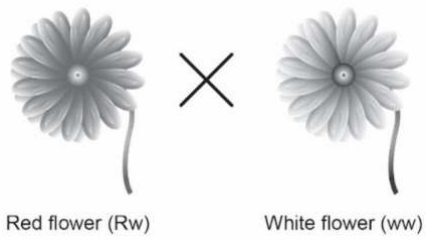
A plant with red lower (Rw) is cross bred with a plant with white lower (ww).
There are two variations of the gene controlling the colour of the lower.
The gene for red lower (R) is dominant over that for white lower (w).

Image

The Punnett square shows the result of the cross.

w

w

R

Rw

Rw

w

ww

ww

1. What percentage of the plants is likely to produce white lowers?
A. 25%
B. 50%
C. 75%
D. 100%
2. A red lower plant (RR) was cross bred with a white lower plant (ww).
What will be the colour of the lower of the next generation plants?
3. What would have caused the variation in the gene for lower colour?
A. Mutation
B. Pollination
C. Speciation
D. Adaption

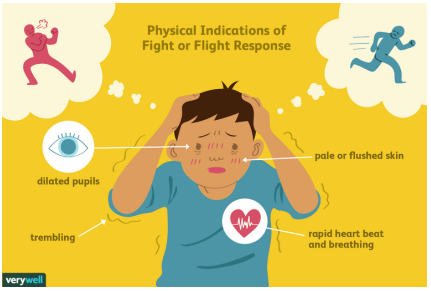
Adrenaline is secreted directly into the blood and carried to different parts of the body. The target organs or the specific tissues on which it acts include the heart. As a result, the heart beats faster, resulting in the supply of more oxygen to our muscles. The blood to the digestive system and skin is reduced due to contraction of muscles around small arteries in these organs. This diverts the blood to our skeletal muscles. The breathing rate also increases because of the contractions of the diaphragm and the rib muscles. All these responses together enable the animal body to be ready to deal with the situation. Such animal hormones are part of the endocrine
system which constitutes the second way of control and coordination in our body.

Image

(a) How does chemical coordination take place in animals ?
(b) Which hormone is called an emergency hormone?
(c) Where are the adrenal gland present in our body?

OR

How does our body respond when adrenaline is secreted into the blood ?
Read the following and answer any three questions from (i) to (iv).The rate of flow of charge is called electric current. The SJ unit of electric current is Ampere (A). The direction of flow of current is always opposite to the direction of flow of electrons in the current. The electric potential is defined as the amount of work done in bringing a unit positive test charge from infinity to a point in the electric field. The amount of work done in bringing a unit positive test charge from one point to another point in an electric field is defined as potential difference.
$\text{V}_{\text{AB}}=\text{V}_{\text{B}}-\text{V}_\text{A}=\frac{\text{W}_{\text{BA}}}{\text{q}}$
The SJ unit of potential and potential difference is volt.
  1. The 2C of charge is flowing through a conductor in 100ms, the current in the circuit will?
     
  2. Define electric current? what is the SJ unit of electric current.
     
  3. The potential difference between the two terminals of battery, if 100 joules of work is required to transfer 20 coulombs of charge from one terminal of the battery to other will?
OR
  1. a) Then number of electrons flowing per second in a conductor if I A current is passing through it?
    b) The voltage can be written as.
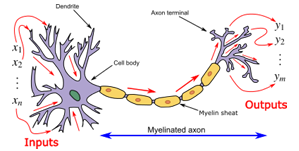
In animals, control and coordination are provided by nervous and muscular tissues. Touching a hot object is an urgent and dangerous situation for us. We need to detect it and respond to it. How do we detect that we are touching a hot object? All information from our environment is detected by the specialised tips of some nerve cells. These receptors are usually located in our sense organs, such as the inner ear, the nose, the tongue, and so on. So gustatory receptors will detect taste while olfactory receptors will detect the smell. This information, acquired at the end of the dendritic tip of a nerve cell, see figure, sets off a chemical reaction that creates an electrical impulse. This impulse travels from the dendrite to the cell body, and then along the axon to its end.
Image
(a) Name the largest cell present in the body.
(b) What is an axon?
(c) Name one gustatory receptor and one olfactory receptor present in a human beingsettings
OR
Name the following parts of a neuron:
a. Where information is acquired.
b. Through which information travels as an electrical impulse.
Read the following and answer any three questions from (i) to (iv).The heating effect of current is obtained by transformation of electrical energy in heat energy. Just as mechanical energy used to overcome friction is covered into heat, in the same way, electrical energy is converted into heat energy when an electric current flows through a resistance wire. The heat produced in a conductor, when a current flows through it is found to depend directly on (a) strength of current (b) resistance of the conductor (c) time for which the current flows. The mathematical expression is given by $\text{H} = \text{I}^2\text{Rt}.$
The electrical fuse, electrical heater, electric iron, electric geyser etc. all are based on the heating effect of current.
  1. What are the properties of heating element?
     
  2. What are the properties of electric fuse?
     
  3. When the current is doubled in a heating device and time is halved, the heat energy produced will be?
    OR
  4. A) A fuse wire melts at 5 A. It is is desired that the fuse wire of same material melt at 10 A. The new radius of the wire will be.

    B) When a current of 0.5A passes through a conductor for 5 min and the resistance of conductor is $10\Omega$ the amount of heat produced will be.
Read the following and answer any three questions from (i) to (iv).ln fermentation, the incomplete oxidation of glucose achieved under anaerobic conditions by sets of reactions where pyruvic acid is converted to $CO _2$ and ethanol. The enzymes, pyruvic acid decarboxylase and alcohol dehydrogenase catalyse these reactions.
i. What is photosynthesis?
  1. Represent Fermentation by the equation?
  2. A test tube containing molasses solution and yeast is kept in a warm place over Night. The gas collected from that mixture will result in.

    OR
  3. a) How does Ethyl alcohol fermentation occur?
    b) what is pyruvic acid?
Use the data in Table 12.2 to answer the following–
  1. Which among iron and mercury is a better conductor?
  2. Which matcrial is the best conductor?
Electrical resistivity of some substances at $20^oC$
- Meterial Resistivity ($\Omega$ m)
Conductors Silver $1.60 \times 10^{-8}$
Copper $1.60\times 10^{-8}$
Aluminium $2.63\times 10^{-8}$
Tungsten $5.20 \times 10^{-8}$
Nickel $6.84\times 10^{-8}$
Iron $10.0 \times 10^{-8}$
Chromoium $12.9 \times 10^{-8}$
Mercury $94.0\times 10^{-8}$
Manganese $1.84 \times 10^{-6}$
Constant (alloy of Cu, Mn and Ni) $49 \times 10^{-6}$
Alloys Manganin (alloy of Cu, Mn and Ni) $44 \times 10^{-6}$
Nichrome (alloy of Ni, Cr, MN and Fe) $100 \times 10^{-6}$
Glass $10^{10}-10^{14}$
Insulators Hard rubber $10^{13}-10^{16}$
Ebonite $10^{15}-10^{17}$
Diamond $10^{12}-10^{13}$
Paper (dry) $10^{12}$
Read the following and answer any three questions from (i) to (iv).The table given below shows six organic compounds A, B, C, D, E and F having different molecular formula:
Organic compound
Molecular formula
A
$C _7 H _{16}$
B
$C _8 H _{16}$  
C
$C _4 H _6$  
D
$C _6 H _{10}$  
E
$C _5 H _{10}$  
F
$C _9 H _{20}$
  1. Write compounds belonging to the same homologous series?
     
  2. Write the member of the same homologous series as E with the help of the table?
     
  3. Identify Compound B from a given table.

    OR
     
  4. A) Write the general formula of Compound (F).
    B) Explain Different between organic and molecular compounds.
A scale for measuring hydronium ion in a solution is called the pH scale. The pH of a neutral solution is 7. A value of less than 7 on the pH scale represents an acidic solution. As the pH value, increases from 7 to 14 it represents OH- ion concentration in solution i.e a basic solution.
Image

(a) What is the pH range of the Human Body?
(b) The strength of acid and bases depends on which factor?

OR

If the pH of soil X is 7.5 while that of soil Y is 4.5, then which soil should be treated with powdered chalk to adjust its pH?