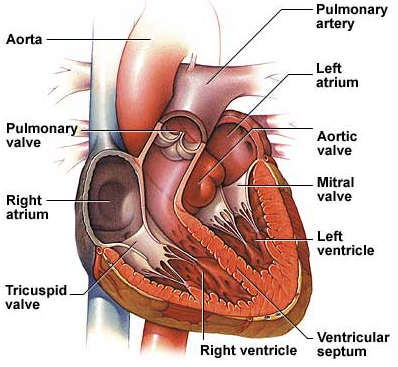
Suggest a suitable reason for the heart having four separate chambers.
Download our app for free and get startedPlay store
Human heart has four chambers that is two auricles and two ventricles. Auricles are the small chambers whereas ventricles are the bigger ones. Presence of four chambered heart serves two purposes. First, it ensures complete segregation of oxygenated and deoxygenated blood. Second, blood is received by the upper chambers and is pumped out by the lower chambers. This segregation between received blood and sent blood increases the efficiency of the heart.
art

Download our app
and get started for free

Experience the future of education. Simply download our apps or reach out to us for more information. Let's shape the future of learning together!No signup needed.*

Similar Questions

  • 1
    1. Define excretion.
    2. Name the basic filtration unit present in the kidney.
    3. Draw excretory system in human beings and label the following organs of excretory system which perform following functions:
    1. Form urine.
    2. Is a long tube which collects urine from kidney.
    3. Store urine until it is passed out.
    View Solution
  • 2
    The partially digested food coming from the stomach of a person enters a long and narrow organ A in his body. The organ A receives the secretion of two glands: liver and pancreas. Liver secretes a greenish - yellow liquid B which is normally stored in the organ C. Pancreas secretes pancreatic juice which contains three digestive enzymes D, E and F. The intestinal juice completes the process of digestion of food. The inner wall of organ A has millions of tiny finger - like projections G which help in the rapid absorption of digested food into blood stream. The undigested part of food then passes into wider tube H which absorbs most of the water from undigested food. The last part of tube H called I stores this undigested food (or waste) for some time. The undigested food is then passed out though opening J as faeces in the process known as K.
    1. Name the organ A.
    2. Name liquid B and organ C.
    3. What are the digestive enzymes D, E and F?
    4. Name the projections G present on the inner wall of organ A.
    5. Name Tube H, Part I, Opening J and Process K.
    View Solution
  • 3
    1. Draw a sectional view of the human heart and label on it: Aorta, Pulmonary arteries, Vena cava, Left ventricle.
    2. Why is double circulation of blood necessary in human beings?
    View Solution
  • 4
    Mention the major events during photosynthesis.
    View Solution
  • 5
    Write the events that occur during the process of breathing in humans.
    View Solution
  • 6
    1. Name the organs that form the excretory system in human beings.
    2. Describe in brief how urine is produced in human body.
    View Solution
  • 7
    Explain the various functions of blood.
    View Solution
  • 8
    Describe double circulation in human beings. Why is it necessary?
    View Solution
  • 9
    Explain the three pathways of breakdown in living organisms.
    View Solution
  • 10
    The organisms A, B and C can obtain their food in three different ways. Organism A derives its food from the body of another living organism which is called its D, without killing it. The organism B takes in the solid food by the process of ingestion, digests a part of this food and throws out undigested food in the process called E. The organism C obtains its food from dead and decaying plants.
    1. What is the mode of nutrition of (i) organism A (ii) organism B, and (iii) organism C?
    2. What is the organism like D called?
    3. Name the process E.
    4. Give one example each of organisms like A, B and C.
    5. What is the general name of three modes of nutrition exhibited by organisms A, B and C?
    View Solution