Question
Suppose in an imaginary world the angular momentum is quantized to be even integral multiples of $\frac{\text{h}}{2\pi}$ What is the longest possible wavelength emitted by hydrogen atoms in visible range in such a world according to Bohr's model?
Answer

Even quantum numbers are allowed,
$\text{n}_1=2,\text{n}_2=4\xrightarrow{\ \ \ }$ For minimum energy or for longest possible wavelength.
$\text{E}=13.6\bigg(\frac{1}{\text{n}^2_1}-\frac{1}{\text{n}^2_2}\bigg)$
$\text{E}=13.6\Big(\frac{1}{2^2}-\frac{1}{4^2}\Big)=2.55$
$2.55=\frac{\text{hc}}{\lambda}$
$\lambda=\frac{\text{hc}}{2.55}=\frac{1242}{2.55}$
$\lambda=487.05\text{nm}=487\text{nm}$

Need a full question paper?

Generate a complete, print-ready paper with questions like this in minutes — across 16+ boards, with answer keys.

Start Generating Free

Similar questions

The magnetic field at a point, $10\ cm$ away from a magnetic dipole, is found to be $2.0 \times 10^{-4 }T$. find the magnetic moment of the dipole if the point is.
  1. In end-on position of the dipole.
  2. In broadside-onposition of the dipole.
A conducting loop is held above a current carrying wire ‘PQ’ as shown in the figure. Depict the direction of the current induced in the loop when the current in the wire PQ is constantly increasing.
A compound microscope is an optical instrument used for observing highly magnified images of tiny objects. Magnifying power of a compound microscope is defined as the ratio of the angle subtended at the eye by the final image to the angle subtended at the eye by the object, when both the final image and the object are situated at the least distance of distinct vision from the eye. It can be given that : $m = m_e \times m_0,$ where $m_e$ is magnification produced by eye lens and $m0$ is magnification produced by objective lens.
Consider a compound microscope that consists of an objective lens of focal length $2.0\ cm$ and an eyepiece of focal length $6.25\ cm$ separated by a distance of $15\ cm.$
  1. The object distance for eye$-$piece, so that final image is formed at the least distance of distinct vision, will be:
  1. $3.45\ cm$
  2. $5\ cm$
  3. $1.29\ cm$
  4. $2.59\ cm$
  1. How far from the objective should an object be placed in order to obtain the condition described in part $(i)$?
  1. $4.5\ cm$
  2. $2.5\ cm$
  3. $1.5\ cm$
  4. $3.0\ cm$
  1. What is the magnifying power of the microscope in case of least distinct vision?
  1. $20$
  2. $30$
  3. $40$
  4. $10$
  1. The intermediate image formed by the objective of a compound microscope is:
  1. Real, inverted and magnified.
  2. Real, erect, and magnified.
  3. Virtual, erect and magnified.
  4. Virtual, inverted and magnified.
  1. The magnifying power of a compound microscope increases with :
  1. The focal length of objective lens is increased and that of eye lens is decreased.
  2. The focal length of eye lens is increased and that of objective lens is decreased.
  3. Focal lengths of both objects and eye$-$piece are increased.
  4. Focal lengths of both objects and eye$-$piece are decreased.
Explain the reverse blas characteristics of $p-n$ junction diode with proper graph.
Light of wavelength 488 nm is produced by an argon laser which is used in the photoelectric effect. When light from this spectral line is incident on emitter, the stopping (cut-off) potential of photoelectrons is 0.38 V. Find the work function of the material from which material is made.
The radio and TV programmes, telecast at the studio, reach our antenna by wave motion. Is it a mechanical wave or nonmechanical?
A simple pendulum fixed in a car has a time period of $4$ seconds when the car is moving uniformly on a horizontal road. When the accelerator is pressed, the time period changes to $3.99$ seconds. Making an approximate analysis, find the acceleration of the car.
The friction coefficient between an athelete's shoes and the ground is 0.90. Suppose a superman wears these shoes and races for 50m. There is no upper limit on his capacity of running at high speeds.
  1. Find the minimum time that he will have to take in completing the 50m starting from rest.
  2. Suppose he takes exactly this minimum time to complete the 50m, what minimum time will he take to stop?
Suppose you are inside the water in a swimming pool near an edge. A friend is standing on the edge. Do you find your friend taller or shorter than his usual height?
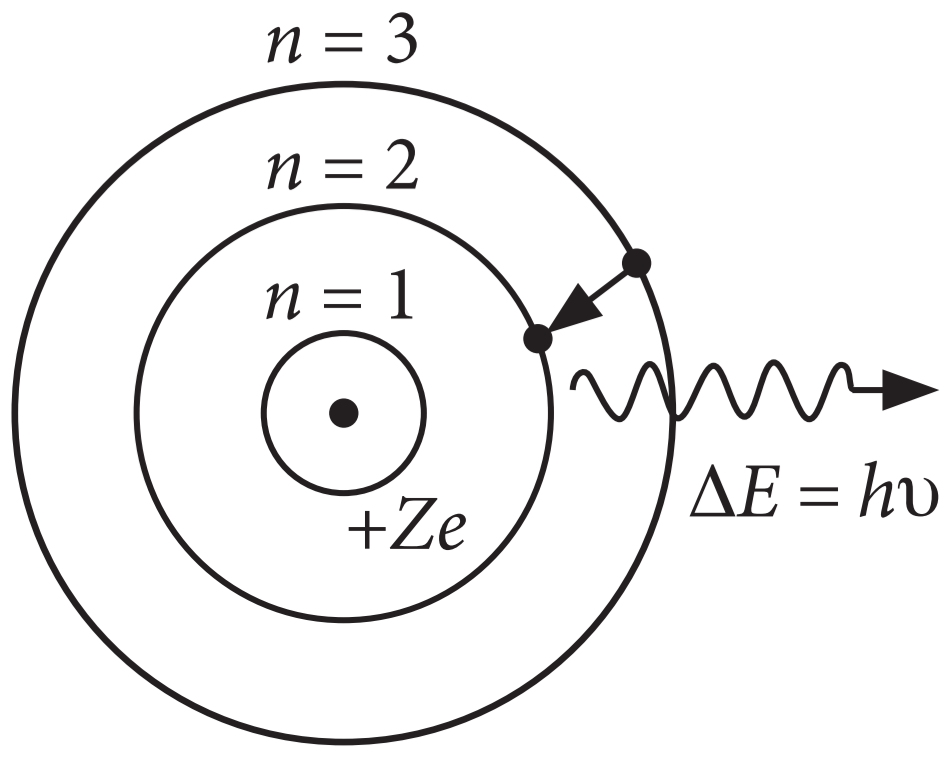
Niels Bohr introduced the atomic Hydrogen model in $1913$. He described it as a positively charged nucleus, comprised of protons and neutrons, surrounded by a negatively charged electron cloud. In the model, electrons orbit the nucleus in atomic shells. The atom is held together by electrostatic forces between the positive nucleus and negative surroundings.

Bohr correctly proposed that the energy and radii of the orbits of electrons in atoms are quantized, with energy for transitions between orbits given by
$\triangle\text{E}=\text{h}\upsilon=\text{E}_\text{i}-\text{E}_\text{f}$ where $\triangle\text{E}$ is the change in energy between the initial and final orbits and $\text{h}\upsilon$ is the energy of an absorbed or emitted photon.
  1. In the Bohr model of the hydrogen atom, discrete radii and energy states result when an electron circles the atom in an integer number of
  1. De Broglie wavelengths
  2. Wave frequencies
  3. Quantum numbers
  4. Diffraction patterns.
  1. The angular speed of the electron in the $n^{th}$ orbit of Bohr's hydrogen atom is.
  1. Directly proportional to $n$
  2. Inversely proportional to $\sqrt{\text{n}}$
  3. Inversely proportional to $n^2$
  4. Inversely proportional to $n^3$
  1. When electron jumps from $n = 4$ level to $n = 1$ level, the angular momentum of electron changes by.
  1. $\frac{\text{h}}{2\pi}$
  2. $\frac{\text{h}}{\pi}$
  3. $\frac{\text{3h}}{2\pi}$
  4. $\frac{\text{2h}}{\pi}$
  1. The lowest Bohr orbit in hydrogen atom has.
  1. The maximum energy
  2. The least energy
  3. Infinite energy
  4. Zero energy
  1. Which of the following postulates of the Bohr model led to the quantization of energy of the hydrogen atom?
  1. The electron goes around the nucleus in circular orbits.
  2. The angular momentum of the electron can only be an integral multiple of $\frac{\text{h}}{2\pi}$.
  3. The magnitude of the linear momentum of the electron is quantized.
  4. Quantization of energy is itself a postulate of the Bohr model.