Question
Suppose in an imaginary world the angular momentum is quantized to be even integral multiples of $\frac{\text{h}}{2\pi}$ What is the longest possible wavelength emitted by hydrogen atoms in visible range in such a world according to Bohr's model?
Answer

Even quantum numbers are allowed,
$\text{n}_1=2,\text{n}_2=4\xrightarrow{\ \ \ }$ For minimum energy or for longest possible wavelength.
$\text{E}=13.6\bigg(\frac{1}{\text{n}^2_1}-\frac{1}{\text{n}^2_2}\bigg)$
$\text{E}=13.6\Big(\frac{1}{2^2}-\frac{1}{4^2}\Big)=2.55$
$2.55=\frac{\text{hc}}{\lambda}$
$\lambda=\frac{\text{hc}}{2.55}=\frac{1242}{2.55}$
$\lambda=487.05\text{nm}=487\text{nm}$

Need a full question paper?

Generate a complete, print-ready paper with questions like this in minutes — across 16+ boards, with answer keys.

Start Generating Free

Similar questions

The potential barrier in the p-n junction diode is the barrier in which the charge recquires additional force for crossing the region. ln other words, the barrier in which the charge carrier stopped by the obstructive force is known as the potential barrier.
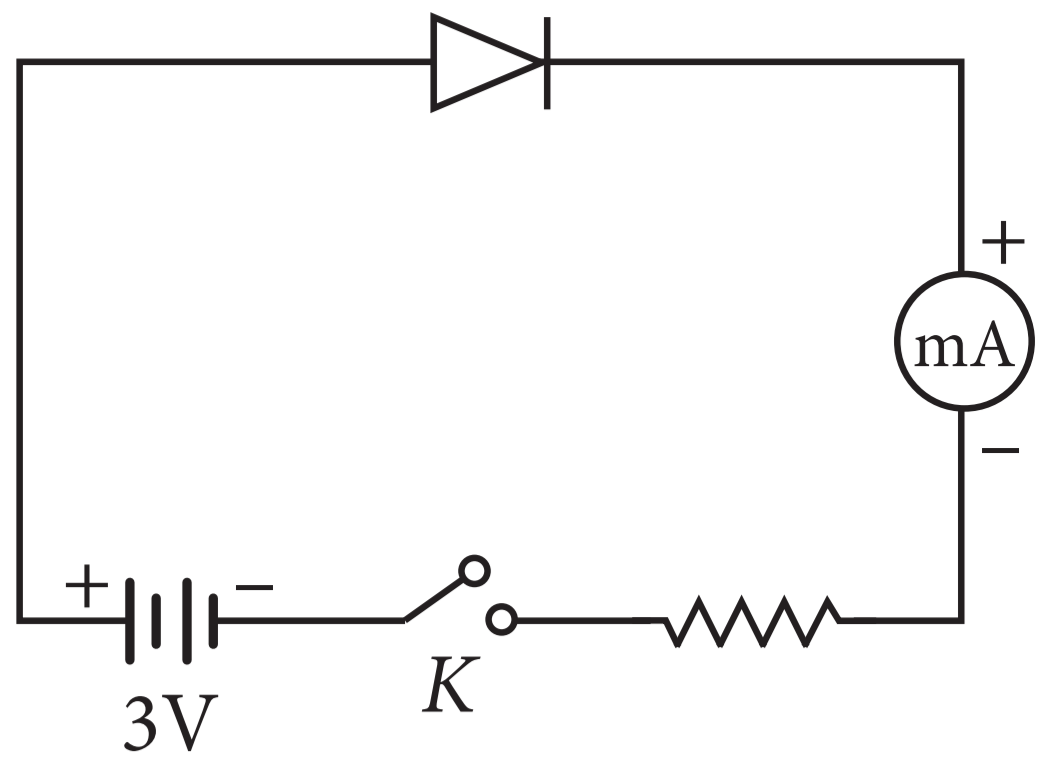
When a p-type semiconductor is brought into a close contact with n-ype semiconductor, we get a p-n junction with a barrier potential 0.4V, and width of depletion region is $4.0 \times 10^{-7}m$. This p-n junction is forward biased with a battery of voltage 3V and negligible internal resistance, in series with a resistor of resistance R, ideal millimeter, and key K as shown in figure. When key is pressed, a current of 20mA passes through the diode.
  1. The intersity of the electric field in the depletion region when p-n junction is unbiased is:
  1. $0.5 \times 10^6Vm^{-1}$
  2. $1.0 \times 10^6Vm^{-1}$
  3. $2.0 \times 10^6Vm^{-1}$
  4. $1.5 \times 10^6Vm^{-1}$
  1. The resistance of resistor R is:
  1. $150\Omega$
  2. $300\Omega$
  3. $130\Omega$
  4. $180\Omega$
  1. In a p-n junction, the potential barrier is due to the charges on either side of the junction, these charges are:
  1. Majority carriers.
  2. Minority carriers.
  3. Both (a) and (b).
  4. Fixed donor and acceptor ions.
  1. If the voltage of the potential barrier is $V_0$. A voltage Vis applied to the input, at what moment will the barrier disappear?
  1. $V < V_0$
  2. $V = V_0$
  3. $V > V_0$
  4. $V << V_0$
  1. If an electron with speed $4.0 \times 10^5ms^{-1}$ approaches the p-n junction from then-side, the speed with which it will enter the p-side is:
  1. $1.39 \times 10^5ms^{-1}$
  2. $2.78 \times 10^5ms^{-1}$
  3. $1.39 \times 10^6ms^{-1}$
  4. $2.78 \times 10^6ms^{-1}$
The electric field intensity at a point at a distance of 20 cm from the centre of a sphere is 10 Volt/meter. Find the intensity of the electric field at a point located at a distance 8 cm from the centre of that circle. The radius of the sphere is 5 cm.
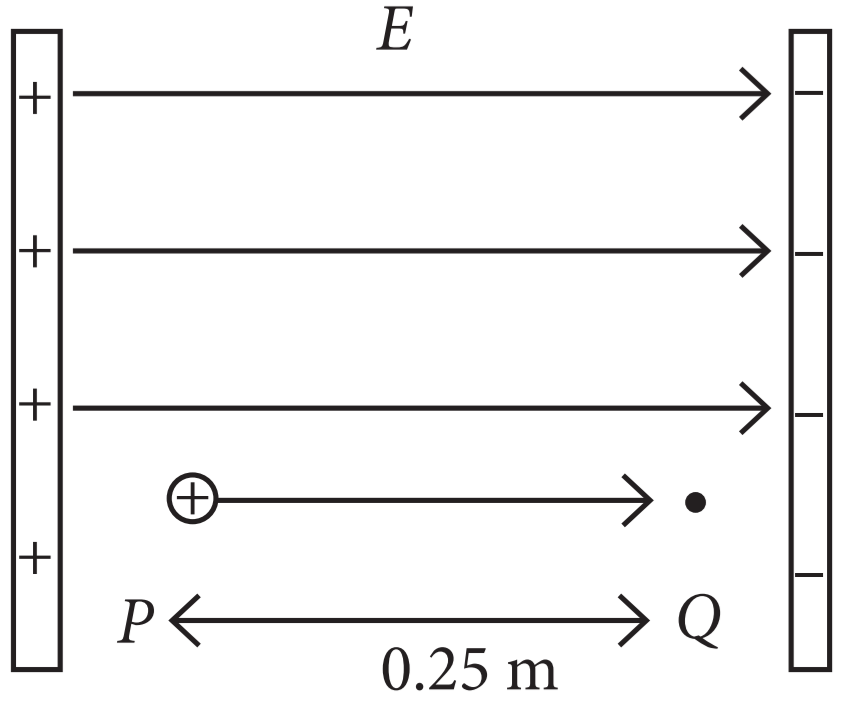
Potential difference $(\triangle\text{V})$ between two points A and B separated by a distance x, in a uniform electric field E is given by $\triangle\text{V}=-\text{Ex},$ where xis measured parallel to the field lines. If a charge $q_0$ moves from P to Q, the change in potential energy $(\triangle\text{U})$ is given as $\triangle\text{U}=-\text{q}_0\triangle\text{V}.$ A proton is released from rest in uniform electric field of magnitude $4.0 \times 10^8Vm^{-1}$ directed along the positive X-axis. The proton undergoes a displacement of 0.25m in the direction of E. Mass of a proton $= 1.66 \times 10^{-27}kg$ and charge of proton $= 1.6 \times 10^{-19}C.$
  1. The change in electric potential of the proton between the points A and B is:
  1. $-1 \times 10^8V$
  2. $1 \times 10^8V$
  3. $6.4 \times 10^{-19}V$
  4. $-6.4 \times 10^{-19}V$
  1. The change in electric potential energy of the proton for displacement from A to B is:
  1. $1.6 \times 10^{11}J$
  2. $0.5 \times 10^{23}J$
  3. $-1.6 \times 10^{-11}J$
  4. $3.2 \times 10^{22}J$
  1. The mutual electrostatic potential energy between two protons which are at a distance of $9 \times 10^{-15}$m, in $_{92}U^{235}$ nucleus is:
  1. $1.56 \times 10^{-14}J$
  2. $5.5 \times 10^{-14}J$
  3. $2.56 \times 10^{-14}J$
  4. $4.56 \times 10^{-14}J$
  1. If a system consistsoftwocharges 4mC and -3mC with no external field placed at (-5cm, 0, 0) and (5cm, 0, 0) respectively. The amount of work required to separate the two charges infinitely away from each other is:
  1. -1.1J
  2. 2J
  3. 2.5J
  4. 3J
  1. As the proton moves from P to Q, then:
  1. The potential energy of proton decreases.
  2. The potential energy of proton increases.
  3. The proton loses kinetic energy.
  4. Total energy of the proton increases.
Mention the changes occurring in the geomagnetic components.
A fat person is standing on a light plank floating on a calm lake. The person walks from one end to the other on the plank. His friend sitting on the shore watches him and finds that the person hardly moves any distance because the plank moves backward about the same distance as the person moves on the plank. Explain.
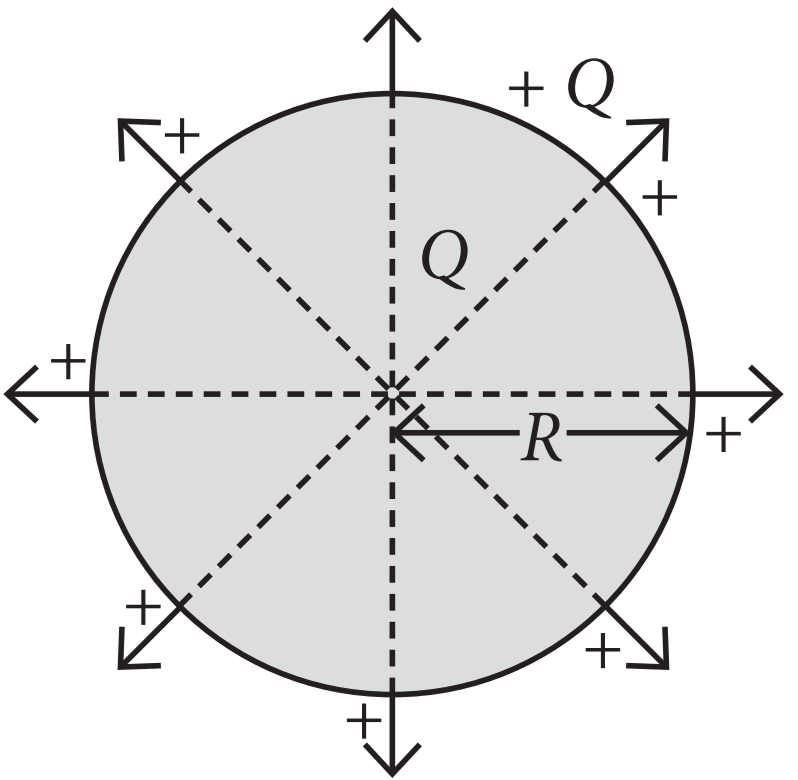
The electrical capacitance of a conductor is the measure of its ability to hold electric charge. An isolated spherical conductor of radius R. The charge Q is uniformly distributed over its entire surface. It can be assumed to be concentrated at the centre of the sphere. The potential at any point on the surface of the spherical conductor will be $\text{V}=\frac{1}{4\pi\in_0}\frac{\text{Q}}{\text{R}}.$

Capacitance of the spherical conductor situated in vacuum is $\text{C}=\frac{\text{Q}}{\text{V}}=\frac{\text{Q}}{\frac{1}{4\pi\in_0}.\frac{\text{Q}}{\text{R}}}$ or $\text{C}=4\pi\in_0\text{R}$ Clearly, the capacitance of a spherical conductor is proportional to its radius. The radius of the spherical conductor of 1F capacitance is $\text{R}=\frac{1}{4\pi\in_0}.$ C and this radius is about 1500 times the radius of the earth $(\sim6\times10^3\text{km}).$
  1. If an isolated sphere has a capacitance 50pE Then radius is:
  1. 90cm
  2. 45cm
  3. 45m
  4. 90m
  1. How much charge should be placed on a capacitance of 25 pF to raise its potential to 105V?
  1. $1\mu\text{C}$
  2. $1.5\mu\text{C}$
  3. $2\mu\text{C}$
  4. $2.5\mu\text{C}$
  1. Dimensions of capacitance is:
  1. $[M L^{-2} T^4 A^2]$
  2. $[M^{-1} L^{-1} T^3 A^1]$
  3. $[M^-L^{-2} T^4 A^2]$
  4. $[M^0 L^{-2} T^4 A^1]$
  1. Metallic sphere of radius R is charged to potential V. Then charge q is proportional to:
  1. V
  2. R
  3. Both V and R
  4. None of these
  1. If 64 identical spheres of charge q and capacitance C each are combined to form a large sphere. The charge and capacitance of the large sphere is:
  1. 64q, C
  2. 16q, 4C
  3. 64q, 4C
  4. 16q, 64C
In the study of Geiger-Marsdon experiment on scattering of α particles by a thin foil of gold, draw the trajectory ofα−particles in the Coulomb field of target nucleus. Explain briefly how one gets the information on the size of the nucleus from this study. From the relation $R = R_0\ A^{1/3},$ where $R_0$ is constant and A is the mass number of the nucleus, show that nuclear matter density is independent of A.
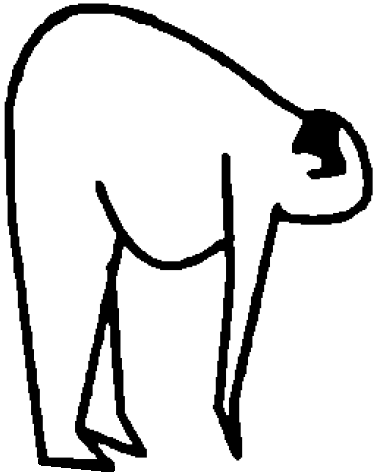
When a fat person tries to touch his toes, keeping the legs straight, he generally falls. Explain with reference to figure.
A container contains water upto a height of 20cm and there is a point source at the centre of the bottom of the container. A rubber ring of radius r floats centrally on the water. The ceiling of the room is 2.0m above the water surface.
  1. Find the radius of the shadow of the ring formed on the ceiling if r = 15cm.
  2. Find the maximum value of r for which the shadow of the ring is formed on the ceiling. Refractive index of water $\frac{4}{3}.$
For a single slit of width "a", the first minimum of the interference pattem of a monochromatic light of wavelength$\lambda$. Occurs at an angle of$\frac{\lambda}{\text{a}}$. At the same angle of$\frac{\lambda}{\text{a}},$ we get a maximum for two narrow slits separated by a distance "a". Explain.