Question
Suppose the entire system of the previous question is kept inside an elevator which is coming down with an acceleration a < g. Repeat parts (a) and (b).
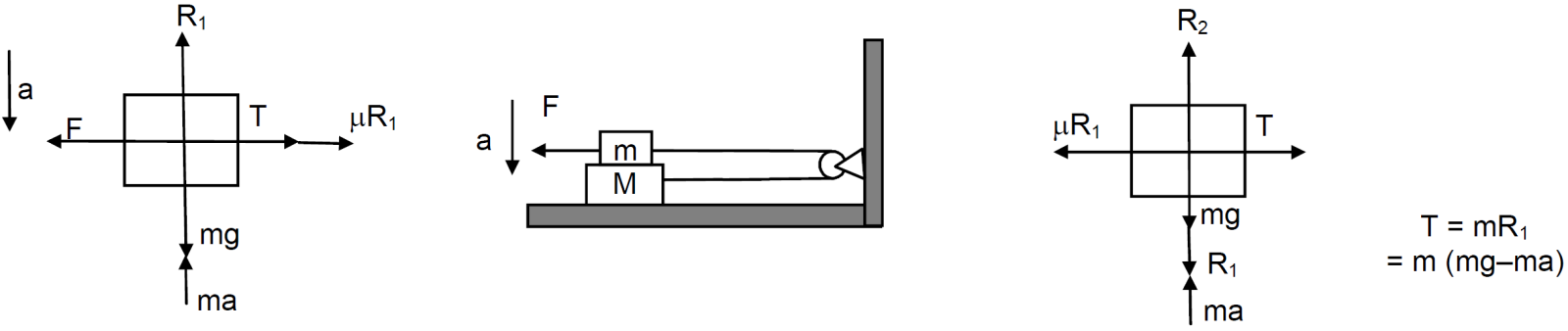
$\text{R}_1+\text{ma}-\text{mg}=0$
$\Rightarrow\text{R}_1=\text{m(g}-\text{a) = mg}-\text{ma} \ ...(\text{i})$
$\text{T}-\mu\text{R}_1=0\Rightarrow\text{T = m(mg}-\text{ma}) \ ...(\text{ii})$
Again, $\text{F}-\text{T}-\mu\text{R}_1=0$
$\Rightarrow\text{F}-\{\mu(\text{mg}-\text{ma})\}-\text{u}(\text{mg}-\text{ma})=0$
$\Rightarrow\text{F}-\mu\text{mg}+\mu\text{ma}-\mu\text{mg}+\mu\text{ma}=0$
$\Rightarrow\text{F}=2\mu\text{mg}-2\mu\text{ma}\Rightarrow\text{F}=2\mu\text{m(g}-\text{a})$
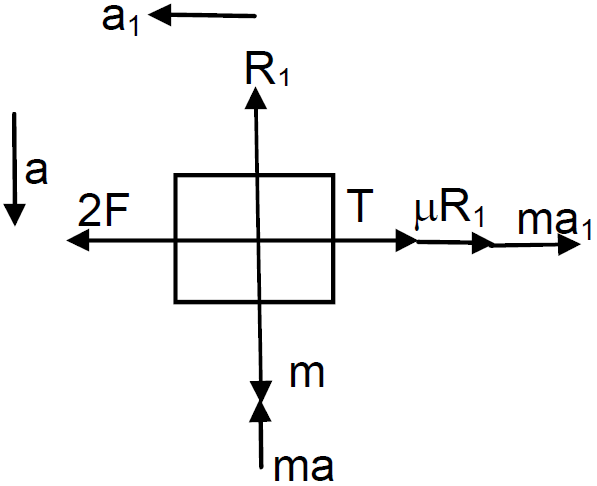
$\text{R}_1=\text{mg}-\text{ma} \ ...(\text{i})$
$2\text{F}-\text{T}-\mu\text{R}_1-\text{ma}_1=0$
$\Rightarrow2\text{F}-\text{t}-\mu\text{mg}+\mu\text{a}-\text{ma}_1=0 \ ...(\text{ii})$
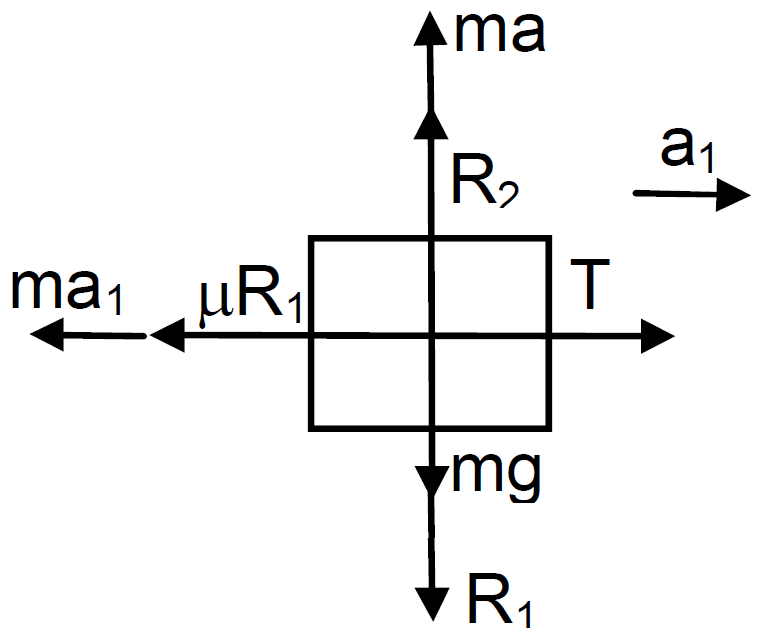
$\text{T}-\mu\text{R}_1-\text{Ma}_1=0$
$\Rightarrow\text{T}=\mu\text{R}_1+\text{Ma}_1$
$\Rightarrow\text{T}=\mu(\text{mg}-\text{ma})+\text{Ma}_1$
$\Rightarrow\text{T}=\mu\text{mg}-\mu\text{ma + Ma}_1$
Subtracting values of F & T, we get
$2(2\mu\text{m(g}-\text{a}))-2(\mu\text{mg}-\mu\text{ma}+\text{Ma}_1)\\-\mu\text{mg}+\mu\text{ma}-\mu\text{a}_1=0$
$\Rightarrow4\mu\text{mg}-4\mu\text{ma}-2\mu\text{mg}+2\mu\text{ma = ma}_1+\text{Ma}_1$
$\Rightarrow\text{a}_1=\frac{2\mu\text{m(g}-\text{a})}{\text{M + m}}$
Both blocks move with this acceleration but in opposite directions.
Generate a complete, print-ready paper with questions like this in minutes — across 16+ boards, with answer keys.
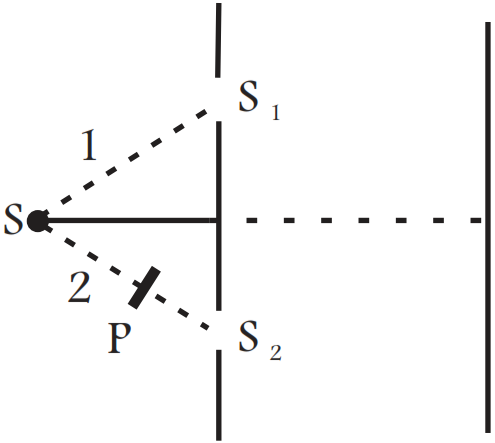
Figure shown a two slit arrangement with a source which emits unpolarised light. P is a polariser with axis whose direction is not given. If I0 is the intensity of the principal maxima when no polariser is present, calculate in the present case, the intensity of the principal maxima as well as of the first minima.