Question
Suppose the gravitational potential due to a small system is $\frac{\text{k}}{\text{r}^2}$ at a distance r from it. What will be the gravitational field? Can you think of any such system? What happens if there were negative masses?

Answer

The gravitational potential due to the system is given as $\text{V}=\frac{\text{k}}{\text{r}^2}.$
Gravitational field due to the system:$\text{E}=-\frac{\text{dv}}{\text{dr}}$
$\Rightarrow\text{E}=-\frac{\text{d}}{\text{dr}}\Big(\frac{\text{k}}{\text{r}^3}\Big)=-\Big(-\frac{2\text{k}}{\text{r}^3}\Big)$
$\Rightarrow\text{E}=\frac{2\text{k}}{\text{r}^3}$
We can see that for this system, $\text{E}\propto\frac{1}{\text{r}^3}$ This type of system is not possible because $F_g$ is always proportional to inverse of square of distance(experimental fact). If there were negative masses, then this type of system is possible. This system is a dipole of two masses, i.e., two masses, one positive and the other negative, separated by a small distance. In this case, the gradational field due to the dipole is proportional to $\frac{1}{\text{r}^3}. $

Need a full question paper?

Generate a complete, print-ready paper with questions like this in minutes — across 16+ boards, with answer keys.
Start Generating Free

Similar questions

Earth’s orbit is an ellipse with eccentricity $0.0167$. Thus, earth’s distance from the sun and speed as it moves around the sun varies from day to day. This means that the length of the solar day is not constant through the year. Assume that earth’s spin axis is normal to its orbital plane and find out the length of the shortest and the longest day. A day should be taken from noon to noon. Does this explain variation of length of the day during the year?
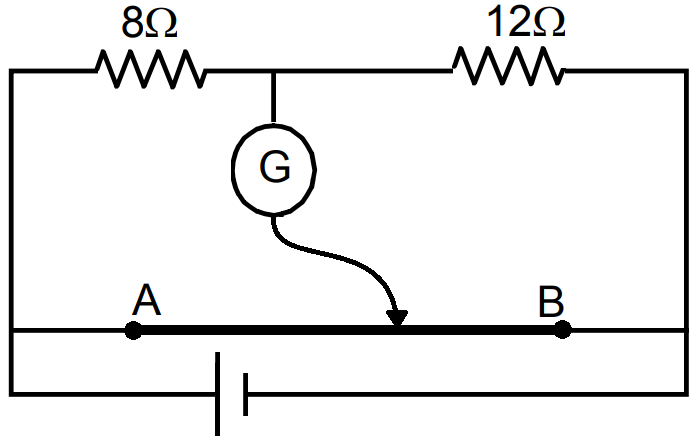
The potentiometer wire AB shown in the figure. is 40cm long. Where should the free end of the galvanometer be connected on AB so that the galvanometer may show zero deflection?
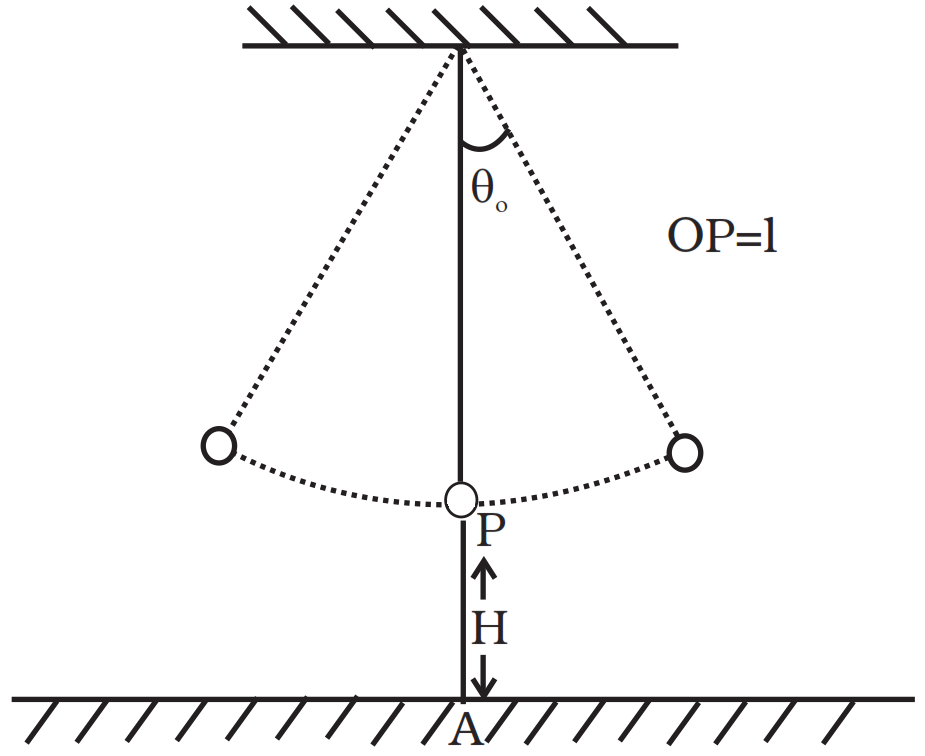
A simple pendulum of time period $1s$ and length l is hung from a fixed support at O, such that the bob is at adistance H vertically above A on the ground The amplitude is $\theta$ The string snaps at $\theta=\frac{\theta_0}{2}$ Find the time taken by the bob to hit the ground. Also find distance from A where bob hits the ground. Assume θ to be small so that $\sin\theta_0\ \text{and}\ \cos\theta_0=1.$
Calculate the velocity of liquid flowing through a pilot tube.
A uniform square plate S(side c) and a uniform rectangular plate R(sides b, a) have identical areas and masses:
Show that:
  1. $\frac{\text{I}_\text{xR}}{\text{I}_\text{xS}}<1$
  2. $\frac{\text{I}_\text{ys}}{\text{I}_\text{ys}}>1$
  3. $\frac{\text{I}_{2\text{R}}}{\text{I}_{2\text{s}}}>1$
  1. What are beats? Name the basic phenomenon due to which beats are produced.
  2. Two sources of sound are producing waves of frequency $n_1$ and $n_2$, where $(n_1 - n_2)$ is small, show mathematically that the beat frequency is $(n_1 - n_2)$.
Find the expression for kinetic energy, potential energy and total energy of a particle executing SHM.
Find the rms speed of hydrogen molecules in a sample of hydrogen gas at $300K$. Find the temperature at which the rms speed is double the speed calculated in the previous part.
The speed of sound in hydrogen at $0^\circ C$ is $1280ms^{-1}$. The density of hydrogen at STP is $0.089kg/m^{-3}$. Calculate the molar heat capacities $C_p$ and $C_v$ of hydrogen.
Calculate work done in raising a stone of mass $5kg$ of specific gravity $3$ immersed in water from a depth of $6m$ to $1m$ below surface of water($g = 10ms^{-2}$).