Question
Calculate the velocity of liquid flowing through a pilot tube.

Answer

SELF

Need a full question paper?

Generate a complete, print-ready paper with questions like this in minutes — across 16+ boards, with answer keys.

Start Generating Free

Similar questions

Mention the statements of the second law of thermodynamics given by Kelvin Planck and Clausius. How are the statements similar to each other?
A sample contains a mixture of $^{108}Ag$ and $^{110}Ag$ isotopes each having an activity of $8.0 \times 10^8$ disintegration per second. $^{110}Ag$ is known to have larger half-life than $^{108}Ag$. The activity A is measured as a function of time and the following data are obtained.
Time (s) Activity (A) ($10^8$ disinte- grations $s^{-1}$) Time (s) Activity (A) ($10^8$ disinte-grations $s^{-1}$)
20 11.799 200 3.0828
40 9.1680 300 1.8899
60 7.4492 400 1.1671
80 6.2684 500 0.7212
100 5.4115    
  1. Plot ln $\Big(\frac{\text{A}}{\text{A}_0}\Big)$ versus time.
  2. See that for large values of time, the plot is nearly linear. Deduce the half-life of $^{110}Ag$ from this portion of the plot.
  3. Use the half-life of $^{110}Ag$ to calculate the activity corresponding to $^{108}Ag$ in the first 50s.
  4. Plot In $\Big(\frac{\text{A}}{\text{A}_0}\Big)$ versus time for $^{108}Ag$ for the first 50s.
  5. Find the half-life of $^{108}Ag$.
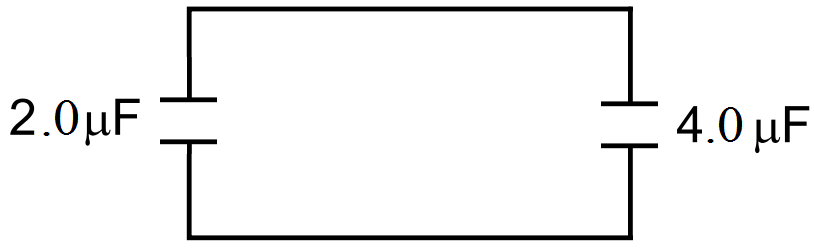
A capacitor of capacitance $2.0\mu\text{F}$ is charged to a potential difference of $12V$. It is then connected to an uncharged capacitor of capacitance $4.0\mu\text{F}$ as shown in figure. Find:
  1. The charge on each of the two capacitors after the connection.
  2. The electrostatic energy stored in each of the two capacitors.
  3. The heat produced during the charge transfer from one capacitor to the other.
A great physicist of this century (P.A.M. Dirac) loved playing with numerical values of Fundamental constants of nature. This led him to an interesting observation. Dirac found that from the basic constants of atomic physics (c, e, mass of electron, mass of proton) and the gravitational constant G, he could arrive at a number with the dimension of time. Further, it was a very large number, its magnitude being close to the present estimate on the age of the universe (~15 billion years). From the table of fundamental constants in this book, try to see if you too can construct this number (or any other interesting number you can think of). If its coincidence with the age of the universe were significant, what would this imply for the constancy of fundamental constants?
Compute the volume in $\mathrm{m}^3$ of a life preserver of SG $0.20$ , which, when worn by a boy weighing $60 kg$ and having SG equal to $0.9$ , will just support him, if $\frac{3}{2}$ of his body is submerged in freshwater of density $1000 \mathrm{~kg} \mathrm{~m}^{-3}$. Assume that the life preserver is completely submerged.
Two glass bulbs of equal volume are connected by a narrow tube and are filled with a gas at $0°C$ at a pressure of $76cm$ of mercury. One of the bulbs is then placed in melting ice and the other is placed in a water bath maintained at $62°C$. What is the new value of the pressure inside the bulbs? The volume of the connecting tube is negligible.
We have $0.5g$ of hydrogen gas in a cubic chamber of size $3cm$ kept at NTP. The gas in the chamber is compressed keeping the temperature constant till a final pressure of $100atm$. Is one justified in assuming the ideal gas law, in the final state? (Hydrogen molecules can be consider as spheres of radius 1 A).
An electron and a proton are detected in a cosmic ray experiment, the first with kinetic energy 10keV, and the second with 100keV. Which is faster, the electron or the proton? Obtain the ratio of their speeds. (electron mass = $9.11 \times 10^{-31}kg$, proton mass = $1.67 \times 10^{-27}kg, 1eV = 1.60 \times 10^{-19}J$).
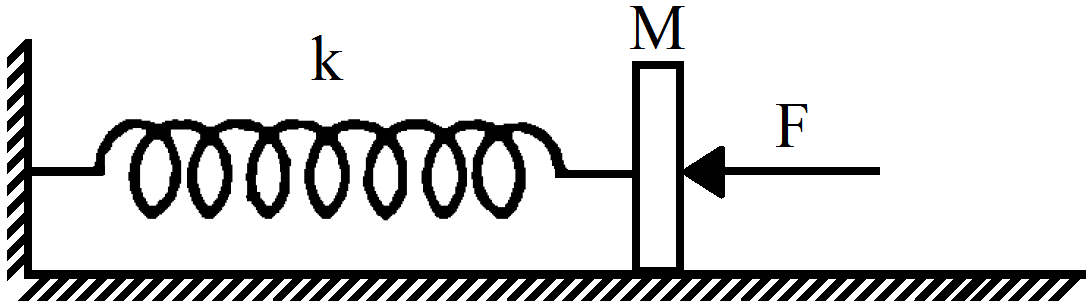
In figure k = 100N/m, M = 1kg and F = 10N,
  1. Find the compression of the spring in the equilibrium position.
  2. A sharp blow by some external agent imparts a speed of 2m/s to the block towards left. Find the sum of the potential energy of the spring and the kinetic energy of the block at this instant.
  3. Find the time period of the resulting simple harmonic motion.
  4. Find the amplitude.
  5. Write the potential energy of the spring when the block is at the left extreme.
  6. Write the potential energy of the spring when the block is at the right extreme.
The answers of (b), (e) and (f) are different. Explain why this does not violate the principle of conservation of energy.
A gas is initially at a pressure of $100kPa$ and its volume is $2.0m^3$. Its pressure is kept constant and the volume is changed from $2.0m^3$ to $2.5m^3$​​​​​​​. Its volume is now kept constant and the pressure is increased from $100kPa$ to $200kPa$. The gas is brought back to its initial state, the pressure varying linearly with its volume.
  1. Whether the heat is supplied to or extracted from the gas in the complete cycle?
  2. How much heat was supplied or extracted?