Question
Suppose the space between the two inner shells of the previous problem is filled with a dielectric of dielectric coastant K. Find the capacitance of the system between A and B.

Answer

Here we should consider two spherical capacitor of capacitance
cab and cbc in series
$\text{Cab}=\frac{4\pi\in_0\text{abk}}{(\text{b}-\text{a})}$
$\text{Cbc}=\frac{4\pi\in_0\text{bc}}{(\text{c}-\text{b})}$
$\frac{1}{\text{C}}=\frac{1}{\text{Cab}}+\frac{1}{\text{Cbc}}$
$=\frac{(\text{b}-\text{a})}{4\pi\in_0\text{abk}}+\frac{(\text{c}-\text{b})}{4\pi\in_0\text{bc}}$
$=\frac{\text{c}(\text{b}-\text{a})+\text{ka}(\text{c}-\text{b})}{\text{k}4\pi\in_0\text{abc}}$
$\text{C}=\frac{\text{k}4\pi\in_0\text{abc}}{\text{c}(\text{b}-\text{a})+\text{ka}(\text{c}-\text{b})}$

Need a full question paper?

Generate a complete, print-ready paper with questions like this in minutes — across 16+ boards, with answer keys.
Start Generating Free

Similar questions

Consider an excited hydrogen atom in state n moving with a velocity u(ν << c). It emits a photon in the direction of its motion and changes its state to a lower state m. Apply momentum and energy conservation principles to calculate the frequency ν of the emitted radiation. Compare this with the frequency ν0 emitted if the atom were at rest.
How is the working of a telescope different from that of a microscope?
The focal lengths of the objective and eyepiece of a microscope are 1.25 cm and 5 cm respectively. Find the position of the object relative to the objective in order to obtain an angular magnification of 30 in normal adjustment.
A particle is moving at a constant speed V from a large distance towards a concave mirror of radius R along its principal axis. Find the speed of the image formed by the mirror as a function of the distance x of the particle from the mirror.
A bullet of mass 25g is fired horizontally into a ballistic pendulum of mass 5.0kg and gets embedded in it. If the centre of the pendulum rises by a distance of 10cm, find the speed of the bullet.
A boy riding on his bike is going towards east at a speed. of $4\sqrt{2}\text{m/s}$ At a certain point he produces a sound pulse of frequency 1650Hz that travels in air at a speed of 334m/s. A second boy stands on the ground 45° south of east from him. Find the frequency of the pulse as received by the second boy.
By explaining magnetic field lines, write their characteristics.
The amount of charge that passes in time t through a cross-section of a wire is,
Q(t) = At2 + Bt + C.
  1. Write the dimensional formulae for A, B and C.
  2. If the numerical values of A, B and C are 5, 3 and 1, respectively, in S.I units, find the value of the current at t = 5s.
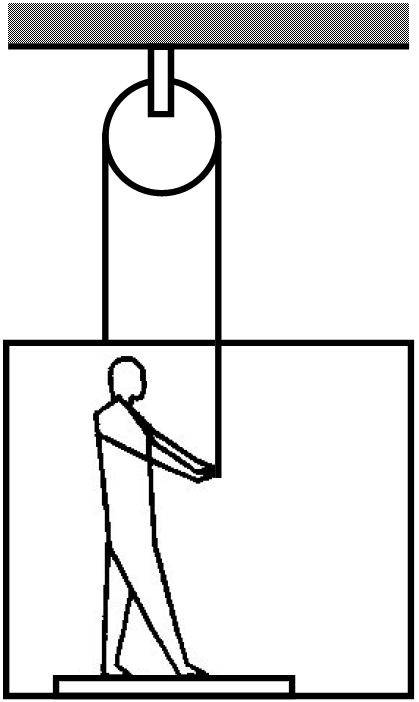
Figure shows a man of mass 60kg standing on a light weighing machine kept in a box of mass 30kg. The box is hanging from a pulley fixed to the ceiling through a light rope, the other end of which is held by the man himself. If the man manages to keep the box at rest, what is the weight shown by the machine? What force should he exert on the rope to get his correct weight on the machine?

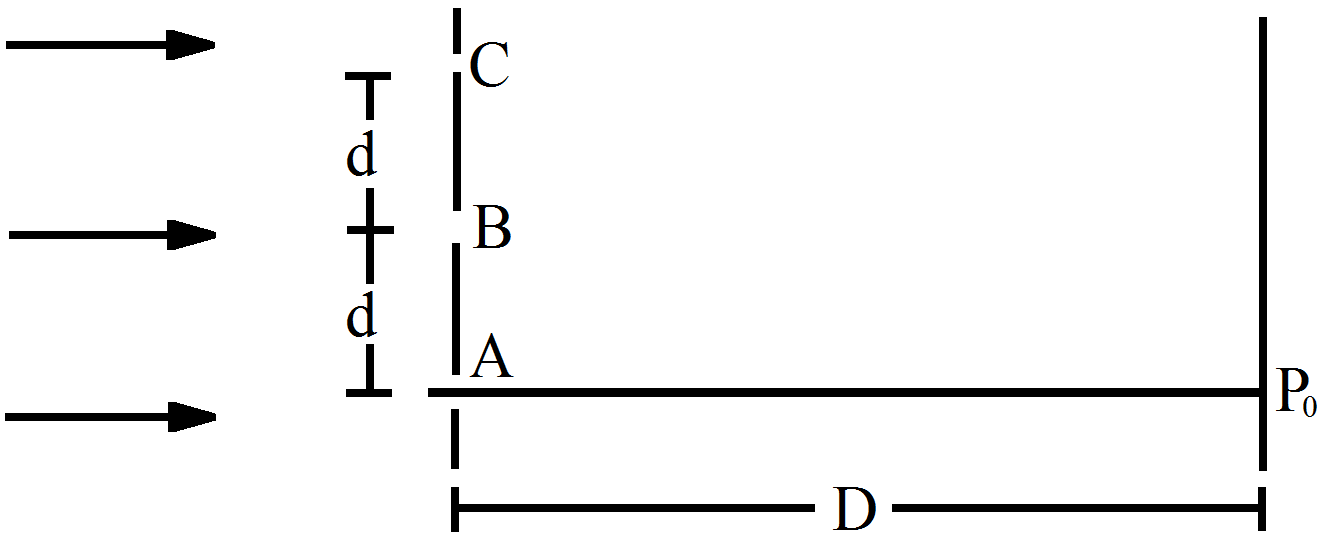
Figure shows three equidistant slits being illuminated by a monochromatic parallel beam of light. Let $\text{BP}_0-\text{AP}=\frac{\lambda}{3}$ and $\text{D}>\lambda.$
  1. Show that in this case $\text{d}=\sqrt{\frac{2\lambda\text{D}}{3}}.$
  2. Show that the intensity at P, is three times the intensity due to any of the three slits individually.

In a Young's double slit interference experiment the fringe pattern is observed on a screen placed at a distance D from the slits. The slits are separated by a distance d and are illuminated by monochromatic light of wavelength $\lambda$. Find the distance from the central point where the intensity falls to,
  1. Half the maximum.
  2. One fourth of the maximum.