MCQ
Suppose $\theta $ and $\phi  (\ne 0)$ are such that $sec\,(\theta  + \phi ),$ $sec\,\theta $ and $sec\,(\theta  - \phi )$ are in $A.P.$ If $cos\,\theta  = k\,cos\,( \frac {\phi }{2})$ for some $k,$ then $k$ is equal to
  • $ \pm \sqrt 2 $
  • B
    $ \pm  1 $
  • C
    $ \pm \frac{1}{{\sqrt 2 }}$
  • D
    $ \pm  2 $

Answer

Correct option: A.
$ \pm \sqrt 2 $
a
Since, $\sec \,(\theta  - \phi ),\,\,\sec \,\theta $ and $\sec \,(\theta  + \phi )$ are in $A.P.,$

$\therefore \,2\,\sec \,\theta \, = \,\sec \,(\theta  - \phi ) + \sec \,(\theta  + \phi )$

$ \Rightarrow \frac{2}{{\cos \theta \,}} = \frac{{\cos \,(\theta  + \phi ) + \,\cos \,(\theta  - \phi )}}{{\cos \,(\theta  - \phi )\,\cos \,(\theta  + \phi )}}$

$ \Rightarrow \,2({\cos ^2}\theta  - {\sin ^2} \phi  )\, = \,\cos \,\theta \,[2\,\cos \theta \,\cos \phi ]$

$ \Rightarrow \,{\cos ^2}\theta \,(1 - \cos \phi )\, = \,{\sin ^2}\phi \, = \,1 - {\cos ^2}\phi $

$ \Rightarrow \,{\cos ^2}\theta \, = 1 + \cos \phi \, = 2{\cos ^2}\frac{\phi }{2}$

$\therefore \,\,\cos \,\theta \, = \, \pm \,\sqrt 2 \cos \frac{\phi }{2}$

But given $\cos \,\theta \, = k\cos \frac{\phi }{2}$

$\therefore \,\,k = \,\, \pm \,\sqrt 2 $
Need a full question paper?

Generate a complete, print-ready paper with questions like this in minutes — across 16+ boards, with answer keys.

Start Generating Free

Similar questions

If the points $(a,b),\,(a',b')$and $(a - a',b - b')$are collinear, then
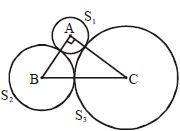
Figure shows $\Delta  ABC$ with $AB = 3, AC = 4$  &  $BC = 5$. Three circles $S_1, S_2$  &  $S_3$ have their centres on $A, B  $ &  $C$ respectively and they externally touches each other. The sum of areas of three circles is
Let the observations $\mathrm{x}_{\mathrm{i}}(1 \leq \mathrm{i} \leq 10)$ satisfy the equations, $\sum\limits_{i=1}^{10}\left(x_{i}-5\right)=10$ and $\sum\limits_{i=1}^{10}\left(x_{i}-5\right)^{2}=40$ If $\mu$ and $\lambda$ are the mean and the variance of the observations, $\mathrm{x}_{1}-3, \mathrm{x}_{2}-3, \ldots ., \mathrm{x}_{10}-3,$ then the ordered pair $(\mu, \lambda)$ is equal to :
The co-ordinates of the orthocentre of the triangle bounded by the lines, $4x - 7y + 10 = 0; x + y=5$ and $7x + 4y = 15$ is :
The value of $\left(\frac{-1+i \sqrt{3}}{1-i}\right)^{30}$ is
If $PQ$ is a double ordinate of hyperbola $\frac{{{x^2}}}{{{a^2}}} - \frac{{{y^2}}}{{{b^2}}} = 1$ such that $OPQ$ is an equilateral triangle, $O$ being the centre of the hyperbola. Then the eccentricity $e$ of the hyperbola satisfies
Which one is the complete set of values of x satisfying log $\text{x}^2(\text{x+1})>0$
If one common tangent of the two circles $x^2 + y^2 = 4$ and ${x^2} + {\left( {y - 3} \right)^2} = \lambda ,\lambda  > 0$ passes through the point $\left( {\sqrt 3 ,1} \right)$, then possible value of  $\lambda$ is
Which of the following is correct for any two complex numbers $z_1$ and $z_2$?
If $={^\text{43}}\text{C}_{\text{r-6}}={^\text{43}}\text{C}_{\text{3r+1}},$ then the value of r is is: