MCQ
Take the mean distance of the moon and the sun from the earth to be $0.4 \times 10^6\,km$ and $150 \times 10^6\,km$ respectively. Their masses are $8 \times 10^{22}\, kg$ and $2 \times 10^{30}\, kg$ respectively. The radius of the earth is $6400\, km$. Let $\Delta {F_1}$ be the difference in the forces exerted by the moon at the nearest and farthest points on the earth and $\Delta {F_2}$ be the difference in the force exerted by the sun at the nearest and farthest points on the earth. Then, the number closest to $\frac{{\Delta {F_1}}}{{\Delta {F_2}}}$ is
  • $2$
  • B
    $6$
  • C
    $10^{-2}$
  • D
    $0.6$

Answer

Correct option: A.
$2$
a
As we know, Gravitational force of attraction,

$F = \frac{{GMm}}{{{R^2}}}$

${F_1} = \frac{{G{M_e}m}}{{r_1^2}}\,and\,{F_2} = \frac{{G{m_e}{M_s}}}{{r_2^2}}$

$\Delta {F_1} = \frac{{2G{M_e}m}}{{r_1^3}}\Delta {r_1}\,and\,\Delta {F_2} = \frac{{G{M_e}{M_s}}}{{r_2^3}}\Delta {r_2}$

$\frac{{\Delta {F_1}}}{{\Delta {F_2}}} = \frac{{m\Delta {r_1}}}{{r_1^3}}\frac{{r_2^3}}{{{M_s}\Delta {r_2}}} = \left( {\frac{m}{{{M_s}}}} \right)\left( {\frac{{r_2^3}}{{r_1^3}}} \right)\left( {\frac{{\Delta {r_1}}}{{\Delta {r_2}}}} \right)$

Using $\Delta {r_1} = \Delta {r_2} = 2{R_{earth}};m = 8 \times {10^{22}}\,kg;$

${M_s} = 2 \times {10^{30\,}}kg$

${r_1} = 0.4 \times {10^6}km\,and\,{r_2} = 150 \times {10^6}\,km$

$\frac{{\Delta {F_1}}}{{\Delta {F_2}}} = \left( {\frac{{8 \times {{10}^{22}}}}{{2 \times {{10}^{30}}}}} \right){\left( {\frac{{150 \times {{10}^6}}}{{0.4 \times {{10}^6}}}} \right)^3} \times 1 \cong 2$

Need a full question paper?

Generate a complete, print-ready paper with questions like this in minutes — across 16+ boards, with answer keys.

Start Generating Free

Similar questions

A block is kept on an inclined plane of inclination $\theta$ of length l. The velocity of particle at the bottom of inclined is (the coefficient of friction is $\mu$)
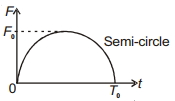
The magnitude of force acting on a particle moving along $x$-axis varies with time $(t)$ as shown in figure. If at $t=0$ the velocity of particle is $v_0$, then its velocity at $t=T_0$ will be
A huge circular arc of length $4.4$ $ly$ subtends an angle $'4 {s}'$ at the centre of the circle. How long it would take for a body to complete $4$ revolution if its speed is $8 \;AU\;per\, second \;?$

Given : $1\, {ly}=9.46 \times 10^{15} \,{m},$ $\, {AU}=1.5 \times 10^{11}\, {m}$

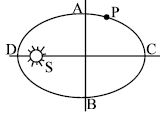
Figure shows the orbit of a planet $P$ round the sun $S.$ $AB$ and $CD$ are the minor and major axes of the ellipse.

If $U$ is the potential energy and $K$ kinetic energy then $|U| > |K|$ at

A block of ice floats on a liquid of density $1.2$ in a beaker then level of liquid when ice completely melt
An object is thrown along a direction inclined at an angle of ${45^o}$ with the horizontal direction. The horizontal range of the particle is equal to
$STATEMENT-1$ A cloth covers a table. Some dishes are kept on it. The cloth can be pulled out without dislodging the dishes from the table. because

$STATEMENT- 2$ For every action there is an equal and opposite reaction.

The maximum speed of a car on a road-turn of radius $30\, m$, if the coefficient of friction between the tyres and the road is $0.4$, will be .......... $m/sec$
A sphere of density $\rho $ , specific heat capacity $c$ and radius $r$ is hung by a thermally insulating thread in an enclosure which is kept at a lower temperature than the sphere. The temperature of the sphere starts to drop at a rate which depends upon the temperature difference between the sphere and the enclosure and the nature of the surface of sphere and is proportional to
To increase the frequency from $100Hz$ to $400Hz$ the tension in the string has to be changed by: