Question
Tea gets cooled when sugar is added to it. Why?

Answer

The sugar absorbs heat energy from the tea and hence temperature of the tea decreases.

Need a full question paper?

Generate a complete, print-ready paper with questions like this in minutes — across 16+ boards, with answer keys.
Start Generating Free

Similar questions

At what temperature do the Kelvin and Celsius scales coincide?
What is the significance of the slope of x-t graph.
Given a + b + c + d = 0, which of the following statements are correct:b + c must lie in the plane of a and d if a and d are not collinear, and in the line of a and d, if they are collinear?
A vertical metal cylinder of radius $2\ cm$ and length $2m$ is fixed at the lower end and a load of $100\ kg$ is put on it. Find
  1. The stress.
  2. The strain and.
  3. The compression of the cylinder. Young's modulus of the metal $= 2 \times 10^{11} N/m^2$.
A metal block of density $6000 \mathrm{~kg} \mathrm{~m}^{-3}$ and mass 1.2 kg is suspended through a spring of spring constant $200 \mathrm{~N} \mathrm{~m}^{-1}$. The spring-block system is dipped in water kept in a vessel. The water has a mass of 260 g and the block is at a height 40 cm above the bottom of the vessel. If the support to the spring is broken, what will be the rise in the temperature of the water. Specific heat capacity of the block is $250 \mathrm{Jkg}^{-1} \mathrm{~K}^{-1}$ and that of water is $4200 \mathrm{Jkg}^{-1} \mathrm{~K}^{-1}$. Heat capacities of the vessel and the spring are negligible.
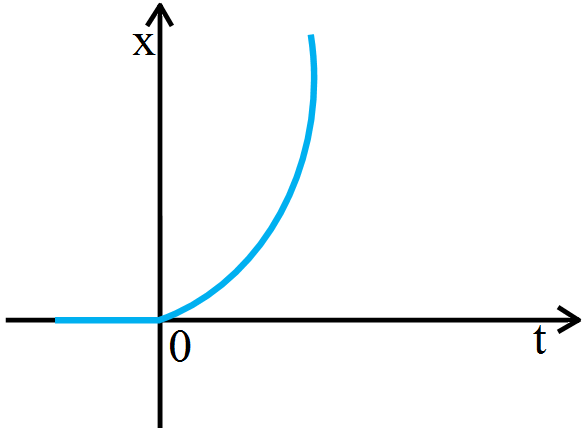
Shows the x-t plot of one-dimensional motion of a particle. Is it correct to say from the graph that the particle moves in a straight line for t < 0 and on a parabolic path for t > 0? If not, suggest a suitable physical context for this graph.
Which unit is used to measure size of a nucleus?
In the given progressive wave $​​​​\text{y}=5\sin(100\pi\text{t+0.4x})$ where y and x are in m, t is in s. What is the:Frequency
If in case of a motion, displacement is directly proportional to the square of time elapsed, what do you think about its acceleration i.e., constant or variable? Explain why?
Is it possible to convert water into vapour form without increasing its temperature, if temperature and pressure of water are 30°C and 1 atm respectively?