Ten tuning forks are arranged in increasing order of frequency in such a way that any two nearest tuning forks produce $4$ beats/sec. The highest frequency is twice of the lowest. Possible highest and the lowest frequencies are
Medium
Download our app for free and get started
(d) Using $n_{Last} = n_{First} + (N -1)x$
where $N =$ Number of tuning fork in series
$x =$ beat frequency between two successive forks
$==> 2n = n + (10 -1) × 4 n = 36 Hz$
$\therefore$ $ n_{First} = 36 Hz$ and $n_{Last} = 2 × n_{First} = 72 Hz$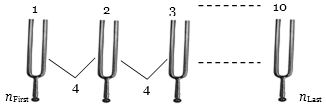

Download our appand get started for free
Experience the future of education. Simply download our apps or reach out to us for more information. Let's shape the future of learning together!No signup needed.*
Similar Questions
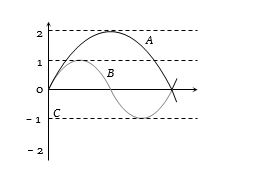
- 1The displacement-time graphs for two sound waves $A$ and $B$ are shown in the figure, then the ratio of their intensities ${I_A}/{I_B}$ is equal toView Solution
- 2Sound wave travels with a velocity of $300\, m\, s^{-1}$ through a gas. $9\, beats$ are produced in $3\, s$ when two waves pass through it simultaneously. If one of the waves has $2\, m$ wavelength, the wavelength of the other wave is ..... $m$View Solution
- 3A standing wave having $3$ nodes and $2$ antinodes is formed between two atoms having a distance $1.21\;\mathring A$ between them. The wavelength of the standing wave is .... $\mathop A\limits^o $View Solution
- 4The string of a violin has a frequency of $440 \,cps$. If the violin string is shortened by one fifth, its frequency will be changed to ........... $cps$View Solution
- 5The fundamental frequency of vibration of a string stretched between two rigid support is $50\,Hz$. The mass of the string is $18\,g$ and its linear mass density is $20\,g / m$. The speed of the transverse waves so produced in the string is $..........\,ms ^{-1}$View Solution
- 6A student plotted the following four graphs representing the variation of velocity of sound in a gas with the pressure $P$. Which one is correctView Solution
- 7A stationary observer receives sound from two identical tuning forks, one of which approaches and the other one recedes with the same speed (much less than the speed of sound). The observer hears $2\; beats/sec$. The oscillation frequency of each tuning fork is $v_{0}=1400 \;\mathrm{Hz}$ and the velocity of sound in air is $350\; \mathrm{m} / \mathrm{s}$. The speed of each tuning fork is close toView Solution
- 8Suppose that the speed of sound in air at a given temperature is $400 m/sec$. An engine blows a whistle at $1200 Hz$ frequency. It is approaching an observer at the speed of $100 m/sec$. What is the apparent frequency as heard by the observer .... $Hz$View Solution
- 9A source of unknown frequency gives $4\,\, beats/s$ when sounded with a source of known frequency $250\,\, Hz.$ The second harmonic of the source of unknown frequency gives five beats per second, when sounded with a source of frequency $513\,\, Hz.$ The unknown frequency is .... $Hz$View Solution
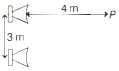
- 10Two small identical speakers are connected in phase to the same source. The speakers are $3 \,m$ apart and at ear level. An observer stands at $P, 4 \,m$ in front of one speaker as shown alongside. The sound she hears is least intense when the wavelength is $\lambda_1$ and most intense when the wavelength is $\lambda_2$. Then, the possible values of $\lambda_1$ and $\lambda_2$ areView Solution