Question
Test if the following equations are dimensionally correct:
  1. $\text{h}=\frac{2\text{S}\cos\theta}{\rho\text{rg}}$
  2. $\text{u}=\sqrt{\frac{\text{P}}{\rho}}$
  3. $\text{V}=\frac{\pi\text{Pr}^4\text{t}}{8\eta l}$
  4. $\text{v}=\frac{1}{2\pi}\sqrt{\frac{\text{mg}l}{\text{I}}}$
where h = height, S = surface tension, $\rho$ = density, P = pressure, V = volume, $\eta$ = coefficient of viscosity, v = frequency and I = moment of inertia.

Answer

  1. $\text{h}=\frac{2\text{S}\cos\theta}{\rho\text{rg}}$
$\text{LHS}=[\text{L}]$
Surface tension $=\text{S}=\frac{\text{F}}{\text{I}}=\frac{\text{MLT}^{-2}}{\text{L}}=[\text{MT}^{-2}]$
Density $=\rho=\frac{\text{M}}{\text{V}}=[\text{ML}^{-3}\text{T}^{0}]$
Radius $=\text{r}=[\text{L],g = [LT}^{-2}]$
$\text{RHS}=\frac{2\text{S}\cos\theta}{\rho\text{rg}}=\frac{[\text{MT}^{-2}]}{[\text{ML}^{-3}\text{T}^0][\text{L}][\text{LT}^{-2}]}=[\text{M}^0\text{L}^1\text{T}^0]=[\text{L}]$
$\text{LHS = RHS}$
So, the relation is correct
  1. $\text{v}=\sqrt{\frac{\text{P}}{\rho}}$ where v = velocity
$\text{LHS = Dimension of v = [LT}^{-1}]$
Dimension of $\text{p}=\frac{\text{F}}{\text{A}}=[\text{ML}^{-1}\text{T}^{-2}]$
Dimension of $\rho=\frac{\text{m}}{\text{v}} = \text{[ML}^{-2}]$
$\text{RHS}=\sqrt{\frac{\text{p}}{\rho}}=\sqrt{\frac{[\text{ML}^{-1}\text{T}^{-2}]}{[\text{ML}^{-3}]}}=[\text{L}^2\text{T}^{-2}]^{\frac{1}{2}}=[\text{LT}^{-1}]$
So, the relation is correct.
  1. $\text{V}=\frac{(\pi\text{pr}^4\text{t})}{(8\eta\text{I})}$
$\text{LHS = Dimension of V = [L}^3]$
Dimension of $\text{p}=[\text{ML}^{-1}\text{T}^{-2}],\text{r}^4=[\text{L}^4],\text{t}=[\text{T}]$
Coefficient of viscosity $=[\text{ML}^{-1}\text{T}^{-1}]$
$\text{RHS}=\frac{\pi\text{pr}^4\text{t}}{8\eta\text{I}}=\frac{[\text{ML}^{-1}\text{T}^{-2}][\text{L}^4][\text{T}]}{[\text{ML}^{-1}\text{T}^{-1}][\text{L}]}$
So, the relation is correct.
  1. $\text{v}=\frac{1}{2\pi}\sqrt{(\text{mgI}/\text{I})}$
$\text{LHS = dimension of v = [T}^{-1}]$
$\text{RHS}=\sqrt{(\text{mgI}/\text{I})}=\sqrt{\frac{[\text{M}][\text{LT}^{-2}][\text{L}]}{[\text{ML}^2]}}=[\text{T}^{-1}]$
$\text{LHS = RHS}$
So, the relation is correct.

Need a full question paper?

Generate a complete, print-ready paper with questions like this in minutes — across 16+ boards, with answer keys.

Start Generating Free

Similar questions

Clear the difference between interference and diffraction.
The image of a small electric bulb fixed on the wall of a room is to be obtained on the opposite wall 3 m away by means of a large convex lens. What is the maximum possible focal length of the lens required for the purpose?
A travelling wave is produced on a long horizontal string by vibrating an end up and down sinusoidally. The amplitude of vibration is 1.0cm and the displacement becomes zero 200 times per second. The linear mass density of the string is 0.10kg/m and it is kept under a tension of 90N.
  1. Find the speed and the wavelength of the wave.
  2. Assume that the wave moves in the positive x-direction and at t = 0, the end x = 0 is at its positive extreme position. Write the wave equation.
  3. Find the velocity and acceleration of the particle at x - 50cm at time t = 10ms.
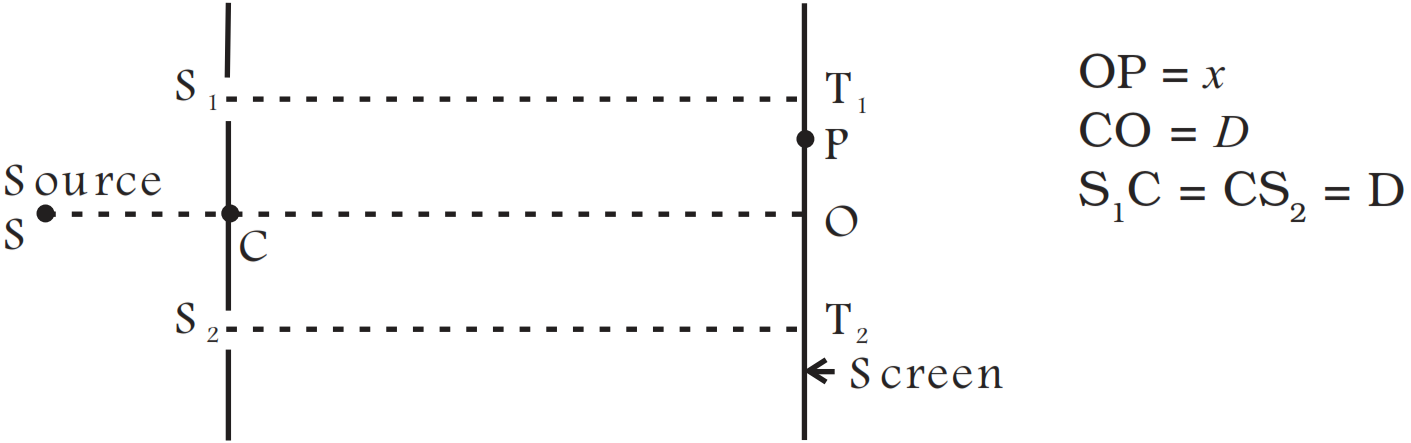
Consider a two slit interference arrangements $($Fig.$)$ such that the distance of the screen from the slits is half the distance between the slits. Obtain the value of $D$ in terms of $\lambda$ such that the first minima on the screen falls at a distance $D$ from the centre $O$.
A particle with a charge of $5.0\ µC$ and a mass of $5.0 \times 10^{-12}kg$ is projected with a speed of $1.0\ km s^{-1}$ in a magnetic field of magnitude $5.0\ mT.$ The angle between the magnetic field and the velocity is $\sin^{-1} (0.90).$ Show that the path of the particle will be a helix. Find the diameter of the helix and its pitch.
Two parallel coaxial circular coils of equal radius ‘R’ and equal number of turns ‘N’, carry equal currents ‘I’ in the same direction and are separated by a distance ‘2R’. Find the magnitude and direction of the net magnetic field produced at the mid-point of the line joining their centres.
When a horse pulls a cart, the force that helps the horse to move forward is the force exerted by:
  1. The cart on the horse.
  2. The ground on the horse.
  3. The ground on the cart.
  4. The horse on the ground.
$^{238}U$ decays to $^{206}Pb$ with a half-life of $4.47 \times 10^9y.$ This happens in a number of steps. Can you justify a single half for this chain of processes? A sample of rock is found to contain $2.00\ mg$ of $^{238}U$ and $0.600\ mg$ of $^{206}Pb.$ Assuming that all the lead has come from uranium, find the life of the rock.
A metre scale made of steel reads accurately at $20^\circ C$. In a sensitive experiment, distances accurate up to $0.055\ mm$ in $1m$ are required. Find the range of temperature in which the experiment can be performed with this metre scale. Coefficient of linear expansion of steel $= 11 \times 10^{-6^\circ} C^{-1}$.
A cubical metal block of edge 12cm floats in mercury with one fifth of the height inside the mercury. Water is poured till the surface of the block is just immersed in it. Find the height of the water column to be poured. Specific gravity of mercury = 13.6.