Question
$\text{H}_2(\text{g})+\text{I}_2(\text{g})\rightleftharpoons2\text{HI}(\text{g}),\text{K}=49$
What is the value of K, for the reaction:
$\text{H}_2(\text{g})\rightleftharpoons\frac{1}{2}\text{H}_2(\text{g})+\frac{1}{2}\text{I}_2(\text{g})?$
Answer

$\text{K}=\frac{[\text{HI}^2]}{[\text{H}_2][\text{I}_2]}$
$\text{K}=49$
$\text{K}'=\frac{[\text{H}_2]^{\frac{1}{2}}[\text{I}_2]^{\frac{1}{2}}}{[\text{HI}]}=\frac{1}{\sqrt{\text{K}}}$
$\Rightarrow\text{K}'=\frac{1}{\sqrt{49}}=\frac{1}{7}$

Need a full question paper?

Generate a complete, print-ready paper with questions like this in minutes — across 16+ boards, with answer keys.

Start Generating Free

Similar questions

Does the number of moles of reaction products increase, decrease or remain same when each of the following equilibria is subjected to a decrease in pressure by increasing the volume?
$\text{PCl}_5\text{ (g)}\rightleftharpoons\text{PCl}_3\text{ (g) + }\text{Cl}_2\text{ (g)}$
Mention the general characteristics of equilibria involving physical processes.
Two different gases ‘A’ and ‘B’ are filled in separate containers of equal capacity under the same conditions of temperature and pressure. On increasing the pressure slightly the gas ‘A’ liquefies but gas B does not liquify even on applying high pressure until it is cooled. Explain this phenomenon.

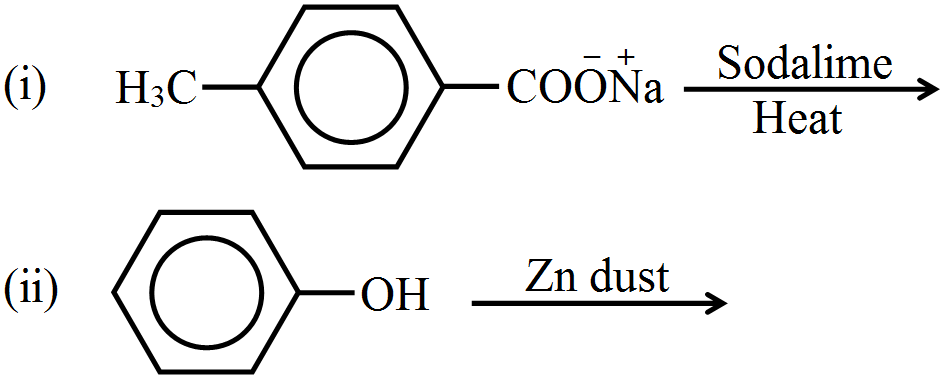
Complete the following:
The combustion of benzene(I) gives $\mathrm{CO}_2(\mathrm{g})$ and $\mathrm{H}_2 \mathrm{O}(\mathrm{I})$. Given that heat of combustion at constant volume is $-3263.9 \mathrm{~kJ} \mathrm{~mol}^{-1}$ at $25^{\circ} \mathrm{C}$; calculate heat of combustion in $\mathrm{kJ} \mathrm{~mol}{ }^{-1}$ at constant pressure. $\left[\mathrm{R}=8.314 \mathrm{JK}^{-1} \mathrm{~mol}^{-1}\right]$
Using van der Waals' gas equation calculate the pressure exerted by 8.5 g of $\mathrm{NH}_3$ contained in 0.5 L vessel at 300 K . For ammonia, 'a' $=4.0 \mathrm{~atm} \mathrm{~L}^2 \mathrm{~mol}^{-2}, ' b '=0.036 \mathrm{~L} \mathrm{~mol}^{-1}$.
Difterentiate between electromagnetic wave and matter wave.
Which of the following has highest lattice energy and why?
CsF, CSCl, CsBr, Csl
Complete the following reactions:
  1. $(\text{CH}_3)_2\text{C}=\text{CH}-\text{CH}_3\xrightarrow[\text{heat}]{\text{KMnO}_4/\text{KOH}}$
  2. $(\text{CH}_3)_2\text{C}=\text{CH}-\text{CH}_3\xrightarrow{\text{cold KMnO}_4/\text{KOH}}$
If the $K _{\text {sp }}$ of AgCl is $4 \times 10^{-8}$ then in 15 lit of its saturated solution, how much AgCl is added?