Maharashtra BoardEnglish MediumSTD 11 SciencePhysicsMathematical Methods4 Marks
Question
That are rectangular components of vectors? Explain their uses.
✓
Answer
$i$. Rectangular components of a vector:
If components of a given vector are mutually perpendicular to each other then they are called rectangular components of that vector.
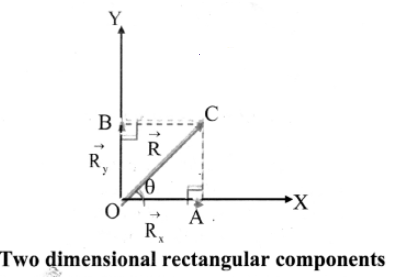
$ii$. Consider a vector $\overrightarrow{ R }=\overrightarrow{ OC }$ originating from the origin $O\ ’$ of a rectangular co $-$ ordinate system as shown in figure.
$iii$. Draw $C A \perp O X$ and $C B \perp O Y$.
Let component of $\vec{R}$ along $X-$ axis $\vec{R}_x$ and component of $\vec{R}$ along $Y-$ axis $=\vec{R}_y$ By parallelogram law of vectors,
$\overrightarrow{ R }=\overrightarrow{ R }_{ x }+\overrightarrow{ R }_{ y } \ldots\left(\because \overrightarrow{ AC }=\overrightarrow{ OB }=\overrightarrow{ R }_y\right)$
or, $ \overrightarrow{ R }=\hat{ i } R _x+\hat{ j } R _{ y }$
where, $\hat{i}$ and $\hat{j}$ are unit vectors along positive direction of $X$ and $Y$ axes respectively.
$iv$. If $\theta$ is angle made by $\vec{R}$ with $X-$ axis, then
$\cos \theta=\frac{O A}{O C}=\frac{R_x}{R}$
$\therefore R_x=R \cos \theta \ \ ....(1)$
$ S_\text{imilarly}$
$ \sin \theta=\frac{R_y}{R} $
$\therefore R_y=R \sin \theta \ \ ...(2)$
$v$. Squaring and adding equation $(1)$ and $(2)$ we get,
$R _{ x }^2+ R _{ y }^2 = R ^2 \cos ^2 \theta+ R ^2 \sin ^2 \theta$
$ = R ^2\left(\cos ^2 \theta+\sin ^2 \theta\right)$
$\therefore R _{ x }^2+ R _y^2= R ^2$
$\therefore \ \ R =\sqrt{ R _x^2+ R _y^2}$
Equation $(3)$ gives the magnitude of $\vec{R}$.
$vi$. Direction of $\vec{R}$ can be found out by dividing equation $(2)$ by $(1),$
$ \text { i.e., } \frac{R_y}{R_x}=\tan \theta $
$\therefore \theta=\tan ^{-1}\left(\frac{R_y}{R}\right) \ \ ......(4)$
Equation $(4)$ gives direction of $\vec{R}$
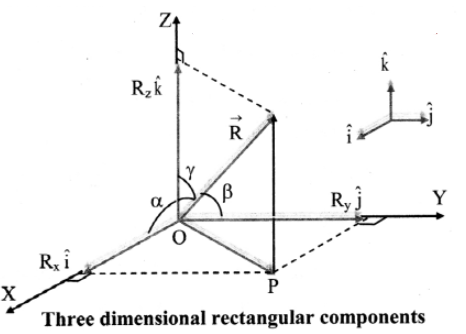
$vii$. When vectors are noncoplanar, it becomes necessary to use the third dimension. If $\overrightarrow{ R }_{ x } \overrightarrow{ R }_{ y }$ are$\overrightarrow{ R }_{ z }$ three rectangular components of $\vec{R}$ long $X, Y$ and $Z$ axes of a three dimensional rectangular cartesian co $-$ ordinate system then.
$\vec{R}=\vec{R}_x+\vec{R}_y+\vec{R}_z \text { or } \vec{R}=R_x \hat{i}+R_y \hat{j}+R_z \hat{k}$
Magnitude of $R$ is given by,
$R =\sqrt{ R _{ x }^2+ R _y^2+ R _z^2} \ldots .\left(\because \hat{ i }^2=\hat{ j }^2=\hat{ k }^2=1\right)$
$[$Note: If $\alpha, \beta$ and $\gamma$ are angles made by $R$ with $R_x, R_y$ and $R_z$ then direction cosine of vector is given by $\cos \alpha=\frac{ R _{ x }}{ R }, \cos \beta=\frac{ R _{ y }}{ R }$ and $\cos \gamma=\frac{ R _{ z }}{ R } ]$
Need a full question paper?
Generate a complete, print-ready paper with questions like this in minutes — across 16+ boards, with answer keys.