Question
Explain block diagram of  communication system.

Answer

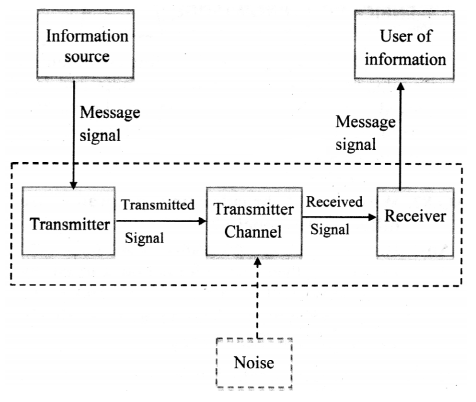
i. There are three basic (essential) elements of every communication system:
  1. Transmitter
  2. channel
  3. Receiver
ii. In a communication system, the transmitter is located at one place and the receiver at another place.
Image
iii. The communication channel is a passage through which signals transfer in between a transmitter and a receiver.
iv. This channel may be in the form of wires or cables, or may also be wireless, depending on the types of communication system.

Need a full question paper?

Generate a complete, print-ready paper with questions like this in minutes — across 16+ boards, with answer keys.
Start Generating Free

Similar questions

Explain the terms:
  1. Acceleration
  2. Average acceleration
  3. Instantaneous acceleration
Explain the I-V characteristic of a forward biased junction diode.
Explain the method to determine distance of a planet from the Earth.
A fighter plane flying horizontally at a altitude of $1.5 \ km$ with a speed of $720 \ km/h$ passes directly overhead an anti$-$aircraft gun. At what angle from the vertical should the gun be fired for the shell with a muzzle velocity of $600 \ m/s$ to hit the plane? At what minimum altitude should the pilot fly to avoid being hit? $[$Take $g = 10 m /s^2]$
A conductor has resistance of $15 \Omega$ at $10^{\circ} C$ and $18 \Omega$ at $400^{\circ} C$. Find the temperature coefficient of resistance of the material.
Discuss the effect of external voltage on the width of depletion region of a p-n junction.
While decreasing linearly from $5\ N$ to $3\ N,$ a force displaces an object from $3\ m$ to $5\ m.$ Calculate the work done by this force during this displacement. [Ans: $8\ N$]
What is friction? Define coefficient of static friction and coefficient of kinetic friction. Give the necessary formula for each.
Explain parallel combination of resistors.
$i.$ Two insulated charged copper spheres $A$ and $B$ have their centres separated by a distance of $50 \ cm.$ What is the mutual force of electrostatic repulsion, if the charge on each is $6.5 \times 10^{-7} C$? The radii of $A$ and $B$ are negligible compared to the distance of separation,
$ii.$ What is the force of repulsion if each sphere is charged double the above amount and the distance between them is halved?