MCQ
That gas cannot be liquified
  • A
    Which obeys Vander Waal's equation
  • Which obeys gas equation at every temperature and pressure
  • C
    The molecules of which are having potential energy
  • D
    Which is a inert gas

Answer

Correct option: B.
Which obeys gas equation at every temperature and pressure
b
An ideal gas can never be liquified because the intermelecular forces of attraction among the ideal gas molecules are negligible. Intermolecular forces are Zero for an ideal gas.

Correct choice - option $B$

Need a full question paper?

Generate a complete, print-ready paper with questions like this in minutes — across 16+ boards, with answer keys.
Start Generating Free

Similar questions

If the distance between a point source and screen is doubled, then intensity of light on the screen will become
The fundamental frequency of vibration of a string stretched between two rigid support is $50\,Hz$. The mass of the string is $18\,g$ and its linear mass density is $20\,g / m$. The speed of the transverse waves so produced in the string is $..........\,ms ^{-1}$
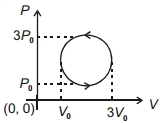
Work done in the cyclic process shown in figure is ...........
A $25\, watt$, $220\, volt$ bulb and a $100\, watt$,  $220\, volt$ bulb are connected in parallel across a $220\, volt$ line. Which bulb will glow more brightly
As the temperature of water increases, its viscosity
A torque meter is calibrated to reference standards of mass, length and time each with $5 \%$ accuracy. After calibration, the measured torque with this torque meter will have net accuracy of$............\%$
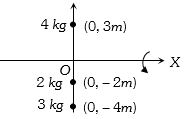
Three particles are situated on a light and rigid rod along $Y$axis as shown in the figure. If the system is rotating with an angular velocity of $2\,rad/\sec $about $X$axis, then the total kinetic energy of the system is ...... $J$
An electric dipole of moment $\overrightarrow p $ is placed normal to the lines of force of electric intensity $\overrightarrow E $, then the work done in deflecting it through an angle of $180^\circ $ is
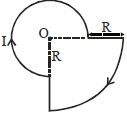
A current $I$ flowing through the loop as shown in the adjoining figure. The magnetic field at centre $O$ is
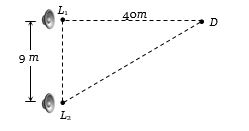
Two loudspeakers $L_1$ and $L_2$ driven by a common oscillator and amplifier, are arranged as shown. The frequency of the oscillator is gradually increased from zero and the detector at $D$ records a series of maxima and minima. If the speed of sound is $330\,ms^{-1}$ then the frequency at which the first maximum is observed is .... $Hz$