MCQ
The ability of eye to focus on both near and far objects is called:
  • A
    Presbyopia
  • B
    Myopia
  • C
    Hypermetropia
  • D
    Power of accommodation

Answer

  1. Power of accommodation

Explanation:

The ability of the eye lens to adjust its focal length is called as power of accommodation.

It helps us to see both near and distant objects clearly.

Need a full question paper?

Generate a complete, print-ready paper with questions like this in minutes — across 16+ boards, with answer keys.

Start Generating Free

Similar questions

Work done to move 1 coulomb charge from one point to another point on a charged conductor having potential 10 volt is:
Each one of the following changes will increase emf (or voltage) in a simple generator except:
  1. Increasing the number of turns in the armature coil.
  2. Winding the coil on a soft iron armature.
  3. Increasing the size of the gap in which the armature turns.
  4. Increasing the speed of rotation.
Electric current can flow through:
The refractive indices of four materials A, B, C and D are 1.33, 1.43, 1.71 and 1.52 respectively. When the light rays pass from air into these materials, they refract the maximum in:
If R is the radius of curvature of a spherical mirror and f is its focal length, then:

  1. R = f

  2. R = 2

  3. $\text{R}=\frac{\text{f}}{2}$

  4. R = 3f

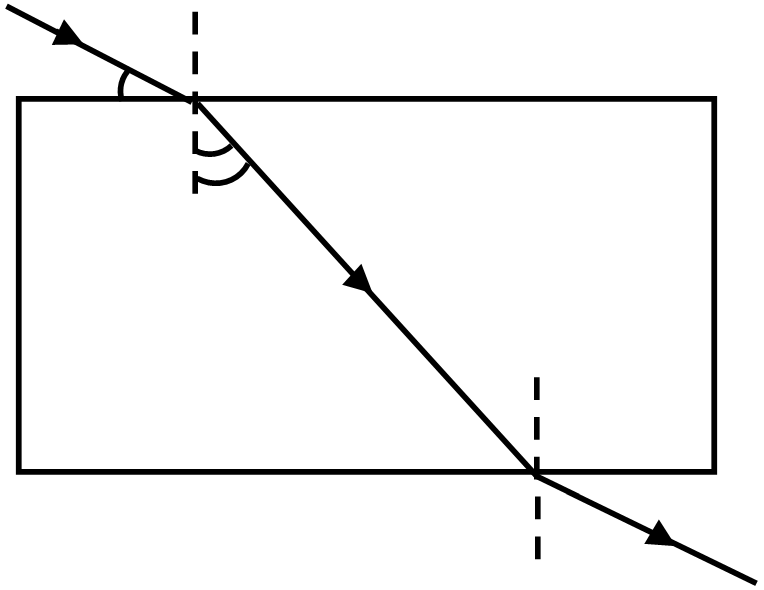
A student traces the path of a ray of white light through a rectangular glass slab and marks, the angles of incidence $(\angle \text{ i})$, refraction (r) and emergence (e) as shown.
A solar cooker may not cook food if.
  1. The solar cooker is not placed in the shade.
  2. The glass sheet cover of solar cooker is not closed.
  3. A convex mirror reflector is not used.
  4. The food containers of insulting material are not used.
To get 2 Ω resistance using only 6 Ω resistors, the number of them required is:
A coil in the heater consume power P on passing current. If it is cut into halves and joined in parallel, it will consume power:
The atmospheric refraction of light causes the twinkling of:
  1. Planets only.
  2. Stars only.
  3. Planets and stars.
  4. Stars and satellites.