MCQ
The $AC$ voltage across a resistance can be measured using:
  • A
    A potentiometer.
  • A hot$-$wire voltmeter.
  • C
    A moving$-$coil galvanometer.
  • D
    A moving$-$magnet galvanometer.

Answer

Correct option: B.
A hot$-$wire voltmeter.
The $AC$ voltae across a resustance can be measured using a hot$-$wore volmeter.

Need a full question paper?

Generate a complete, print-ready paper with questions like this in minutes — across 16+ boards, with answer keys.
Start Generating Free

Similar questions

Light described at a place by the equation $\varepsilon = (100V/m)\, [sin(5 \times 10^{15} s^{-1})t + sin (8 \times 10^{15} s^{-1})t]$ falls on a metal surface having work function $2eV$. Calculate the maximum kinetic energy of the photo electrons............... $eV$
An experiment is performed to determine the $I-V$ characteristics of a Zener diode, which has a protective resistance of $R = 100 \,\Omega ,$ and a maximum power of dissipation rating of $1\,W$ .The minimum voltage range of the $DC$ source in the circuit is
Two parallel plates separated by a distance of 5mm are kept at a potential difference of 50 V. A particle of mass $10^{-15}$ kg and charge $10^{-11}$ C Centers in it with a velocity $10^{7}$ m/s. The acceleration of the particle will be
In a certain arrangement, a proton does not get deflected while moving through a magnetic field region. Under what condition is it possible?
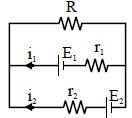
See the electrical circuit shown in the adjoining figure. Which of the following equation is a correct equation for it
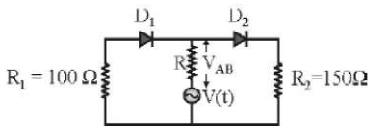
In the circuit given below, $V ( t )$ is the sinusoidal voltage source, voltage drop $V_{A B}(t)$ across the resistance $R$ is
A particle of mass $m$ and carrying charge $-q_1$ is moving around a charge $+q_2$ along a circular path of radius r. Find period of revolution of the charge $-q_1$
If $\vec{E}$ and $\vec{K}$ represent electric field and propagation vectors of the EM waves in vacuum, then magnetic field vector is given by : $(\omega-$ angular frequency) :
Consider two point charges of equal magnitude and opposite sign separated by a certain distance. The neutral point due to them
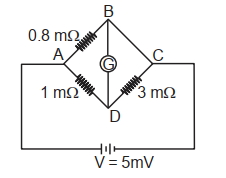
To measure the temperature coefficient of resistivity $\alpha$ of a semiconductor, an electrical arrangement shown in the figure is prepared. The arm BC is made up of the semiconductor. The experiment is being conducted at $25^{\circ} \mathrm{C}$ and resistance of the semiconductor arm is $3 \mathrm{~m} \Omega$. Arm BC is cooled at a constant rate of $2^{\circ} \mathrm{C} / \mathrm{s}$. If the galvanometer $\mathrm{G}$ shows no deflection after $10 \mathrm{~s}$, then $\alpha$ is :