MCQ
The adiabatic elasticity of a gas is equal to
  • A
    $\gamma \times$ density
  • B
    $\gamma \times$ volume
  • $\gamma \times$ pressure
  • D
    $\gamma \times$ specific heat

Answer

Correct option: C.
$\gamma \times$ pressure
(c) Adiabatic elasticity $K_a=\gamma P$

Need a full question paper?

Generate a complete, print-ready paper with questions like this in minutes — across 16+ boards, with answer keys.
Start Generating Free

Similar questions

A rocket is going away from the earth at a speed $0.2 c$, where $c=$ speed of light. It emits a signal of frequency $4 \times 10^7 Hz$. What will be the frequency observed by an observer on the earth
A body of $10 \mathrm{~kg}$ is acted by a force of $129.4 \mathrm{~N}$ if $g=9.8 \mathrm{~m} / \mathrm{sec}^2$. The acceleration of the block is $10 \mathrm{~m} / \mathrm{s}^2$. What is the coefficient of kinetic friction
When the wave of hydrogen atom comes from infinity into the first orbit then the value of wave number is
In an electromagnetic wave, the amplitude of electric field is $1 V / m$. the frequency of wave is $5 \times 10^{14} Hz$. The wave is propagating along $z$-axis. The average energy density of electric field, in Joule/m, will be
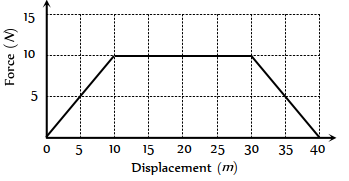
Adjacent figure shows the force-displacement graph of a moving body, the work done in displacing body from $x=0$ to $x=35 \mathrm{~m}$ is equal to

Image

If $R$ and $L$ represent respectively resistance and self inductance, which of the following combinations has the dimensions of frequency
A particle at the end of a spring executes simple harmonic motion with a period $t_1$, while the corresponding period for another spring is $t_2$. If the period of oscillation with the two springs in series is $T$, then
Stopping potential for photoelectrons
A Container having $1$ mole of a gas at a temperature $27^{\circ} \mathrm{C}$ has a movable piston which maintains at constant pressure in container of $1 \mathrm{~atm}$. The gas is compressed until temperature becomes $127^{\circ} \mathrm{C}$. The work done is ( $C$ for gas is $7.03 \mathrm{cal} / \mathrm{mol} / \mathrm{K}$ )
A free body of mass $8 \mathrm{~kg}$ is travelling at 2 meter per second in a straight line. At a certain instant, the body splits into two equal parts due to internal explosion which releases 16 joules of energy. Neither part leaves the original line of motion finally