MCQ
The adjacent sides of a rectangle with given perimeter as  $100\, cm $ and enclosing maximum area are
  • A
    $10 \,cm$  and  $40\, cm$
  • B
    $20 \,cm$  and $ 30\, cm$
  • $25\, cm $ and  $25 \,cm$
  • D
    $15 \,cm$  and $ 35 \,cm$

Answer

Correct option: C.
$25\, cm $ and  $25 \,cm$
c
(c) $2x + 2y = 100 \Rightarrow x + y = 50$…..$(i)$

Let area of rectangle is $A;$      $\therefore A = xy \Rightarrow y = \frac{A}{x}$

Put in $(i),$ we have $x + \frac{A}{x} = 50 \Rightarrow A = 50x - {x^2}$

==> $\frac{{dA}}{{dx}} = 50 - 2x$

For maximum area $\frac{{dA}}{{dx}} = 0$

$\therefore 50 - 2x = 0 \Rightarrow x = 25$ and $y = 25$

Hence adjacent sides are  $25$ and $ 25\, cm.$

Need a full question paper?

Generate a complete, print-ready paper with questions like this in minutes — across 16+ boards, with answer keys.

Start Generating Free

Similar questions

$\int_{1/e}^e {|\log x|\,dx = } $
The area (in sq. units) of the region

$\left\{(\mathrm{x}, \mathrm{y}) \in \mathrm{R}^{2} | 4 \mathrm{x}^{2} \leq \mathrm{y} \leq 8 \mathrm{x}+12\right)$ is 
Suppose $A=\left[\begin{array}{ll}a & b \\ c & d\end{array}\right]$ is a real matrix with non-zero entries, $\alpha d-b c=0$ and $A^2=A$. Then, $a + d$ equals
If $\text{P(A)}=\frac{7}{13},\text{P(B)}=\frac{9}{13}$ and $\text{P}(\text{A}\cap\text{B})=\frac{4}{13}.$ then, $\text{P}(\overline{\text{A}}|\text{B})=$
  1. $\frac{5}{9}$
  2. $\frac{4}{9}$
  3. $\frac{4}{13}$
  4. $\frac{6}{13}$
If $\text{f}(\text{x})=\tan^{-1}(\text{g}(\text{x})),$ where g(x) is monotonically increasing for $0<\text{x}<\frac{\pi}{2}.$ Then, f(x) is:
  1. Increasing on $\Big(0,\frac{\pi}{2}\Big)$
  2. Decreasing on $\Big(0,\frac{\pi}{2}\Big)$
  3. Increasing on $\Big(0,\frac{\pi}{4}\Big)$ and decreasing on $\Big(\frac{\pi}{4},\frac{\pi}{2}\Big)$
  4. None of these.
If $A$ and $B$ are symmetric matrices of the same order, then
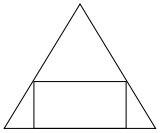
If a rectangle is inscribed in an equilateral triangle of side length $2 \sqrt{2}$ as shown in the figure, then the square of the largest area of such a rectangle is $....$
Area bounded by the ellipse $\frac{\text{x}^2}{4}+\frac{\text{y}^2}{9}=1$
  1. $6\pi\text{ sq}.\text{units}$
  2. $3\pi\text{ sq}.\text{units}$
  3. $12\pi\text{ sq}.\text{units}$
  4. $\text{None of these}$
Let $f: R \rightarrow R$ be a function defined by

$f(x)=\left\{\begin{array}{cc}x^2 \sin \left(\frac{\pi}{x^2}\right) & \text { if } x \neq 0 \\ 0, & \text { if } x=0\end{array}\right.$

Then which of the following statements is $TRUE$?

If $\phi (x) = {x^2} + 1$ and $\psi (x) = {3^x}$, then $\phi \{ \psi (x)\} $ and $\psi \{ \phi (x)\} = $