MCQ
The amplitude of a damped oscillator becomes half in one minute. The amplitude after $3$ minute will be $\frac{1}{X}$ times the original, where $X$ is
  • A
    $2 \times 3$
  • ${2^3}$
  • C
    ${3^2}$
  • D
    $3 \times {2^2}$

Answer

Correct option: B.
${2^3}$
b
(b) Amplitude of damped oscillator $A = {A_0}{e^{ - \lambda t}};\;\lambda \; = $constant, $t = time$

For $t =1 min$. $\frac{{{A_0}}}{2} = {A_0}{e^{ - \lambda t}} \Rightarrow {e^\lambda } = 2$ 

For $t = 3 min$ $A = {A_0}{e^{ - \lambda \times 3}} = \frac{{{A_0}}}{{{{({e^\lambda })}^3}}} = \frac{{{A_0}}}{{{2^3}}}$ $ \Rightarrow X = {2^3}$

Need a full question paper?

Generate a complete, print-ready paper with questions like this in minutes — across 16+ boards, with answer keys.
Start Generating Free

Similar questions

$Assertion$: A rigid disc rolls without slipping on a fixed rough horizontal surface with uniform angular velocity. Then the acceleration of lowest point on the disc is zero.
$Reason$ : For a rigid disc rolling without slipping on a fixed rough horizontal surface, the velocity of the lowest point on the disc is always zero
Two balls are thrown simultaneously from ground with same velocity of $10\,m / s$ but different angles of projection with horizontal. Both balls fall at same distance $5 \sqrt{3}\,m$ from point of projection. What is the time interval between balls striking the ground?
The escape velocity of a sphere of mass $m$ is given by $(G=$ Universal gravitational constant; $M_e=$ Mass of the earth and $R_e=$ Radius of the earth)
A person sitting in a chair in a satellite feels weightless because:
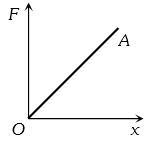
The force required to stretch a spring varies with the distance as shown in the figure. If the experiment is performed with the above spring of half length, the line $OA$ will
The angular momentum of a planet of mass $M$ moving around the sun in an elliptical orbit is $\overrightarrow{ L }$. The magnitude of the areal velocity of the planet is:
Two particles of equal mass $m$ go around a circle of radius $R$ under the action of their mutual gravitational attraction. The speed of each partial with respect to their centre of mass is
The moment of inertia of $HCl$ molecule about an axis passing through its centre of mass and perpendicular to the line joining the ${H^ + }$ and $C{l^ - }$ ions will be, if the interatomic distance is $1\ Å$
pendulum made of a uniform wire of cross sectional area $A$ has time period $T$. When an additional mass $M$ is added to its bob, the time period changes to $T_M$. If the Young's modulus of the material of the wire is $Y$ then $\frac{1}{Y}$ is equal to : ($g$ = gravitational acceleration)
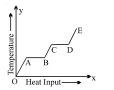
A solid material is supplied with heat at a constant rate. The temperature of material is changing with heat input as shown in the figure. What does slope $DE$ represent.