Question
The angle between an incident ray and the plane mirror is 30°. The total angle between the incident ray and reflected ray will be:
  1. 30°
  2. 60°
  3. 90°
  4. 120°

Answer

  1. 120°

Explanation:

Since, angle of incidence = 90° - angle between plane mirror and incident ray = 90° - 30° = 60° and according to first law of reflection, angle of incidence = angle of reflection = 60°

Total angle between incident ray and reflected ray = 60° + 60° = 120° 

Need a full question paper?

Generate a complete, print-ready paper with questions like this in minutes — across 16+ boards, with answer keys.

Start Generating Free

Similar questions

A real image of an object is to be obtained. The mirror required for this purpose is:
Which one of the following statements is not true?
  1. In a house circuit, lamps are used in parallel.
  2. Switches, fuses and circuit breakers should be placed in the neutral wire.
  3. An electric iron has its earth wire connected to the metal case to prevent the user receiving a shock.
  4. When connecting a three-core cable to a 13 three-pin plug, the red wire goes to the live pin.
Figure shows the magnetic field lines between the two faces A and B of two magnets.
Image
he insulator of electricity is:
Which of the following statements is correct regarding the propagation of light of different colours of white light in air?
  1. Red light moves fastest.
  2. Blue light moves faster than green light.
  3. All the colours of the white light move with the same speed.
  4. Yellow light moves with the mean speed as that of the red and the violet light.
If the image formed is always virtual, the mirror can be:
  1. Concave or convex.
  2. Concave or plane.
  3. Convex or plane.
  4. Only convex.
The stars appear higher in the sky than they actually are, due to:
A student is observing the diagram showing the path of a ray of light passing through a glass prism. He would find that for all angles of incidence the ray of light bends:
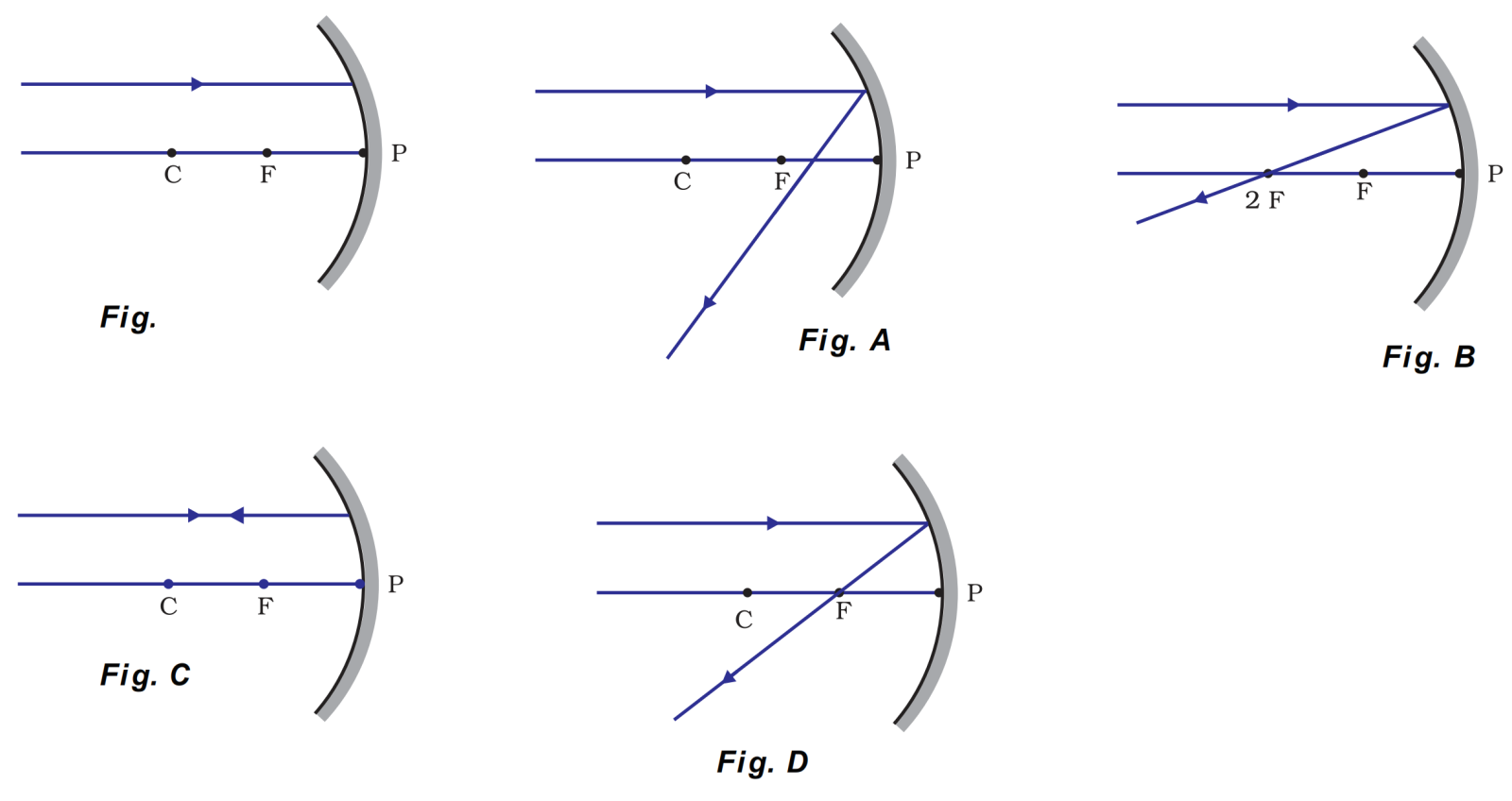
Which of the following ray diagrams is correct for the ray of light incident on a concave mirror as shown in Figure?
Under which of the following conditions a concave mirror can form an image larger than the actual object?