Question
The angle between the resultant contact force and the normal force exerted by a body on the other is called the angle of friction. Show that, if $\lambda$ be the angle of friction and la the coefficient of static friction, $\lambda\leq\tan^{-1}\mu.$
Answer


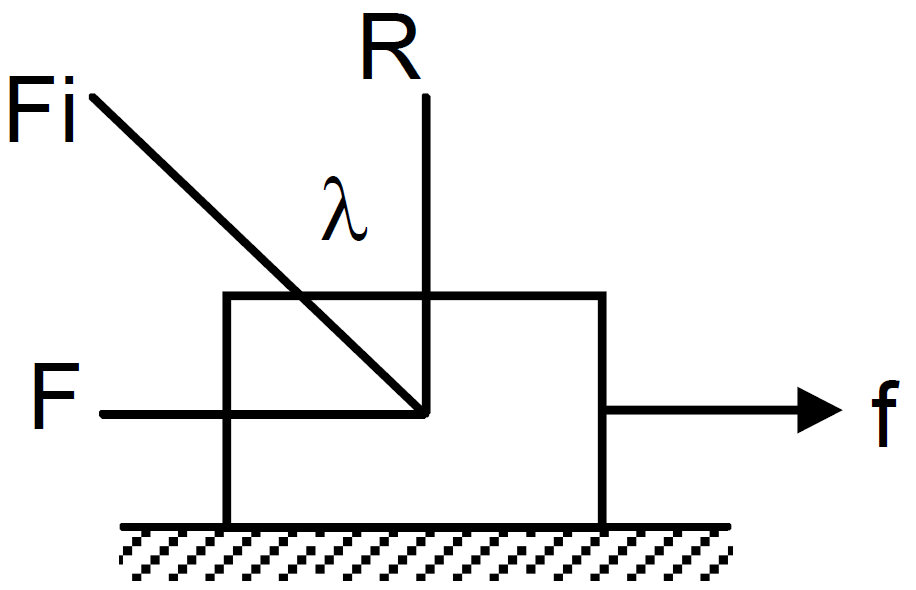
$f →$ applied force
$F_i →$ contact force
$F → $ frictional force
$R → $ normal reaction
$\mu=\tan\lambda=\frac{\text{F}}{\text{R}}$
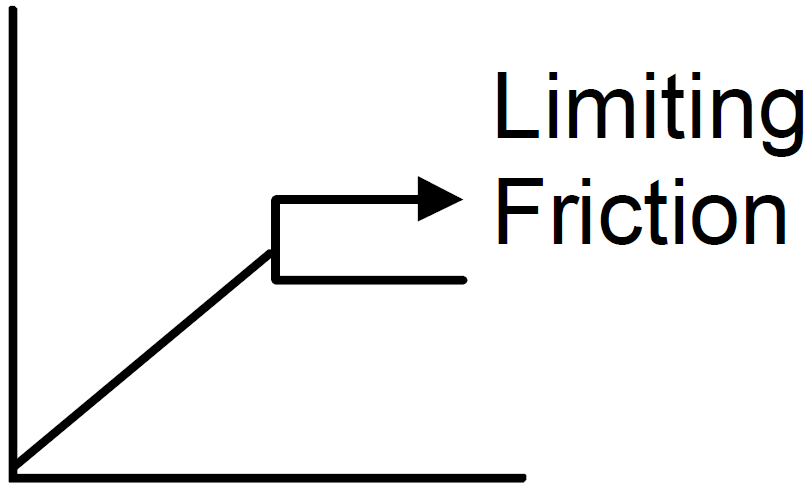
When $\text{F}=\mu\text{R, F}$ is the limiting friction (max friction). When applied force increase, force of friction increase upto limiting friction $(\mu\text{R})$
Before reaching limiting friction

$\text{F}<\mu\text{R}$
$\therefore\tan\lambda=\frac{\text{F}}{\text{R}}\leq\frac{\mu\text{R}}{\text{R}}\Rightarrow\tan\lambda\leq\mu\Rightarrow\lambda\leq\tan^{-1}\mu$

Need a full question paper?

Generate a complete, print-ready paper with questions like this in minutes — across 16+ boards, with answer keys.

Start Generating Free

Similar questions

Prove that the value of energy stored in a capacitor is $\frac{1 Q^2}{2 C}$ and the energy density of the electric field is $u=\frac{1}{2} \epsilon_0 E ^2$.
What is a transformer? It is of how many types? Explain the principle, construction and working of any transformer.
  1. Draw the circuit diagram of a fullwave rectifier using p-n junction diode. Explain its working and show the output, input waveforms.
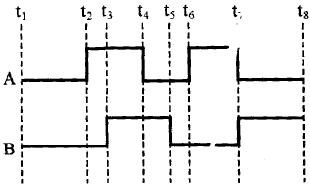
  2. Show the output waveforms (Y) for the following inputs A and B of
    1. OR gate.
    2. NAND gate.
The work function of a photoelectric material is 4.0eV.
  1. What is the threshold wavelength?
  2. Find the wavelength of light for which the stopping potential is 2.5V.
A compound microscope consists of an objective lens of focal length 2.0 cm and an eyepiece of focal length 6.25 cm separated by a distance of 15 cm. How far from the objective should an object be placed in order to obtain the final image at (a) the least distance of distinct vision (25 cm), and (b) at infinity? What is the magnifying power of the microscope in each case?
Consider an excited hydrogen atom in state n moving with a velocity u(ν << c). It emits a photon in the direction of its motion and changes its state to a lower state m. Apply momentum and energy conservation principles to calculate the frequency ν of the emitted radiation. Compare this with the frequency $ν_0$ emitted if the atom were at rest.
Two convex lenses, each of focal length 10cm, are placed at a separation of 15cm with their principal axes coinciding,
  1. Show that a light beam coming parallel to the principal axis diverges as it comes out of the lens system.
  2. Find the location of the virtual image formed by the lens system of an object placed far away.
  3. Find the focal length of the equivalent lens.
(Note that the sign of the focal length is positive although the lens system actually diverges a parallel beam incident on it).
A 4µF capacitor is charged by a 200V supply. It is then disconnected from the supply, and is connected to another uncharged 2µF capacitor. How much electrostatic energy of the first capacitor is lost in the form of heat and electromagnetic radiation?
A paperweight in the form of a hemisphere of radius 3.0cm is used to hold down a printed page. An observer looks at the page vertically through the paperweight. At what height above the page will the printed letters near the centre appear to the observer?
Explain ac voltage applied on a series LCR circuit and give its analytical solution.