MCQ
The angular velocity of a particle rotating in a circular orbit $100$ times per minute is
  • A
    $1.66\, rad/s$
  • $10.47\, rad/s$
  • C
    $10.47 \,deg/s$
  • D
    $60 \,deg/s$

Answer

Correct option: B.
$10.47\, rad/s$
b
(b)$\omega = 2\pi n = \frac{{2\pi \times 100}}{{60}} = 10.47\,rad/s$

Need a full question paper?

Generate a complete, print-ready paper with questions like this in minutes — across 16+ boards, with answer keys.
Start Generating Free

Similar questions

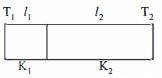
One end of a thermally insulated rod is kept at a temperature $T_1$ and the other at $T_2$ . The rod is composed of two sections of length $l_1$ and $l_2$ and thermal conductivities $K_1$ and $K_2$ respectively. The temperature at the interface of the two section is
Consider a binary star system of star $A$ and star $B$ with masses $m_{A}$ and $m_{B}$ revolving in a circular orbit of radii $r_{A}$ and $r_{B}$, respectively. If $T_{A}$ and $T_{B}$ are the time period of star $A$ and star $B$, respectively, then -
First law of thermodynamics:
Energy possessed by a body by virtue of its motion is:
From the equation $\tan \theta = \frac{{rg}}{{{v^2}}}$, one can obtain the angle of banking $\theta $ for a cyclist taking a curve (the symbols have their usual meanings). Then say, it is
A wave is given by $y = 3\sin 2\pi \left( {\frac{t}{{0.04}} - \frac{x}{{0.01}}} \right)$, where $y$ is in $cm$. Frequency of wave and maximum acceleration of particle will be
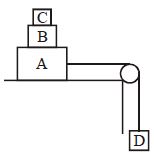
Three blocks $A$, $B$ and $C$ of equal mass $m$ are placed on a smooth surface as shown. Coefficient of friction between any block $A, B$ and $C$ is $μ$. The maximum value of mass $D$ so the block $A, B$ & $C$ move without slipping over each other is
Two circular discs $\sqrt {2gh} $ and $B$ are of equal masses and thickness but made of metals with densities ${d_A}$ and ${d_B}$ $({d_A} > {d_B})$. If their moments of inertia about an axis passing through centres and normal to the circular faces be ${I_A}$ and ${I_B}$, then 
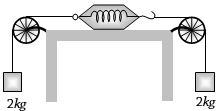
As shown in the figure, two equal masses each of $2\, kg$ are suspended from a spring balance. The reading of the spring balance will be ......... $kg$
In a system of particles, internal forces can change (for the system)