MCQ
The animals called predators have:
  • A
    Both the eyes on the sides.
  • B
    One eye on the side and one at the front.
  • C
    One eye on the front and one at the back.
  • D
    Both the eyes at the front.

Answer

  1. Both the eyes at the front.

Explanation:

Predators have both the eyes at the front of their heads so that they can judge the distance of their prey accurately.

Need a full question paper?

Generate a complete, print-ready paper with questions like this in minutes — across 16+ boards, with answer keys.

Start Generating Free

Similar questions

f the amount of electric charge passing through a conductor in 10 minutes is 300C, the current flowing is:
The strength of the magnetic field between the poles of an electromagnet would be unchanged if:
The splitting up of white light into seven colours on passing through a glass prism is called:
  1. Refraction.
  2. Deflection.
  3. Dispersion.
  4. Scattering.
The refractive indexes of four substances P, Q, R and S are 1.77, 1.50, 2.42 and 1.31 respectively. When light travelling in air is incident on these substances at equal angles, the angle of refraction will be the maximum in:
  1. Substance P.
  2. Substance Q.
  3. Substance R.
  4. Substance S.
After tracing the path of a ray of light passing through a rectangular glass slab for four different values of the angle of incidence, a student reported his observations in tabular form as given below:
S. No.$\angle\text{ i}$$\angle\text{ r}$$\angle\text{ e}$
I$30^{0}$$19^{0}$$29^{0}$
II$40^{0}$$28^{0}$$40^{0}$
III$50^{0}$$36^{0}$$50^{0}$
IV$60^{0}$$40^{0}$$59^{0}$
The best observation is:
In order to obtain a magnification of −2 (minus 2) with a concave mirror, the object should be placed:
The splitting of white light into its constituent colours by a triangular prism is called ________?
Which of the following phenomena of light are involved in the formation of a rainbow?
  1. Reflection, refraction and dispersion.
  2. Refraction, dispersion and total internal reflection.
  3. Refraction, dispersion and internal reflection.
  4. Dispersion, scattering and total internal reflection.
Which of the following is not a fossil fuel?
  1. Coal.
  2. Petroleum gas.
  3. Biogas.
  4. Natural gas.
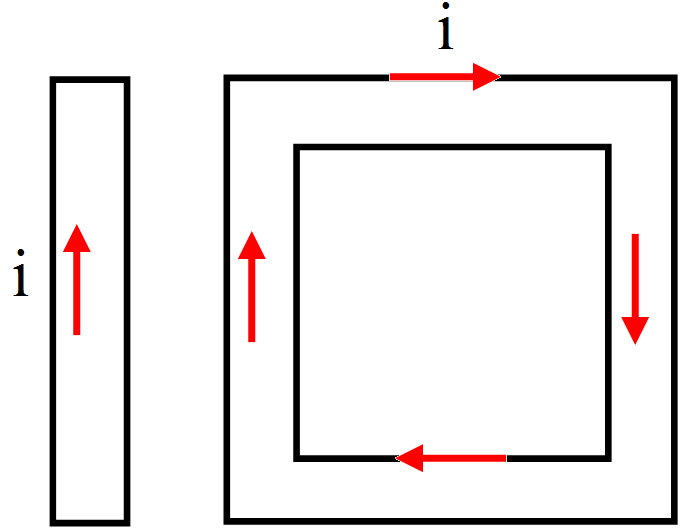
A rectangular loop carrying a current is situated near a long straight wire such that the wire is parallel to one of the sides of the loop and is in the plane of the loop. If a steady current its created in wire as shown in figure below, then the loop will